

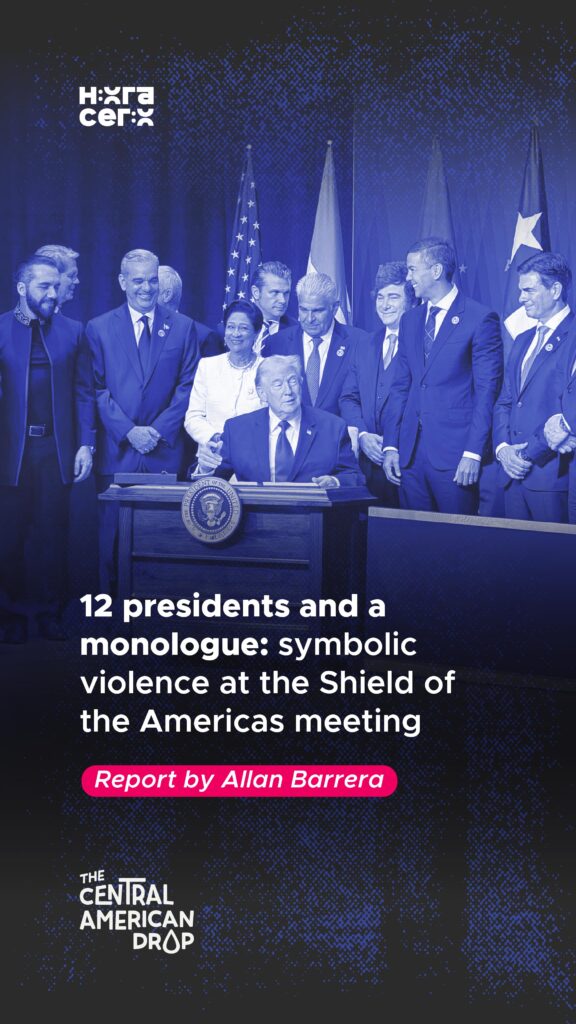
On March 7, 2026, Donald Trump brought together 12 Latin American right-wing presidents in what was called the Shield of the Americas. The summit was held in Miami at the president’s private golf course. Its purpose was to announce a military coalition to «combat drug cartels in the region.» Among the Central American guests were Nayib Bukele of El Salvador, Nasry Asfura of Honduras, José Raúl Mulino of Panama, and Rodrigo Cháves and Laura Fernández of Costa Rica. The latter two represent a country that doesn’t even have armed forces. Mexico and Colombia, which are strategic countries in the fight against drug trafficking, were not invited. Nor was Brazil the largest economy in Latin America. These absences are significant given the regional strategy.
Although Trump spoke of combating drug trafficking in his speech, the implicit objective of the summit was different: to force the presidents to accept subordination and US interference disguised as military aid. If Trump were interested in fighting drug trafficking, they wouldn’t have released a Juan Orlando Hernández, the former president of Honduras, who was convicted of drug trafficking in New York in 2024. If he were truly interested, he would stop the illegal flow of weapons from the United States to Mexico, as President Claudia Sheinbaum stated, and would guide appropriate actions to eradicate the main epicenter of drug consumption: the United States.
The times the United States has raised the banner of drug trafficking in the region have had counterproductive results. During the 1980s, within the context of the Cold War, drug trafficking played a significant role as a source of covert and parallel funding for the Contras in Nicaragua, facilitated by the CIA and tolerated by the Reagan administration. The United States also provided millions in aid to the Mexican government of Felipe Calderón (2006-2012) in its “war on drugs,” which ultimately benefited the Sinaloa Cartel. As researcher Hilary Goodfriend aptly stated in a recent article, “just like the Cold War and the ‘war on terror,’ the ‘war on drugs’ provides a framework for the subordinate integration of the region into the economic and security regimes of the United States.”
Symbolically, Trump’s statement to the twelve presidents present, from the comfort of his private golf course, «I’m not going to learn your damn language. I don’t have time. I have no problem with languages, but I’m not going to spend that much time learning yours,» speaks volumes about the subordinate relationship he will maintain with them: they are pawns, not allies, nor friends. The summit was rife with symbolic violence. At the end of his speech, the twelve presidents applauded Trump while he signed a document. The president gave them black pens as souvenirs, which President Rodrigo Chávez of Costa Rica distributed. None of the guests spoke. There was no dialogue, only monologues from Trump, Pete Hegseth, Marco Rubio, and Kristi Noem.
The model the Trump administration seeks to replicate is Daniel Noboa’s Ecuador. The Ecuadorian president has not only severed relations with Cuba as a gesture of loyalty to the United States, but has also placed his country’s territory and sovereignty at the disposal of the U.S. military. Under the pretext of combating drug trafficking, Noboa authorizes overflights and operations by Department of Defense personnel on Ecuadorian soil, thus defying the popular will expressed at the polls on November 16, 2015, when citizens voted against foreign military bases. The danger of aligning with this military coalition, as journalist Marco Terugi has pointed out, is that the United States dictates what the threats to Latin America are, turns them into internal enemies, and then proposes that the answer is militarization with the weapons, troops, and generals of the Southern Command.
This summit comes at a time when the American empire has shed its liberal trappings we were used to. These used to invoke democratic principles or human rights to justify intervening in the internal affairs of each country. Now, with its true colors revealed, the empire has no qualms about expressing its “Donroe Doctrine” in the face of China’s rise as a superpower. The Donroe Doctrine includes the subordination, territorial control, and resource control of Latin America, which they consider their sphere of influence. The kidnapping of Nicolás Maduro and his wife, the current economic siege of Cuba through the oil blockade, the transformation of El Salvador into a Guantanamo-style prison to receive deportees from the United States, the intention to seize the Panama Canal and Greenland, as well as the effort to rename the Gulf of Mexico, are all part of their expansionist and interventionist foreign policy. This also occurs within a Latin American context where the left is severely weakened; neither Mexico, nor Colombia, nor Brazil has managed to establish a regional counter-narrative, and is unified with Trump’s interventionist and violent rhetoric.
In Central America, the situation is unfavorable. The United States, as an imperial power, has always imposed its geopolitical interests on the peripheral and dependent Central American economies. These interests have sometimes been met grudgingly, and at other times with shameful servility. Nayib Bukele in El Salvador, Nasry Asfura in Honduras, Laura Fernández in Costa Rica, and José Raúl Mulino in Panama seem willing to bow down to Trump, favoring foreign interests at the expense of their own countries’ sovereignty or economies. Although they may see it as a kind of badge of honor, that summit was humiliating. Unfortunately, due to their internalized colonialism, they will not be able to see it that way.
In El Salvador, a similar level of compliance hasn’t been seen since the presidency of Francisco Flores (1999-2004), who, during George W. Bush’s administration, sent Salvadoran army troops to support the invasion of Iraq. If the current war between the United States and Iran continues, all indications are that Bukele would repeat the same action. Kneeling before Trump and signing an agreement to allow the militarization of our countries with U.S. troops will bring few benefits to the working-class sectors governed by these servile presidents, humiliated by Trump.
| Cookie | Duración | Descripción |
|---|---|---|
| cookielawinfo-checkbox-analytics | 11 months | This cookie is set by GDPR Cookie Consent plugin. The cookie is used to store the user consent for the cookies in the category "Analytics". |
| cookielawinfo-checkbox-functional | 11 months | The cookie is set by GDPR cookie consent to record the user consent for the cookies in the category "Functional". |
| cookielawinfo-checkbox-necessary | 11 months | This cookie is set by GDPR Cookie Consent plugin. The cookies is used to store the user consent for the cookies in the category "Necessary". |
| cookielawinfo-checkbox-others | 11 months | This cookie is set by GDPR Cookie Consent plugin. The cookie is used to store the user consent for the cookies in the category "Other. |
| cookielawinfo-checkbox-performance | 11 months | This cookie is set by GDPR Cookie Consent plugin. The cookie is used to store the user consent for the cookies in the category "Performance". |
| viewed_cookie_policy | 11 months | The cookie is set by the GDPR Cookie Consent plugin and is used to store whether or not user has consented to the use of cookies. It does not store any personal data. |