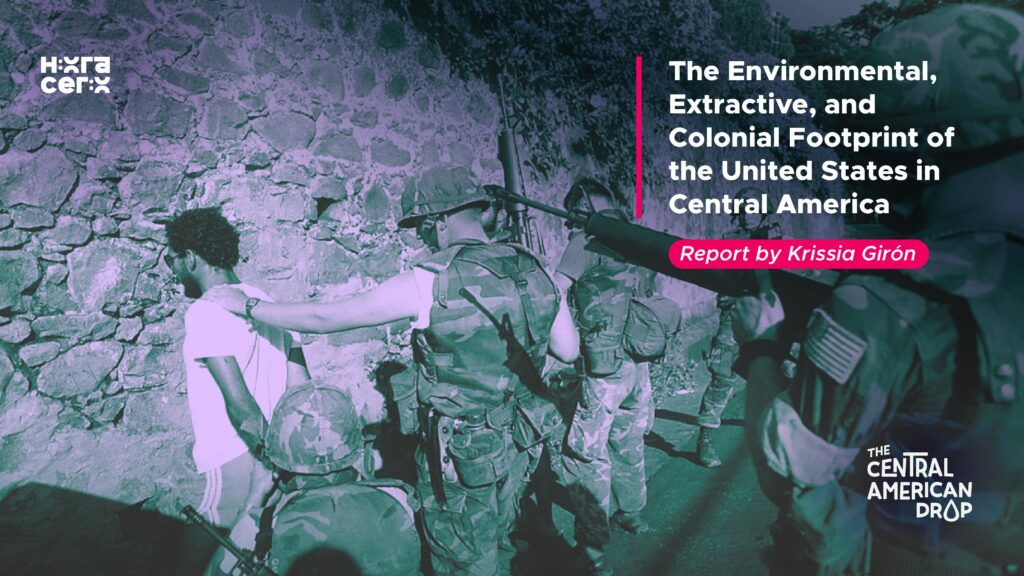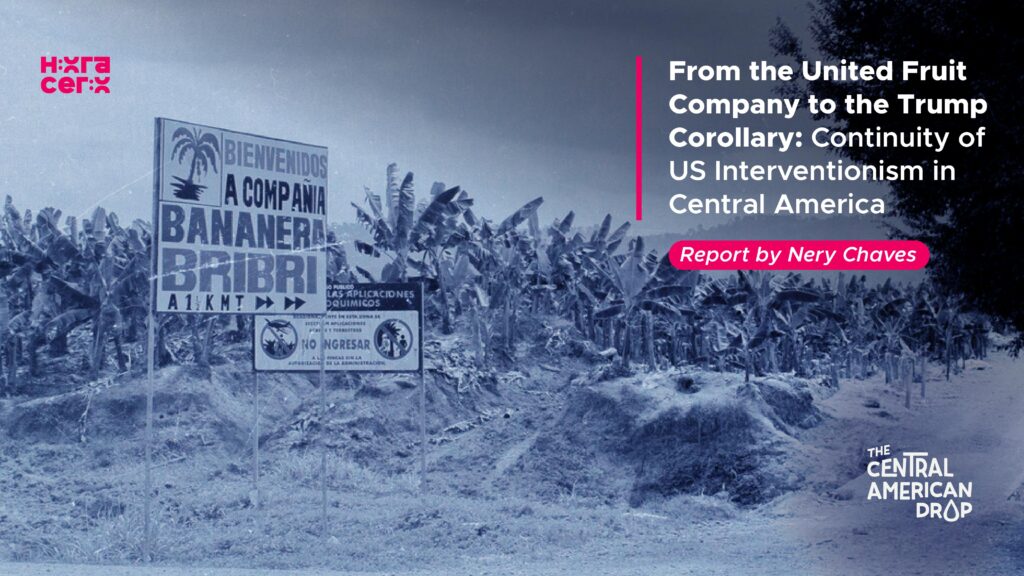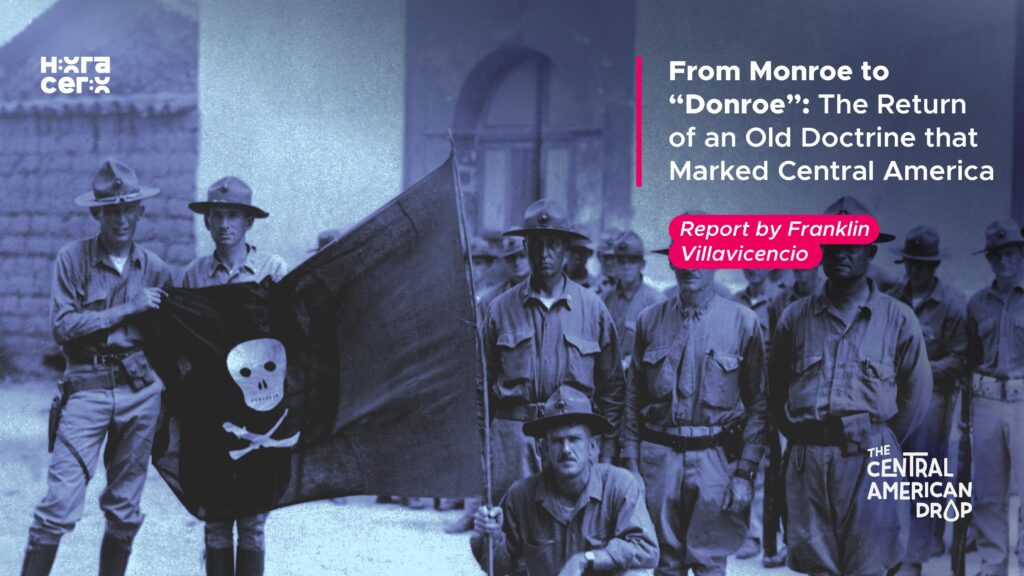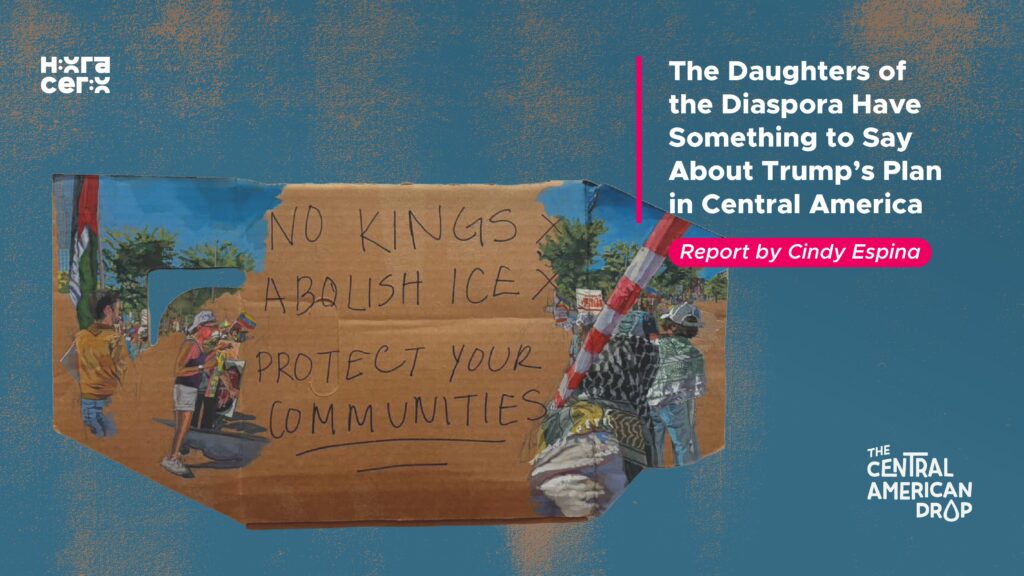

This week’s Central American Drop examines the long arc of external power that has shaped the region’s political, economic, and social landscapes. Rather than treating intervention as an exception or a relic of the Cold War, this package traces its continuities—from plantation economies and military doctrine to contemporary security policies and diasporic resistance—revealing how Central America remains entangled in imperial projects that refuse to disappear.
We begin by mapping the environmental, extractive, and colonial footprint of the United States, situating today’s ecological crises within a history of resource extraction and territorial control. From there, we follow the thread of interventionism from the United Fruit Company to what some have called the “Trump Corollary,” showing how economic coercion, militarization, and political pressure have been repackaged rather than abandoned. This logic is further historicized through an examination of the Monroe Doctrine’s revival—rebranded as “Donroe”—and its enduring role in legitimizing U.S. dominance over the region.

The package also foregrounds voices that are often sidelined in geopolitical analysis. Daughters of the Central American diaspora confront Trump’s plans for the region, articulating forms of political critique and memory shaped by displacement, inheritance, and transnational struggle. Finally, we widen the lens beyond Washington to examine Israel’s role in Central America during the Cold War, tracing how arms sales, military training, and counterinsurgency alliances embedded the region within a global network of repression.
Together, these pieces argue that Central America’s present cannot be understood without reckoning with the external forces that have repeatedly intervened in its futures—and the voices now insisting on naming, resisting, and reimagining those histories.
| Cookie | Duración | Descripción |
|---|---|---|
| cookielawinfo-checkbox-analytics | 11 months | This cookie is set by GDPR Cookie Consent plugin. The cookie is used to store the user consent for the cookies in the category "Analytics". |
| cookielawinfo-checkbox-functional | 11 months | The cookie is set by GDPR cookie consent to record the user consent for the cookies in the category "Functional". |
| cookielawinfo-checkbox-necessary | 11 months | This cookie is set by GDPR Cookie Consent plugin. The cookies is used to store the user consent for the cookies in the category "Necessary". |
| cookielawinfo-checkbox-others | 11 months | This cookie is set by GDPR Cookie Consent plugin. The cookie is used to store the user consent for the cookies in the category "Other. |
| cookielawinfo-checkbox-performance | 11 months | This cookie is set by GDPR Cookie Consent plugin. The cookie is used to store the user consent for the cookies in the category "Performance". |
| viewed_cookie_policy | 11 months | The cookie is set by the GDPR Cookie Consent plugin and is used to store whether or not user has consented to the use of cookies. It does not store any personal data. |