

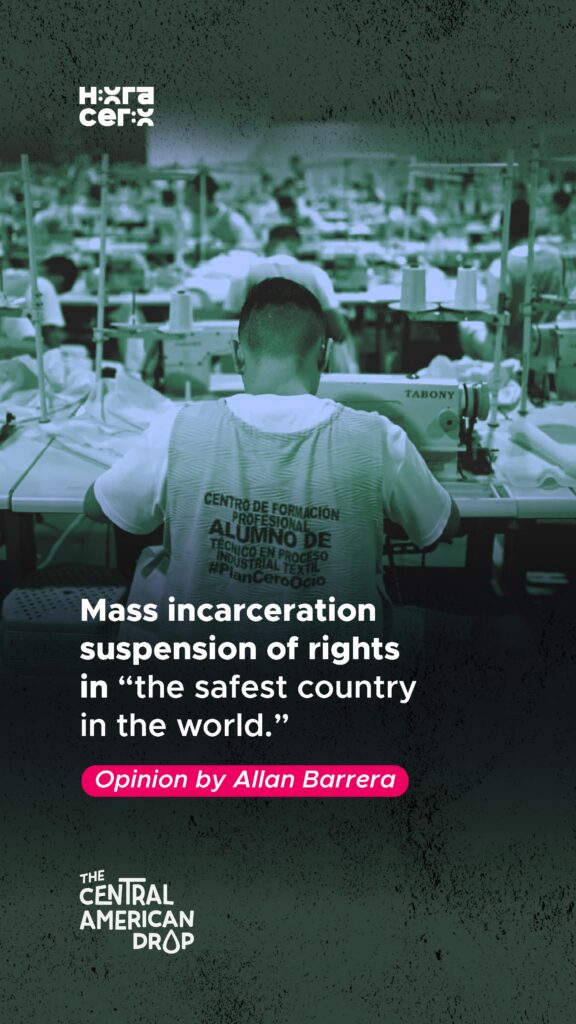
Four years have passed since the implementation of the state of emergency in El Salvador in March 2022. Many are asking: if the gangs have been eliminated and the country has become “one of the safest in the world,” why are constitutional guarantees still suspended? One answer is obvious: because this mechanism not only serves to imprison gang members. It also serves to imprison political opponents, sow terror among the population, and, as seen with the “Zero Idleness Plan”, it provides a favorable environment for accessing a significant source of forced labor. This last point is rarely discussed.
According to propaganda from the presidential palace, the Zero Leisure Plan «seeks to promote work discipline among the prison population and contribute to different communities through their work, as a way of making amends for the damage caused to society.» However, journalistic investigations have documented that prisoners have also been used for private work: a friend of the mother of the Director of Prisons, Osiris Luna —accused of systematic human rights violations, family corruption, and links to criminal structures—, built her ranch on the beach with that labor, and there are likely other cases that have not come to light.
Under the promise of reduced sentences, prisoners work on the construction of hospitals, schools, and roads. Some have died while working, as seen in the construction of the new Rosales Hospital and on the viaduct of the Los Chorros highway. Unfortunately, due to a lack of transparency and the withholding of public information, there is no way to verify whether the government has compensated their families, nor to confirm whether the sentences of the others have been reduced.
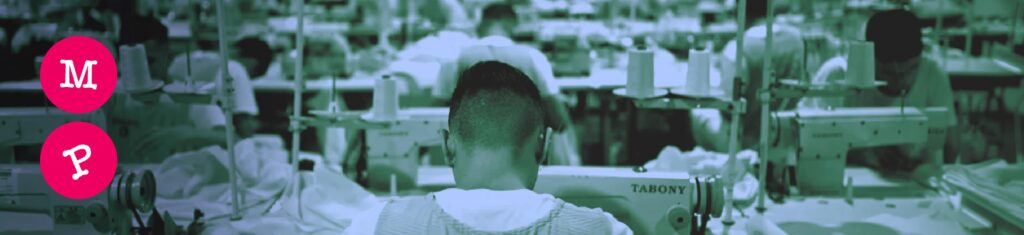
An unknown percentage of the 100,000 people imprisoned under the state of emergency are now working without pay or rights in the ongoing «revitalization» of San Salvador’s historic center. This is a lucrative business, because the state of emergency is financed with public funds. This facilitates the criminalization and effective expulsion of people living in poverty and informal employment from the areas where Bukele, his family, and their business associates want to invest. The state of emergency also operates as a tool for capital accumulation. Based on dispossession, they establish new businesses, buy properties, or increase the value of those they already own. And they top it all off with the slave labor that repairs the streets and other works that increase the value of their assets. Those who refuse to be displaced are offered the state of emergency: prison. These same displaced people may then end up working on those same projects.
According to criminal lawyers, the work of prisoners violates Articles 9 and 27 of El Salvador’s Constitution and could constitute forced labor. But the Bukele government and its subservient legislative assembly modified the Constitution at will. Examples of this are the reelection that made him a de facto president and the recent approval of life imprisonment for murderers, rapists, and terrorists, which was passed without any debate. The work of prisoners has also raised other alarms. Recently, the Office of the United States Trade Representative launched an investigation into 60 of its trading partners, including El Salvador, to determine if those countries use forced labor.
Certainly, incarcerated individuals are restricted from certain fundamental rights, such as freedom of movement. However, they retain all other rights, including the right to decent work. The prisoners whom the government exploits without pay have families, children, spouses, mothers, fathers, and grandparents who need to eat and earn money for their families’ monthly food baskets. A head of household imprisoned under this state of emergency is unable to provide for themselves. It would be fair for the government to compensate them, even minimally, for the work they perform. They are not beasts of burden; they are human beings. Many are victims of arbitrary detention, without access to legal representation, the right to the presumption of innocence, or due process.
According to the General Directorate of Prisons—headed by Osiris Luna, who has also been accused of illegally using inmate labor—the profits generated by products made by prisoners in jail are intended to ensure the prisons’ self-sustainability. But aside from CECOT, which serves as a propaganda tool for the prison system abroad, the Salvadoran prison system remains in inhumane conditions: overcrowding, unsanitary conditions, people dying from curable diseases, missing prisoners, some who haven’t seen their families in years while awaiting sentencing, and a growing number of political prisoners.
Added to this are the in-kind bribes to the relatives of detainees in exchange for information or visits carried out by the Directorate of Penitentiary Centers, or the charging for visits not regulated in the Penitentiary Law, documentedby organizations like CristosalIn addition to the corrupt network between lawyers and prison authorities that facilitates the movement of illicit resources from the families of detainees (extortion), in exchange for access to information or visits, also documented by El Faro.
The value generated by the exploitation of this labor force is not perceived by the prisoners themselves, but by others who, entrenched in the privileged positions of the repressive apparatus of cruelty and mass incarceration created by Bukele, have found business opportunities. This comes at a time when the economic miracle promised for a second unconstitutional term is nowhere to be seen in the authoritarian policies of the Bukele regime. The supposed progress and the image of the “safest country in the world” rest on mass incarceration and the suspension of basic rights. And also on the revitalization of the institution of slavery.
| Cookie | Duración | Descripción |
|---|---|---|
| cookielawinfo-checkbox-analytics | 11 months | This cookie is set by GDPR Cookie Consent plugin. The cookie is used to store the user consent for the cookies in the category "Analytics". |
| cookielawinfo-checkbox-functional | 11 months | The cookie is set by GDPR cookie consent to record the user consent for the cookies in the category "Functional". |
| cookielawinfo-checkbox-necessary | 11 months | This cookie is set by GDPR Cookie Consent plugin. The cookies is used to store the user consent for the cookies in the category "Necessary". |
| cookielawinfo-checkbox-others | 11 months | This cookie is set by GDPR Cookie Consent plugin. The cookie is used to store the user consent for the cookies in the category "Other. |
| cookielawinfo-checkbox-performance | 11 months | This cookie is set by GDPR Cookie Consent plugin. The cookie is used to store the user consent for the cookies in the category "Performance". |
| viewed_cookie_policy | 11 months | The cookie is set by the GDPR Cookie Consent plugin and is used to store whether or not user has consented to the use of cookies. It does not store any personal data. |