

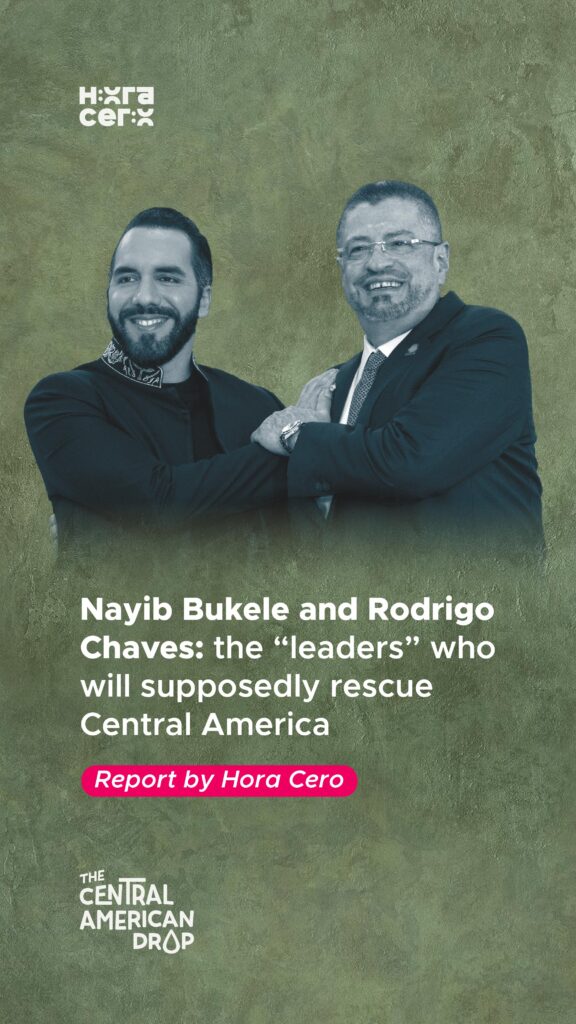
Rodrigo Chaves and Nayib Bukele met for the first time on June 1, 2024, when Bukele was sworn in for his second presidential term, after being re-elected unconstitutionally, violating more than seven articles of the Salvadoran Constitution. “I had never spoken with him before, but I was impressed,” Chaves said in an interview with Channel 36 of Costa Rica. The impression was such that, the second time, he awarded him a prize and offered a gala dinner in his honor; the third time, they spent hours talking about history. And fourth, the complicity was already so great that their mega-prison projects — and even their wardrobe— matched.

Costa Rica has faced a homicide crisis in recent years. In 2025 alone, 873 homicides were recorded, the third-highest figure in its history. According to Chaves, the solution is to apply the security policies that Bukele has implemented in El Salvador: a state of emergency that has been extended more than 46 times, the militarization of the security forces, and the construction of a mega-prison, among other measures.
However, the achievements of these policies are grounded on more than 3,000 reports of human rights violations and arbitrary detentions, in addition to approximately 466 deaths of people in state custody and hundreds of missing persons, according to national and international human rights organizations.
For his part, Bukele claims in most of his speeches that there are no longer any homicides in El Salvador. During his recent visit to Costa Rica, he said that “there is a minimal number of homicides, which are generally domestic.” Since 2022, El Salvador has excluded from its official records the deaths of alleged criminals in confrontations, skeletal remains found in clandestine graves, and the deaths of people deprived of their liberty. Furthermore, despite the existence of a law that recognizes femicide, official records no longer list them as such, which favors impunity in these cases.
From day one, the Costa Rican president has not hidden his fascination with the Terrorism Confinement Center (CECOT), the Salvadoran “peace,” and the way in which, in his words, Bukele “was democratically elected twice”. This ignores the fact that, to achieve this, he has co-opted the Legislative and Judicial branches (the former with a majority pro-government bloc and the latter through the illegal imposition of new magistrates). This allowed him to issue a series of rulings and reforms that endorsed his reelection, bypassing more than seven articles of the Constitution of the Republic that prohibit it.
But it was his security plans that led Chaves to award Bukele, on November 11, 2024, the Juan Mora Fernández National Order, in the grade of Grand Cross with Gold Plaque, a top distinction for foreigners. Amid gifts, toasts, and anecdotes regarding the large Bukele family and its branch in Costa Rica, both governments signed agreements in different areas such as culture, tourism, environment, and economy.
At this same event, they announced the creation of the “League of Nations” a proposal to unite small countries “that think like us” to attract investment and security, bypassing traditional regional organizations. “We want to formulate joint proposals to the rest of the world and the United States. We’re not going to be a very large club, precisely because we want to be a very distinguished one. Security and prosperity, obviously within the framework of democracy,” said Chaves. To date, it is unknown whether other countries have joined this league.
In his speech, Bukele asserted that “in a country, no one can be violent except the State, and only then to intervene and maintain peace.” “There wasn’t a single institution in El Salvador that disagreed with how we combated crime. There wasn’t a single official in a position of power who disagreed. If you’ll take my advice, everyone has to get behind the leader, otherwise it won’t work,” Bukele said, implying that the powers of the State and its institutions must be aligned with the one leading the strategies.
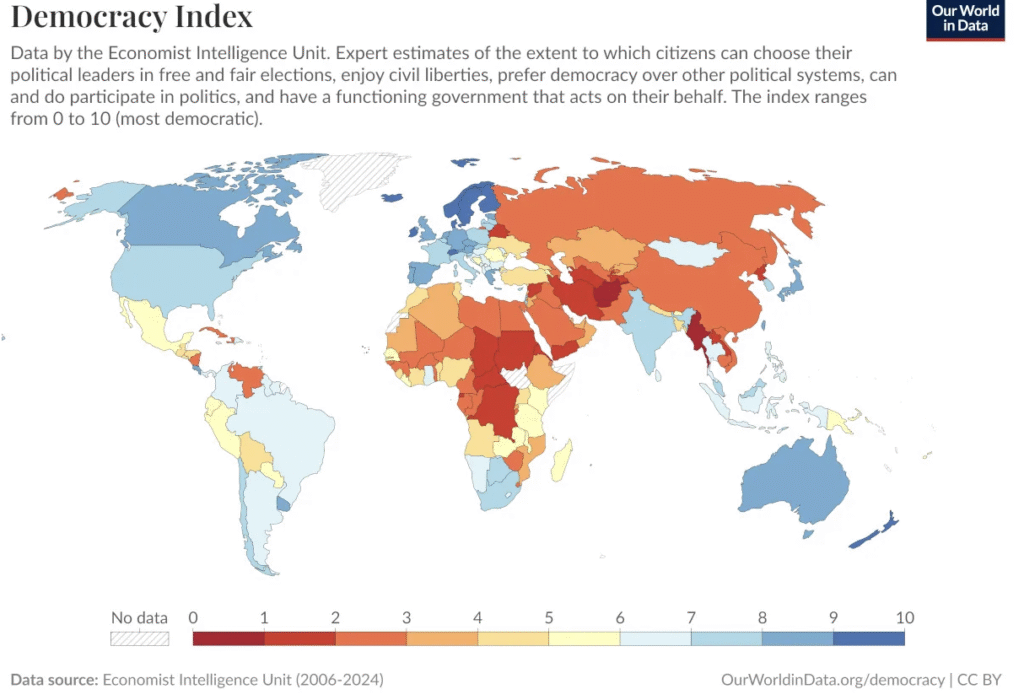
Chaves endorsed this ruling. “In a democracy, it is necessary to grant sufficient power to those who govern.” What the Costa Rican president omits is that since Bukele came to power in 2019, El Salvador has fallen 24 places in the democracy ranking. According to the report of the Economist Intelligence Unit (EIU), since 2020, El Salvador has been considered a “hybrid regime,” combining electoral democracy with authoritarian tendencies. Furthermore, the Global Initiative on the State of Democracy study places the country in a “low-ranking performance” category for Rights and the Rule of Law. “Over the past five years, it has declined in numerous areas, particularly in credible elections, effective parliament, access to justice, civil liberties, judicial independence, personal integrity and security, and predictable enforcement,” the study states.
The gala took place amidst a series of floods, landslides, and hundreds of people affected by Hurricane Rafael, which struck the Pacific coast. During the event, Chaves had to shift the focus away from President Bukele to «send a message of solidarity to the families affected by the rains.» He reported that more than 40 institutions were working amidst the crisis and that he had requested assistance from the United States to address the emergency. In response, Bukele offered a shipment of aid and hundreds of soldiers to carry out rescue operations. The cheers were immediate.
The plane carrying humanitarian aid arrived promptly and entered Costa Rica the following day: a support contingent accompanied by approximately 75 members of the Salvadoran Armed Forces. This situation sparked a debate in the Legislative Assembly, as this branch of government is responsible for authorizing the entry of military personnel into the country. Representatives from the Frente Amplio party questioned why Rodrigo Chaves failed to inform the legislature of this situation, violating Article 121 of the Constitution, which establishes the «power» to approve or deny the entry of foreign troops into Costa Rican territory or permits for the presence of military aircraft.
Following debate, Congress approved an exceptional permit for the continued presence of military personnel in a country where there is no army. However, they demanded a report from the Executive Branch detailing the number of Armed Forces personnel, their military ranks, and their length of stay in the country, and reiterated that the Legislative Branch has the “exclusive and sole” authority to authorize any permit for any military force to enter the country.
“Welcome to your second home,” Bukele told Chaves during their third meeting in El Salvador. There, they signed the Coatepeque Declaration, which seeks to foster the exchange of experiences between the two countries in various areas. They also launched the “Shield of the Americas,” an alliance between countries to combat crime, drug trafficking, and transnational criminal organizations. As with the League of Nations, they stated that “in time, we will invite other countries that share our vision.”
For Bukele, El Salvador is less developed than Costa Rica because, according to him, it experienced two wars: the civil war in the 1980s and the “gang war” or what he called the “gang dictatorship.” “Back then we lived under a dictatorship, not now that we live in total democracy,” he said.
The messages exchanged between the two presidents, in which Chaves praises Bukele’s policies and the latter advises continuing with the approach that has led to low crime rates by aligning all three branches of government, are a recurring theme during each visit. On this particular visit, Chaves stated that the Costa Rican opposition accused him of “being a would-be dictator, because what I want is to change the laws. What I really want is for my country to change the ‘harmful power’—excuse me, the Judiciary—so that citizens can leave their homes and criminals can stay in jail.»
Without questioning it, Chaves repeats Bukele’s data and narrative regarding security levels in El Salvador. For example, during his visit to CECOT, the Costa Rican president told Trivision that it was a “lie” that there were “innocent people” in Salvadoran prisons, since in that center there were “people who had killed more than 10 people”.
“That’s the biggest lie. Basically, what El Salvador did was say: this isn’t a matter of crime, it’s a matter of war,” the president said, ignoring the fact that organizations like the Movement of Victims of the State of Emergency (MOVIR) have documented more than 1,500 cases of families affected by arrests without evidence until August 2025, the month in which they requested the repeal of said measure. Chaves also deflects attention from the reports of Human Rights Watch, Amnesty International, the Inter-American Commission on Human Rights and the United Nations Working Group on Arbitrary Detention. Among other organizations, countries, and the international community have pointed out, since the implementation of the regime, the systematic violation of human rights and how these measures are impacting, above all, people in the poorest communities.
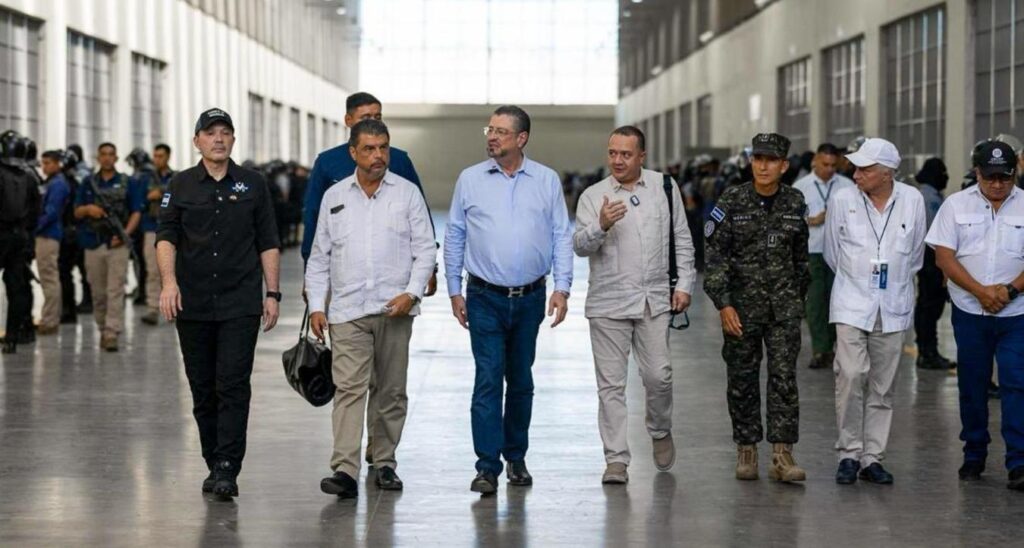
Two percent of El Salvador’s population is incarcerated in various prisons that are far removed from the reality of CECOT. Reports of torture, overcrowding, untreated illnesses, and unjustified deaths form the bulk of these reports. Furthermore, the victims are not only the detainees themselves, but also their families, mostly women, who bear the burden of caring for children without their fathers and sending food packages and money to their imprisoned relatives. All of this is without even considering other situations, such as the exile of more than 40 journalists and a number of other human rights defenders due to persecution, harassment by police authorities, and the possibility of arrests without evidence
In Costa Rica, the close relationship with Bukele quickly raised suspicions. Where does cooperation end and influence begin? This is the question being asked by members of Congress and judges in that country. The fourth meeting between these friends took place on January 14, at a delicate moment in the Costa Rican political calendar: the final stretch of the presidential elections.
The Salvadoran president visited Alajuela, where a mega-prison called the High-Containment Center for Organized Crime (CACCO), modeled after the CECOT prison, is under construction. His speeches during this visit again focused on the need for swift action against crime. This is the first visit under the «Shield of the Americas» Alliance, signed in Coatepeque in 2025.
Before his arrival, the Supreme Electoral Tribunal had to reiterate the obvious: no foreign head of state can interfere in the internal politics of another country. The close relationship that Cheves has with the Salvadoran president has been leveraged by the ruling party’s candidate, Laura Fernández. For example, during the announcement of scanners in the towns of Puntarenas and Limón, President Bukele sent a greeting that was played during press conference that Chaves gave. Hours later, Laura Fernández issued a statement thanking Bukele for «his words and good wishes.»
“You can be sure that in the continuity government that, with the support of the majority of Costa Ricans, I will lead, starting in May 2026, security will continue to be one of the highest priorities,” Fernández said in the video, which can be found on various social media platforms.
Article 19 of the Constitution of Costa Rica states that foreigners cannot interfere in the political affairs of the country and are subject to the jurisdiction of the courts of justice and the authorities of the Republic.
Vigilante leagues, crime-fighting alliances, bilateral agreements, hugs, gala dinners, and plenty of backslapping. This has been the dynamic of the friendship between Rodrigo Chaves and Nayib Bukele, a relationship under the microscope of the media, Costa Rica’s Legislative and Judicial branches (which remain checks and balances), and the Costa Rican public, who, with the upcoming elections approaching, place their hopes in the so-called «Bukele model» of security. Meanwhile, opposition groups, human rights defenders, and the Salvadoran population itself remind them that the cost of this model has been quite high.
| Cookie | Duración | Descripción |
|---|---|---|
| cookielawinfo-checkbox-analytics | 11 months | This cookie is set by GDPR Cookie Consent plugin. The cookie is used to store the user consent for the cookies in the category "Analytics". |
| cookielawinfo-checkbox-functional | 11 months | The cookie is set by GDPR cookie consent to record the user consent for the cookies in the category "Functional". |
| cookielawinfo-checkbox-necessary | 11 months | This cookie is set by GDPR Cookie Consent plugin. The cookies is used to store the user consent for the cookies in the category "Necessary". |
| cookielawinfo-checkbox-others | 11 months | This cookie is set by GDPR Cookie Consent plugin. The cookie is used to store the user consent for the cookies in the category "Other. |
| cookielawinfo-checkbox-performance | 11 months | This cookie is set by GDPR Cookie Consent plugin. The cookie is used to store the user consent for the cookies in the category "Performance". |
| viewed_cookie_policy | 11 months | The cookie is set by the GDPR Cookie Consent plugin and is used to store whether or not user has consented to the use of cookies. It does not store any personal data. |