

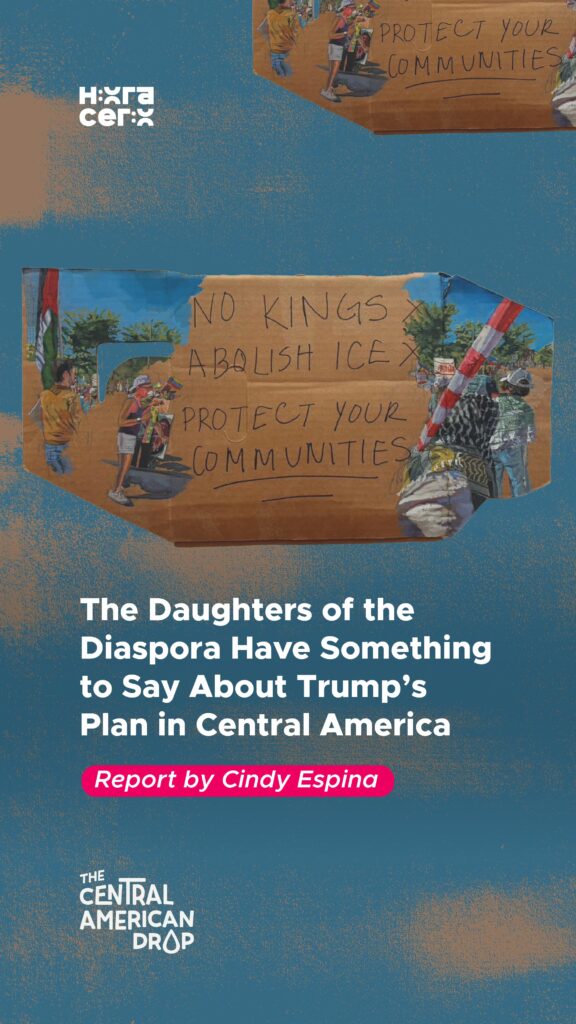
Kiara Machado and Brenda Hernández agree that in the current context of the United States, the most frequent advice they receive from their parents is to «be careful» when expressing themselves in public and when attending marches against the actions of President Donald Trump.
The two women, both born in California, say they understand the context of their parents’ words, as they both came from and lived in Central American countries during military dictatorships and managed to escape or resist forced recruitment when they were just children and teenagers. They understand their parents’ fear and say they are now experiencing it more acutely in their own country and community.
It is because of that past from which their parents escaped that both have much to say about Trump’s plan in Central America, which is part of his strategic plan for the Western Hemisphere, which the US president has called: The new Monroe Doctrine, which stems from a 1823 plan that President James Monroe sought to prevent European powers from interfering in the hemisphere; now that power is located in Asia and China.
This new doctrine began with the plan to occupy the Panama Canal and, most recently, with its public intervention before the elections in Honduras in favor of Nasry Asfuera, the elected president of that country, who belongs to the National Party (right-wing) and with the release of Juan Orlando Hernández, former president of Honduras convicted in the United States for drug trafficking.
The voice from a podcast
Brenda Hernández is the producer of the Central American Voices Podcast, a space that unites Central Americans in the United States and helps them reconnect with their roots. It’s a place where people of Central American origin discuss their initiatives and actions, because for her, that’s the way to elevate the representation of her community. From there, Brenda speaks about how this Doctrine recalls the cause of migration of the Honduran diaspora in the United States.
“The United States’ intervention in Central America during the 1980s forced my father to flee. He was forced into the army (while still a minor), and after he was discharged, they didn’t even have enough to eat, so he decided to move to the United States,” Brenda explains from her room via video call. While Honduras did not face an internal war similar to those in El Salvador, Guatemala, and Nicaragua, its geographical location led to extreme militarization by the United States within the context of the Cold War and violations of the human rights of the civilian population.
That’s why the actions of the United States in Latin America evoke complicated emotions in her. “The Trump administration supported the dictatorship of Juan Orlando Hernández, and now they’re letting him go free… the fight they’re waging in Venezuela, they’re not waging in Honduras… all those plans have always affected us, but they’re always blaming us for seeking a better life.”
Art that represents a diaspora
Kiara Machado, 32, is an artist of Salvadoran and Guatemalan descent. Her paintings depict the struggle of a community against ICE and Trump’s regime of deportation, persecution, criminalization, and imprisonment of immigrants in the United States.
“Migration is natural, forced migration is not, and my father was forced to migrate to the United States when he was 12; he turned 13 during his journey,” Kiara explains via video call from her home in California. The artist continues, recounting that her father fled El Salvador during the internal armed conflict in the 1980s. He did so before turning 13 because otherwise he would have been drafted into the Salvadoran army.
The history and stories her father told her about that era guided her political awareness and are the reason she disapproves of any U.S. interference in Central America. “They (the United States) provided the weapons,” Kiara says, recalling that what her father faced also stemmed from a strategy based on the Monroe Doctrine.
Resistance to ICE
Both Kiara and Brenda believe that the United States is not a safe place for their parents, despite the fact that they are now U.S. citizens. “Being an American citizen doesn’t protect you anymore,” Brenda says fearfully, especially for her father.
“I remember that when I was little, my mom always told us that we should always carry our passports because of anti-immigration laws. But this time it’s completely different; they arrest you, imprison you, and deport you simply because of your skin color and physical features.”
The two women of Central American origin are active in protests against ICE and are proud that their parents sometimes accompany them. Brenda Hernández is clear about why she has to take to the streets to protest: “Those of us from this generation sometimes forget that if our parents hadn’t made the decision to migrate, we wouldn’t be in the same place with these privileges.”
| Cookie | Duración | Descripción |
|---|---|---|
| cookielawinfo-checkbox-analytics | 11 months | This cookie is set by GDPR Cookie Consent plugin. The cookie is used to store the user consent for the cookies in the category "Analytics". |
| cookielawinfo-checkbox-functional | 11 months | The cookie is set by GDPR cookie consent to record the user consent for the cookies in the category "Functional". |
| cookielawinfo-checkbox-necessary | 11 months | This cookie is set by GDPR Cookie Consent plugin. The cookies is used to store the user consent for the cookies in the category "Necessary". |
| cookielawinfo-checkbox-others | 11 months | This cookie is set by GDPR Cookie Consent plugin. The cookie is used to store the user consent for the cookies in the category "Other. |
| cookielawinfo-checkbox-performance | 11 months | This cookie is set by GDPR Cookie Consent plugin. The cookie is used to store the user consent for the cookies in the category "Performance". |
| viewed_cookie_policy | 11 months | The cookie is set by the GDPR Cookie Consent plugin and is used to store whether or not user has consented to the use of cookies. It does not store any personal data. |