

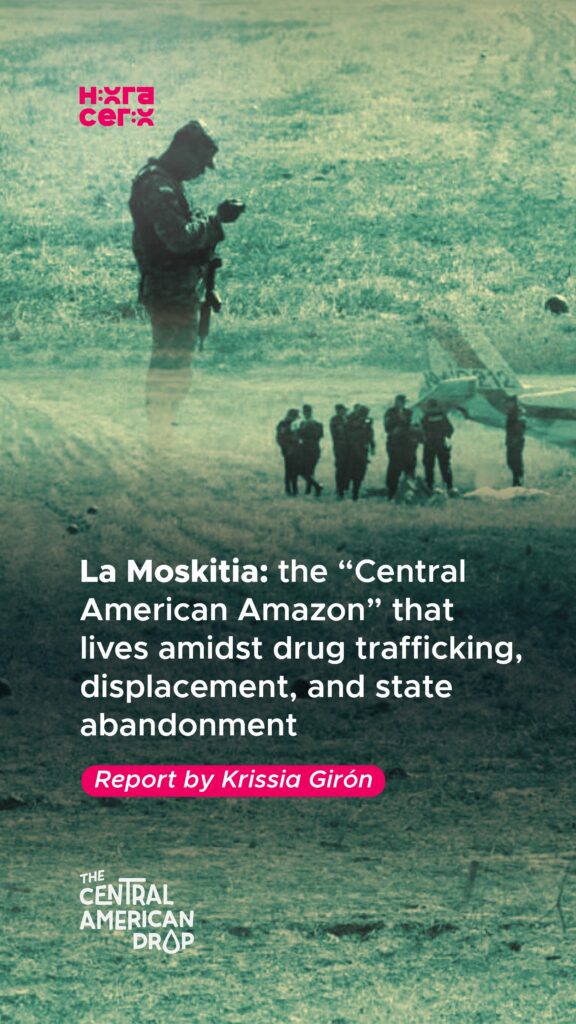
It’s 22,568 km² of jungle and history that covers a large part of the border between Honduras and Nicaragua. La Mosquitia—the second largest forest in CentralAmerica—is home to species such as jaguars, macaws, eagles and other migratory birds, and is a transboundary territory that in 2026 lives under siege from drug trafficking, private enterprise, settlers and the economic interests of the States of both countries, which has endangered the life, means of survival and culture of the Miskito, Garifuna, Pech, Tawahka, Nahua and Tolupan peoples.
“When you arrive, it seems like you’ve arrived in another country, where there is no government, no law, no presence of state institutions,” says Pedro Landa, an environmentalist and human rights defender from Honduras.
In Honduras, this forest encompasses the Río Plátano Biosphere Reserve, the largest and most important protected area in the country, and since 1981, declared a World Heritage Site by UNESCO. It also includes the Bioreserve of Tawahka Asangni and the Patuca National Park, and in Nicaragua, the Bosawás Natural Reserve.
One of the concerns, Landa says, is that it is «an area suitable for illegal trade,» where precious woods such as Honduran Mahogany, paleto, Caribbean pine and other species are trafficked from the mountains of the Olancho department and transported through the rivers that cover the Moskitia to the lagoon complex, where they are loaded onto ships waiting at sea and then turned into furniture that is sold in stores all over the world.
“There are high levels of mafia activity linked to the trafficking of precious woods in the Moskitia region.» The presence of the merchant marine and the National Police is minimal, so this happens right in front of everyone,» Landa says.
A report from the National Institute of Forest Conservation of Honduras, issued in 2024, indicated that, up to August of that year, they had seized more than 265,000,831 board feet of illegally logged timber, the equivalent of the transport capacity of 106 logging trucks. The seizures were made during patrols in protected areas such as the Río Plátano Biosphere Reserve, among others.
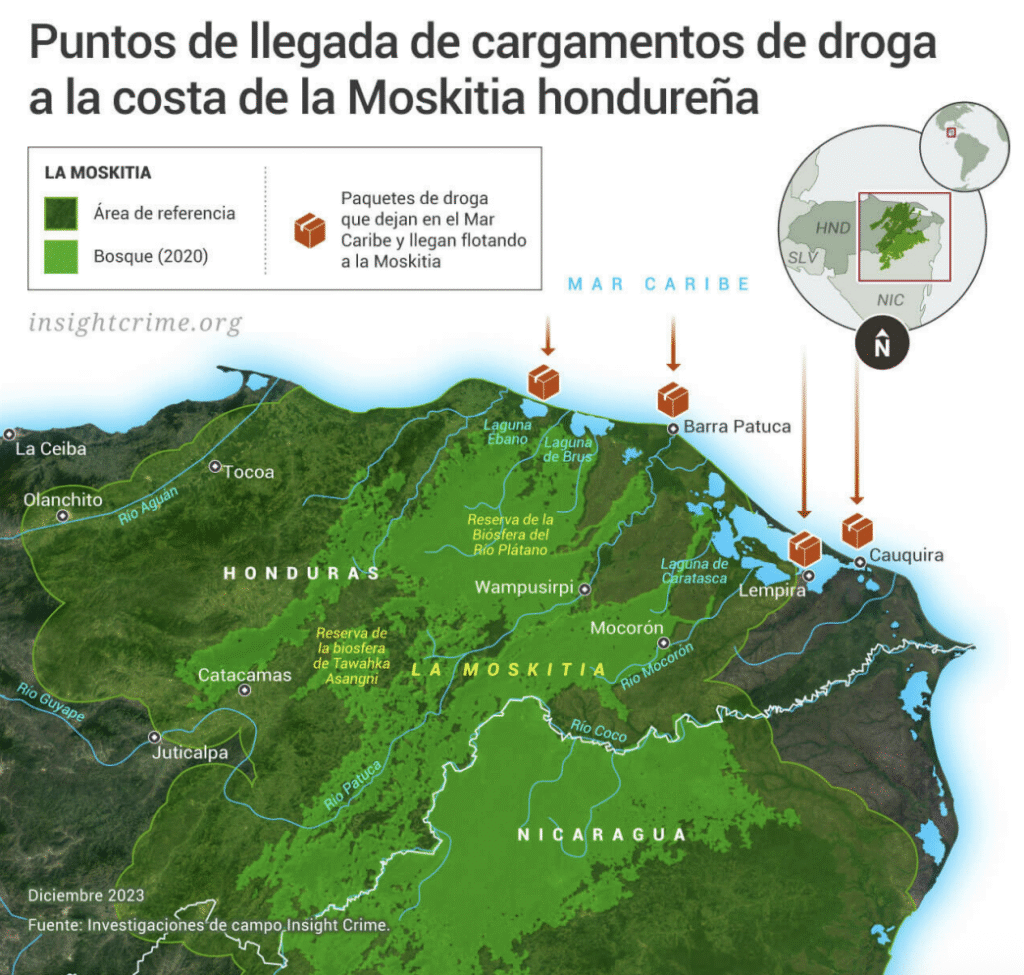
One of the mafias Landa mentions is drug trafficking, an illegal activity that has flooded La Mosquitia, and according to an Insight Crime investigation, drug traffickers forcibly enter the area to clear and fence off hectares of land. They have gone from having a discreet presence to controlling parts of the territory in the last 10 years, using clandestine airstrips, beaches, ports, and rivers to traffic cocaine to the United States.
The investigation reveals that cocaine has become a source of money for those who find it on the beaches or in Miskito territory. The packages that «appear floating» in the sea and reach the territory can have a price of up to $4,000 per kilo, although according to the testimonies present in the document, the drug traffickers have unified the price downwards to obtain more profits and pay less to the inhabitants.
Landa explains that the presence of drug trafficking dates back to the 1980s, because La Moskitia is a region of difficult access, which can only be reached by small plane or boat. «That makes it an area that drug traffickers saw as ideal for unloading drugs,» he said.
“They would usually drop [the packages] off at night via airplanes, and the communities would go to collect them. And then, the next day, people would arrive to request the shipments and pay them. In other words, they turned poverty into a necessity.”
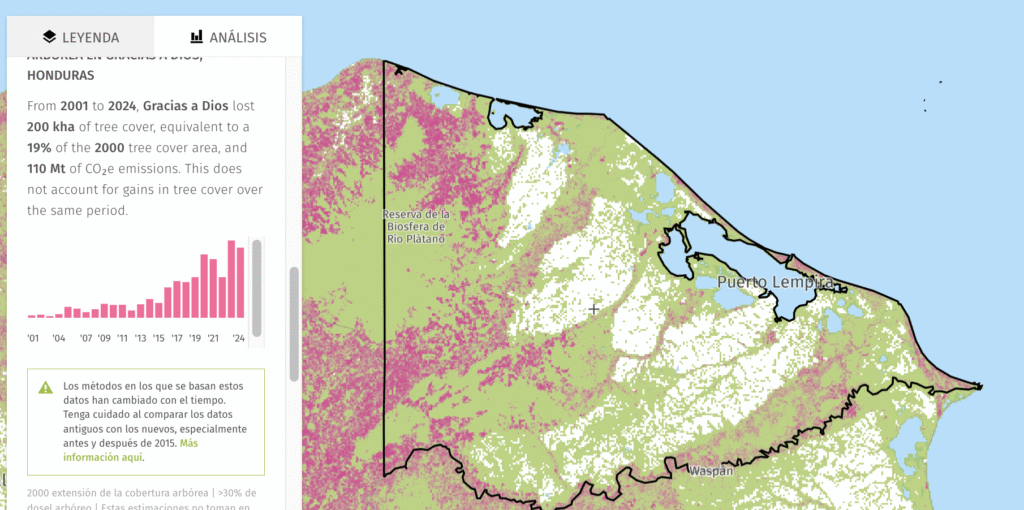
One of the consequences of these illegal activities is the high levels of deforestation in the reserves. According to Global Forest Watch, from 2001 to 2024, the department of Gracias a Dios lost 100 square kilometers of primary rainforest, representing 51% of its total tree cover loss during the same period. The total area of primary rainforest in Gracias a Dios decreased by 19% during this time.
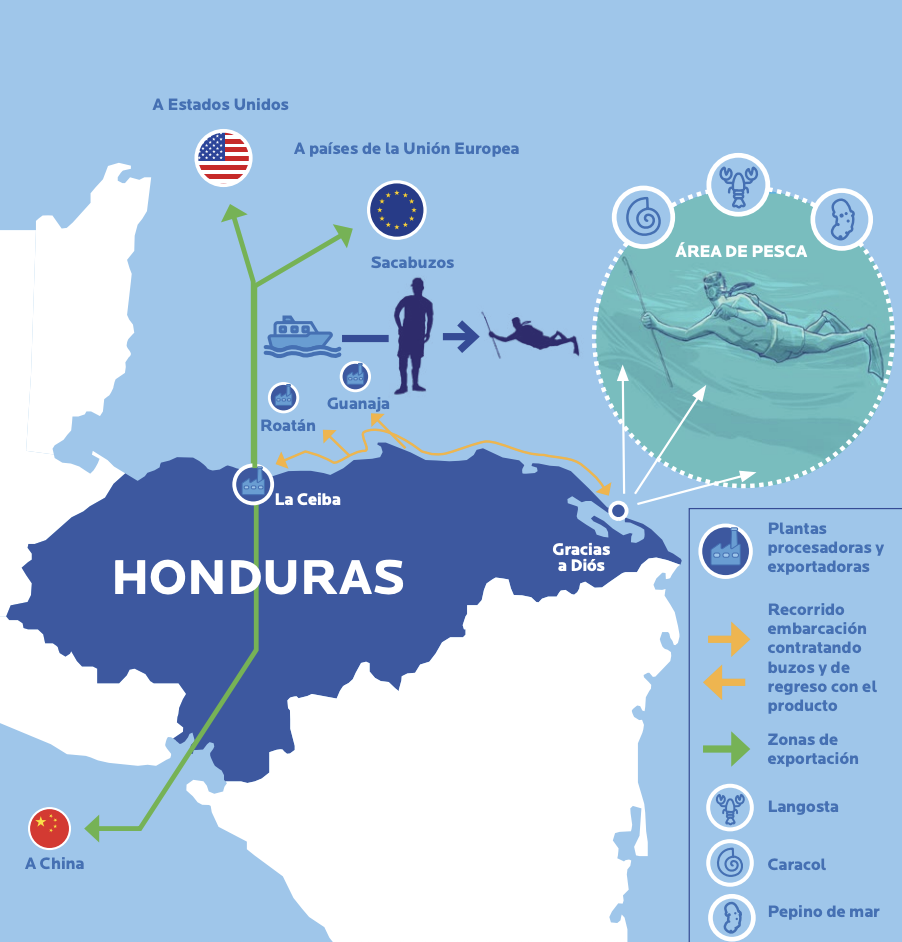
Another element that makes life precarious for the population of La Moskitia is the diving for lobster, sea cucumber, jellyfish, and other species coveted by Chinese companies and processors who, according to testimonies, pay $1 per kilo, while they are sold in international restaurants for more than $200.
“The boats left with a limit set by the Merchant Marine of 20 passengers. However, along the way, there were canoes with other fishermen waiting to board, making a total of 60 fishermen on one boat. That meant overcrowding, terrible hygienic conditions, and competition for oxygen, because divers need to go to ever greater depths, which is another issue; the overexploitation of lobster has forced divers to go to increasingly deeper waters.”
What the environmentalist explains has had serious consequences for fishermen due to the lack of oxygen, such as disabilities and death. A report from the National Commissioner for Human Rights of Honduras (CONADEH indicated that around 400 divers died from work-related illnesses.
“They are completely abandoned. When you go to the main cities of Moskitia, you realize that the economically active life of a Miskito can last 20, 30 years at most, because most of them already have problems derived from decompression sickness, because the work there is: either you get into drugs, or you get into diving,” the defender emphasized.
The Inter-American Court of Human Rights condemned the State of Honduras in 2021 for structural violations against 42 Miskito divers from Moskitia, indigenous people living in extreme poverty, whose only source of employment was underwater fishing for lobster and sea cucumber. For the sentence review in 2024, a partial compliance with the measures is highlighted: risky illegal fishing persists despite condemnation, the State reports limited progress, and organizations denounce opacity and the continuation of tragedies.
While in Honduras, the latent threats are found in the siege of drug trafficking, the illegal timber trade, the dangers of diving, and accelerated deforestation. In Nicaragua, the harassment and repression come from the State itself: the police, the army, and the concessions to foreign actors.
The North Caribbean Coast not only shares the same rich biodiversity with Honduras, as well as indigenous peoples such as the Miskito, Mayangna, Rama, and Afro-descendant Creole/Garifuna communities, but also the same suffering and the same structural threats. Bosawás is the largest forest reserve in Central America and one of the most biodiverse areas in the Moskitia region. It contains 21 types of ecosystems and 6 types of forest, with diverse species of plants, birds, mammals (including jaguar, tapir, and white-lipped peccary), as well as reptiles, amphibians, fish, and insects.
In 2025, the UN Permanent Forum on Indigenous Issues (UNPFII) urged Nicaragua to respect the rights of indigenous peoples in La Mosquitia, and to cease the militarization and criminalization of leaders and communities defending their territories, the Office of the United Nations High Commissioner for Human Rights for Central America (OHCHR) expressed his concern about the escalation of repression against indigenous leaders and communities in Nicaragua, especially those actions that violate the fundamental rights of the Indigenous and Afro-descendant Peoples of the Nicaraguan Caribbean Coast, resulting in the silencing of voices that defend their lands, their culture and their human rights.
In 2022 and 2023, Brooklyn Rivera, a member of the National Assembly for the Yapti Tasba Masraka Nanih Aslatakanka (YATAMA) party, the main party representing Indigenous and Afro-descendant peoples in Nicaragua, and his alternate, Nancy Henríquez, were arrested. Their party was outlawed by the Ortega-Murillo dictatorship in 2024, ahead of the regional elections. Nancy was sentenced to eight years in prison for “conspiring to undermine national integrity and spreading false news to the detriment of the State.”
On March 21, Nancy was released, and with that, demands for the release of Brooklyn Rivera, who continues to be detained. The same month, Amnesty International urged the dictatorship to provide proof of life for the indigenous leader.
“Keeping Brooklyn Rivera detained without information about his whereabouts and health status, and without access to family or lawyers, adds to grave human rights violations. The Nicaraguan authorities have an obligation to demonstrate without delay that he is alive and to guarantee that his rights are fully respected,” said Astrid Valencia, Deputy Director of Research for the Americas at Amnesty International.
Brooklyn’s family has stated that they do not know his whereabouts. «We don’t know if he’s alive, in a morgue, or in serious condition in a hospital,» a family member told a news outlet.
On the Caribbean coast, forced displacement is a constant due to the murders and harassment of settlers by the army and police. The area’s gold and silver reserves have attracted numerous settlers seeking opportunities to sell the extracted minerals to companies.
A 2024 report titled «Nicaragua’s Gold Rush,» from the Oakland Institute, reveals how, despite US sanctions on the gold mining sector, the industry has experienced a boom driven by foreign commercial interests. The United States is the primary destination, receiving 79% of Nicaraguan gold exports.
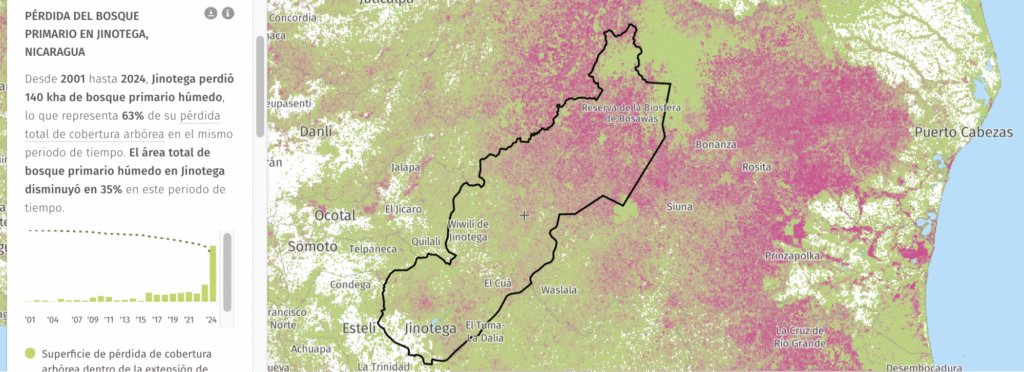
Furthermore, the Caribbean Coast is part of this large forest complex that includes the Bosawas Reserve, one of the largest in Central America, which is under pressure from agricultural and livestock expansion, mining concessions, and colonization. From 2001 to 2024, the department of Jinotega lost 140 kilohectares of primary rainforest, representing 63% of its total tree cover loss during the same period. The total area of primary rainforest in Jinotega decreased by 35% during this time.
La Moskitia, the Central American Amazon, is a region of stark contrasts, teeming with unparalleled natural wealth compared to other forests in the region, yet preserving the culture of its ancestral peoples who resist the neglect and encroachment of states, criminal groups, and large corporations whose voracious appetites threaten the territory. Even in 2026, human rights organizations, environmentalists, and the Indigenous communities themselves continue to voice their demands for direct protection measures, before the silence becomes irreversible.

| Cookie | Duración | Descripción |
|---|---|---|
| cookielawinfo-checkbox-analytics | 11 months | This cookie is set by GDPR Cookie Consent plugin. The cookie is used to store the user consent for the cookies in the category "Analytics". |
| cookielawinfo-checkbox-functional | 11 months | The cookie is set by GDPR cookie consent to record the user consent for the cookies in the category "Functional". |
| cookielawinfo-checkbox-necessary | 11 months | This cookie is set by GDPR Cookie Consent plugin. The cookies is used to store the user consent for the cookies in the category "Necessary". |
| cookielawinfo-checkbox-others | 11 months | This cookie is set by GDPR Cookie Consent plugin. The cookie is used to store the user consent for the cookies in the category "Other. |
| cookielawinfo-checkbox-performance | 11 months | This cookie is set by GDPR Cookie Consent plugin. The cookie is used to store the user consent for the cookies in the category "Performance". |
| viewed_cookie_policy | 11 months | The cookie is set by the GDPR Cookie Consent plugin and is used to store whether or not user has consented to the use of cookies. It does not store any personal data. |