

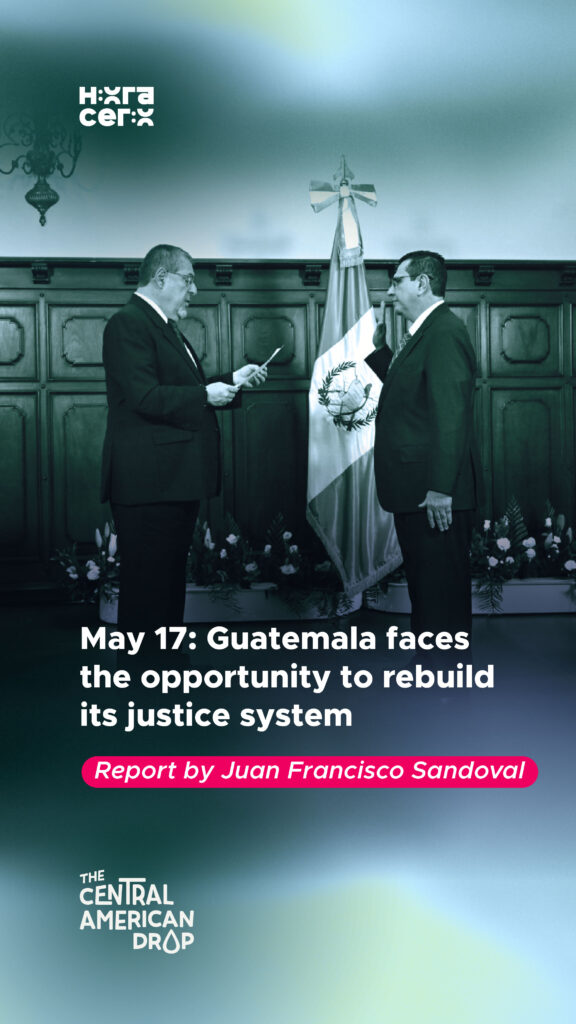
May 17th will not simply be the day for a chance in leadership at the Public Prosecutor’s Office. For many Guatemalans, this date represents much more than an administrative change. It will mark the end of a period characterized by fear, institutional weakening, forced exile, and the perception that justice, on too many occasions, ceased to serve the interests of citizens and instead became an instrument of pressure and punishment.
Over time, the Public Prosecutor’s Office lost a fundamental element: the public’s trust. Restrictive measures multiplied, doors were closed, secrecy became the norm, and silence prevailed within the institution. Many employees chose to remain silent to protect their jobs; others were displaced, some faced legal proceedings, and others were forced to leave the country. Gradually, a fear took hold that investigating certain issues could be risky and that questioning internal matters could have personal consequences.
Those who have experienced exile know that some experiences are never reflected in official documents or speeches. Exile is lived in the birthdays one can no longer attend, in calls to reassure those who remain at home, in the daily uncertainty, and in that complex feeling of having left behind fragments of life out of the conviction that fighting corruption and defending the rule of law was worthwhile. Therefore, this change cannot be analyzed solely in political terms: it possesses a human dimension that was ignored for years.
Of course, the change at the Attorney General’s Office won’t immediately solve the problems that have accumulated over the last eight years. To believe otherwise would be naive. Structures, fears, and practices deeply rooted in the institution persist. There will be resistance, and some will try to adapt quickly to the new landscape simply to survive. It’s also likely that some will prefer that nothing fundamentally change.
Despite this, a different atmosphere is palpable. Perhaps because Guatemala has reached a point of exasperation where many now recognize the damage caused by the use of the justice system as a mechanism for persecution, protecting special interests, or instilling fear. The country needs to regain trust in its institutions, and the Public Prosecutor’s Office now has the opportunity to begin restoring what seemed lost.
The new attorney general will inherit a weakened institution, plagued by technical deficiencies and subject to constant scrutiny. However, they will also find honest prosecutors, dedicated investigators, and staff who, despite the challenges, have persevered in their duties. Guatemala still has individuals willing to rebuild the institution if there is a genuine commitment to restoring its independence and dignity.
The challenge will be considerable. It won’t be enough to modify rhetoric or change visible figures; real transformations will be required. It will be necessary to review criminalization practices, strengthen technical capacities, restore certainty to the prosecutorial career path, and acknowledge that justice cannot operate under fear or absolute obedience. Citizens must regain confidence that the Public Prosecutor’s Office investigates crimes and protects rights, not that it intimidates dissenters.
Furthermore, it is essential to understand that rebuilding does not mean persecuting those who previously held office. Guatemala is all too familiar with cycles of revenge and the political manipulation of institutions. What the country needs is far more complex: to restore the rule of law, transparency, and trust.
Many of us have followed this process from afar: some from exile, others from the disillusionment of recent years. But also with a cautious hope that hasn’t been felt for a long time. It’s not a naive or triumphalist hope, but the modest hope that, if there is genuine will, things can begin to change.
May 17 will mark the end of a difficult chapter for the Public Prosecutor’s Office and for Guatemala. What matters is what happens next. Because the country doesn’t need propaganda or heroic narratives: it needs institutions that, once again, move closer to justice.
| Cookie | Duración | Descripción |
|---|---|---|
| cookielawinfo-checkbox-analytics | 11 months | This cookie is set by GDPR Cookie Consent plugin. The cookie is used to store the user consent for the cookies in the category "Analytics". |
| cookielawinfo-checkbox-functional | 11 months | The cookie is set by GDPR cookie consent to record the user consent for the cookies in the category "Functional". |
| cookielawinfo-checkbox-necessary | 11 months | This cookie is set by GDPR Cookie Consent plugin. The cookies is used to store the user consent for the cookies in the category "Necessary". |
| cookielawinfo-checkbox-others | 11 months | This cookie is set by GDPR Cookie Consent plugin. The cookie is used to store the user consent for the cookies in the category "Other. |
| cookielawinfo-checkbox-performance | 11 months | This cookie is set by GDPR Cookie Consent plugin. The cookie is used to store the user consent for the cookies in the category "Performance". |
| viewed_cookie_policy | 11 months | The cookie is set by the GDPR Cookie Consent plugin and is used to store whether or not user has consented to the use of cookies. It does not store any personal data. |