

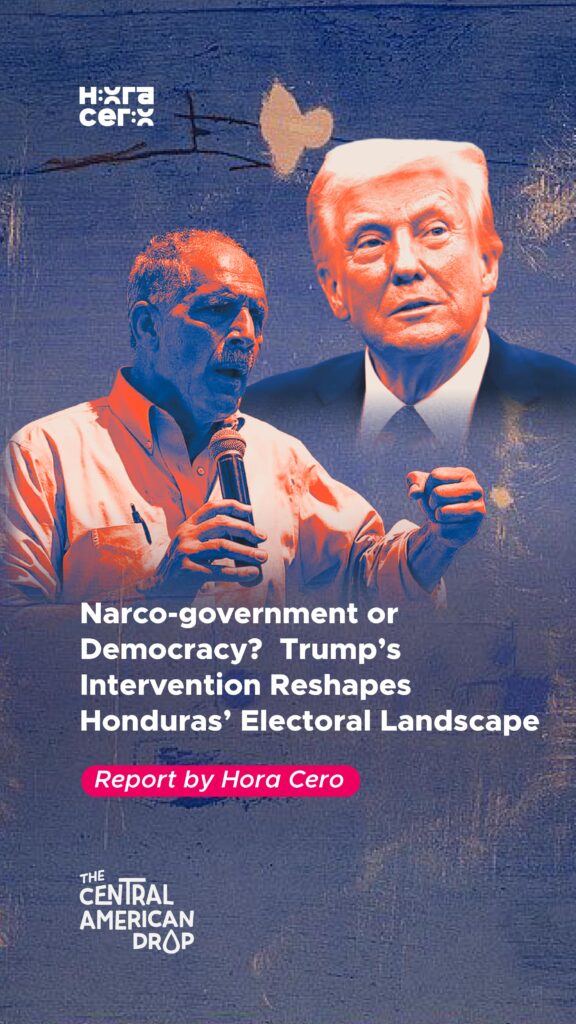
On November 28, U.S. President Donald Trump announced that he would grant a full pardon to former Honduran President Juan Orlando Hernández (JOH), who is currently serving a 45-year prison sentence in the United States for drug trafficking. The announcement came just days before Honduras’ presidential elections and immediately reverberated across the country’s tense political landscape.
Trump’s statements went far beyond the pardon. He openly endorsed Nasry Asfura, the 67-year-old businessman and National Party candidate, while dismissing rival Salvador Nasralla as “unreliable” and labeling Libre candidate Rixi Moncada a “Fidel Castro fanatic.” He warned that if Asfura did not win, the United States would not “waste” its money on the wrong leader. This direct intervention in the final stretch of the campaign has raised alarms about renewed U.S. interference in Central American elections—an issue many believed was fading into the past.
The timing could not be more consequential. Honduran politics remain deeply polarized, and the three leading candidates have traded accusations of electoral fraud throughout the campaign. Polls have produced inconsistent, sometimes contradictory results. According to recent surveys by Le Vote and the Justice Institute, Nasralla entered the final week as the frontrunner, with over 30% of voter preference, compared to 21% for Asfura and 14% for Moncada. The impact of Trump’s intervention on these dynamics remains uncertain.
The National Party, which backs Asfura, is the same political force that brought JOH to power. Over the past decade, Hernández played a central role in shaping post-coup Honduras, securing strong support from Washington, consolidating power, and even obtaining an unconstitutional reelection in 2017. That reelection sparked nationwide protests and amplified public outrage, which deepened after the conviction of JOH’s brother Tony Hernández for drug trafficking. By 2021, voters punished the National Party at the ballot box, electing Xiomara Castro of Libre with a historic 51% of the vote.
Yet within segments of the National Party, JOH retains significant loyalty. Trump’s promise of a pardon has reignited fears that Honduras could once again drift toward a “narco-state,” where political elites implicated in drug trafficking return to public life with impunity. For many Hondurans, the possibility of JOH’s rehabilitation symbolizes the fragility of the country’s democratic recovery after the institutional rupture caused by the 2009 coup.
Trump’s involvement in the Honduran elections is not an isolated incident. Only weeks earlier, he conditioned U.S. financial support to Argentina following Javier Milei’s electoral victory. His willingness to publicly anoint preferred leaders in the region—and threaten consequences if voters do not comply—reflects a broader pattern of intervention that contradicts long-standing U.S. rhetoric on sovereignty and democratic self-determination.
Hondurans went to the polls on Sunday, November 30, to elect a president for the 2026–2030 term, along with 128 members of Congress and 298 mayors. They did so amid profound political tension, institutional distrust, and now, unprecedented interference from a U.S. president. The stakes extend far beyond partisan competition: at issue is whether Honduras will continue its effort to rebuild democratic institutions or slide back into the shadow of corruption, foreign meddling, and narco-politics.
| Cookie | Duración | Descripción |
|---|---|---|
| cookielawinfo-checkbox-analytics | 11 months | This cookie is set by GDPR Cookie Consent plugin. The cookie is used to store the user consent for the cookies in the category "Analytics". |
| cookielawinfo-checkbox-functional | 11 months | The cookie is set by GDPR cookie consent to record the user consent for the cookies in the category "Functional". |
| cookielawinfo-checkbox-necessary | 11 months | This cookie is set by GDPR Cookie Consent plugin. The cookies is used to store the user consent for the cookies in the category "Necessary". |
| cookielawinfo-checkbox-others | 11 months | This cookie is set by GDPR Cookie Consent plugin. The cookie is used to store the user consent for the cookies in the category "Other. |
| cookielawinfo-checkbox-performance | 11 months | This cookie is set by GDPR Cookie Consent plugin. The cookie is used to store the user consent for the cookies in the category "Performance". |
| viewed_cookie_policy | 11 months | The cookie is set by the GDPR Cookie Consent plugin and is used to store whether or not user has consented to the use of cookies. It does not store any personal data. |