

May 2025 was a month in which the repression by the Bukele government reached unprecedented levels, in a context of political tension following revelations by the digital media outlet El Faro, documented the Bukele government’s pacts with Salvadoran gangs; the violent repression suffered by the El Bosque cooperative for protecting its territory; and the arrest of Alejandro Henríquez, an environmental lawyer and member of ReverdES, and José Ángel Pérez, pastor of the Elim Church and president of the cooperative. All these events clearly demonstrated the Bukele regime’s fear of critical voices it considers inconvenient, and indicated that its strategy for confronting these voices was evolving toward an undeniable level of repression.
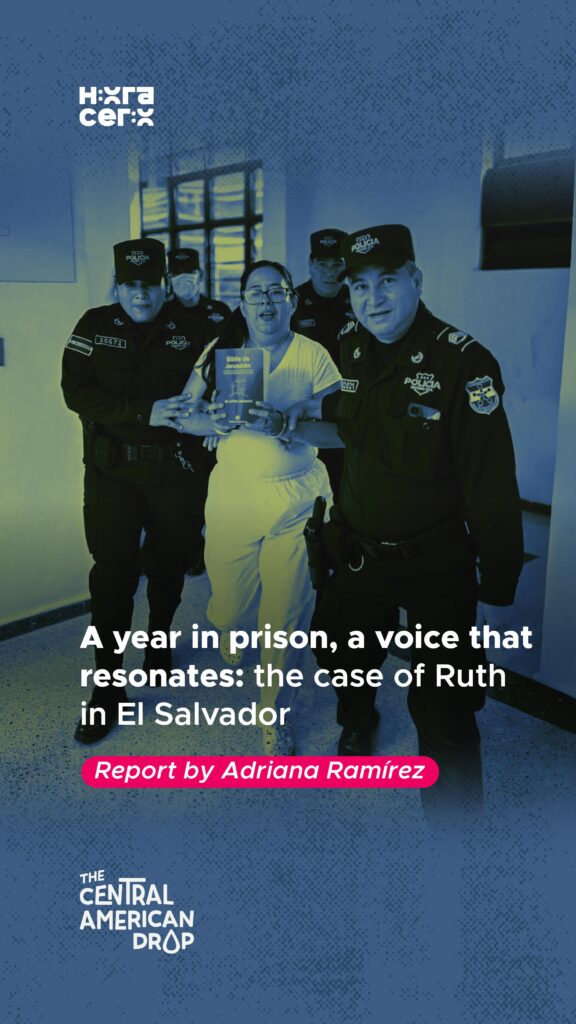
This wave of repression and the attempt to silence critical voices reached one of its highest points with Ruth’s arrest on May 18, 2025. The police arrived at her house. They lured her from her home under false pretenses and arrested her without a warrant. Initially, it was reported that she was being prosecuted for embezzlement, but this charge was later changed to illicit enrichment, demonstrating that even the prosecution lacked clarity on how to build a case against her.
If she is accused of crimes related to public funds—funds that belong to all of us who contribute through our taxes—it is inevitable to ask: Why, in a case involving public funds, is the information completely confidential? If it concerns public funds, doesn’t the public have the right to know the amounts, transactions, and mechanisms used for these alleged crimes? The only time we have seen Ruth publicly, she pleaded for an open trial and maintained her innocence.
This arrest had profound symbolic and material significance for activists, land defenders, human rights defenders, and journalists, since the capture of a lawyer of such a high reputation seemed implausible. Ruth established herself as an uncomfortable figure for the government by presenting complaints and investigations of abuses of power and corruption in cases such as illicit contracts for the purchase of supplies to face the COVID-19 emergency, questions about the transparency in financial operations related to the implementation of Bitcoin and, mainly, for her denunciation of human rights violations, arbitrary detentions of victims of the exceptional regime as head of the Anti-Corruption and Justice Unit of Cristosal.
Ruth was also one of the signatories of the lawsuit challenging the constitutionality of the General Law of Metallic Mining in El Salvador (approved to reverse the country’s historical prohibition) before the Constitutional Chamber of the Supreme Court of Justice, a lawsuit that was accompanied by more than 57,000 citizen signatures. Alejandro Henríquez, who at that time had already been captured, was also a signatory.
When the news began to spread, many people in various chat groups thought it was just a rumor; however, upon seeing the photos and video, something shifted in the level of insecurity many of us already felt. Her capture was a turning point. This motivated many organized individuals and human rights defenders to decide to leave El Salvador and seek refuge in other countries, while at the same time continuing to use their voice in places where minimum security conditions are guaranteed for dissent.
Ruth’s arrest carries significant political weight because her voice in defense of justice is grounded in the legitimacy of her extensive academic background, her impeccable professional record, and her strong ties with colleagues. Ruth is a woman capable of challenging the singular narratives imposed by the Bukele regime and disputing them together through the work of Cristosal through speeches supported by in-depth research and multiple pieces of evidence that show cases of corruption in the Nuevas Ideas government: from the lack of transparency in the purchase of supplies during the pandemic to the lawsuit of unconstitutionality against the recently approved General Mining Law.
For more than 365 days, Ruth has been deprived of her liberty, most of that time at the Izalco Penitentiary Farm, where her family has been unable to contact her, nor have her lawyers, to prepare her defense. Ruth has not received any visitors for months; information about her health and whether she is receiving the minimum conditions of dignity within the prison system has been denied. Within this system, Humanitarian Legal Aid has recorded more than 500 deaths of people not linked to gangs while in state custody, and Cristosal has documented torture.
To think about Ruth is to think of a brave, strong, and deeply committed woman who manages to balance her spirit of seeking justice with the intellectual rationality that allows her to substantiate all her accusations. But it is also remembering a mother, sister, wife, and friend who is missed every day and who has been cut off from her political and emotional support networks as a strategy to try to weaken her.
For me, it is her profoundly human sensitivity that makes her commitment to the search for justice for the most vulnerable, innocent people detained under the state of emergency, and the victims of theft and dispossession of water and territories. Her unwavering commitment to her ideals and her pursuit of justice are what made her such a thorn in the side of the regime. She sees the humanity in others and recognizes that unjust conditions hinder the development of a dignified life, especially for the poorest people in El Salvador.
Thinking of Ruth, I recall the words of the beloved Berta Cáceres (a land defender murdered in Honduras in 2016): “You have the bullet, I have the word; the bullet dies when it is fired, the word lives on when it is shared.” Amid so many bullets of repression, disinformation, the impoverishment of the Salvadoran people, and political violence, Ruth’s voice has resonated more than ever. Since her capture, she has received numerous awards and recognitions for her work in defense of justice and human rights.
While these awards are significant, what I find even more impressive is the fact that her voice has transcended so many spaces and territories. I believe this replication that Berta spoke of, and which has become visible again with Ruth’s imprisonment, is a political calculation that the regime did not anticipate: that more and more people and institutions abroad, such as the United Nations and Amnesty International, are becoming aware of the dictatorship that Bukele leads.
We believe in Ruth’s innocence and are certain that, as she herself stated, she is a political prisoner because of her advocacy work. From our respective positions, we never stop talking about Ruth; we never stop thinking about her and admiring her, and we continue to nurture and fight for the hope that justice will be served.
One year after her capture, her voice lives on, repeating itself: wherever we are, wherever we arrive, wherever we speak, Ruth will also be there, will arrive and speak.
FREEDOM FOR RUTH AND FOR ALL SALVADORAN POLITICAL PRISONERS!
-Adriana Ramirez
| Cookie | Duración | Descripción |
|---|---|---|
| cookielawinfo-checkbox-analytics | 11 months | This cookie is set by GDPR Cookie Consent plugin. The cookie is used to store the user consent for the cookies in the category "Analytics". |
| cookielawinfo-checkbox-functional | 11 months | The cookie is set by GDPR cookie consent to record the user consent for the cookies in the category "Functional". |
| cookielawinfo-checkbox-necessary | 11 months | This cookie is set by GDPR Cookie Consent plugin. The cookies is used to store the user consent for the cookies in the category "Necessary". |
| cookielawinfo-checkbox-others | 11 months | This cookie is set by GDPR Cookie Consent plugin. The cookie is used to store the user consent for the cookies in the category "Other. |
| cookielawinfo-checkbox-performance | 11 months | This cookie is set by GDPR Cookie Consent plugin. The cookie is used to store the user consent for the cookies in the category "Performance". |
| viewed_cookie_policy | 11 months | The cookie is set by the GDPR Cookie Consent plugin and is used to store whether or not user has consented to the use of cookies. It does not store any personal data. |