

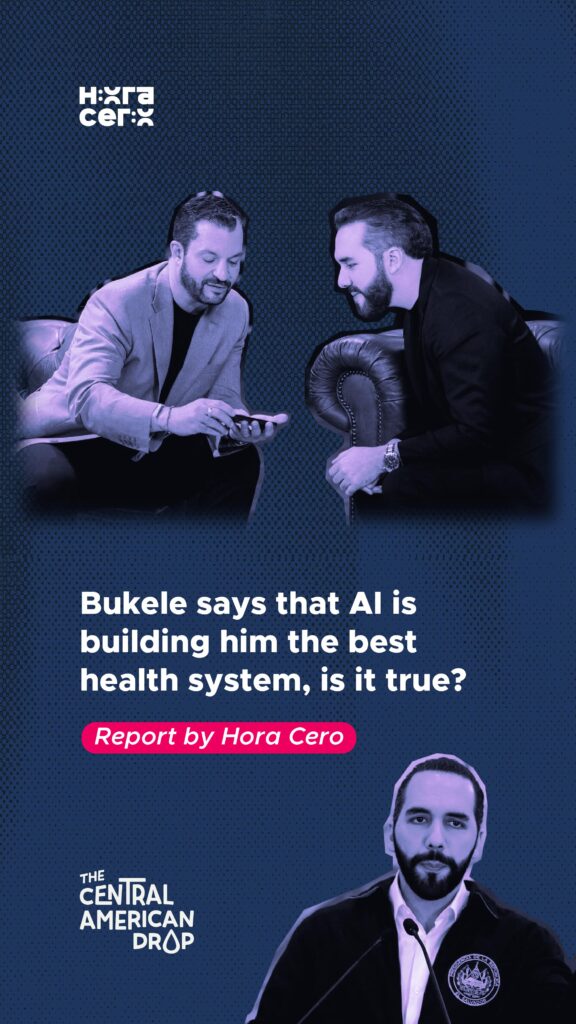
Through a national broadcast, the Presidency of El Salvador, Nayib Bukele, announced Phase II of the Dr. SV application, which was launched in November 2025. From this stage onwards, the management of the Salvadoran public health system will be administered by Google’s Artificial Intelligence (AI) (Gemini).
In 2023, the Legislative Assembly of El Salvador approved the hiring of Google for the administration of health services for $500 million over seven years. Google’s AI will create medical records, perform initial diagnoses, and schedule appointments. It is also expected to track chronic illnesses.
During the national address, the president of El Salvador was accompanied by Guy Nae from Google, as well as three experts in AI and medicine. However, despite the program being promoted as the gateway to “the best healthcare system in the world,” it is actually an experiment overseen by Google.
Dr. SV is a mobile phone application. Salvadorans will register their symptoms and, using artificial intelligence, they will connect with a doctor to receive a diagnosis, test recommendations, and follow-up treatment. That means Google will administer personal and sensitive data.
How will the personal and health information of Salvadorans be protected? Although the government assures that Dr. SV will operate in compliance with the Personal Data Protection Law of El Salvador, in force since November 2024, AI stores information to train its models and improve its services.
The announcement of the second phase of Dr. SV comes amid criticism from the medical community: during 2025, the Government dismissed more than 7,000 health system workers, including internists and specialists, nurses, and basic care staff.
Nayib Bukele’s government has already made bets on technology companies in the past, which have been a failure. In 2021, it was the president who pushed for the passage of a cryptocurrency law for the use of Bitcoin, including the Chivo Wallet app. However, the population refused to use it as currency, and it failed.
Recently, Michael Burry, known for predicting the 2008 financial crisis and portrayed in the film «The Big Short,» expressed strong skepticism about the rise of AI companies via the social network «X,» classifying them as a speculative bubble that could burst in the next two years.
Previously, in February 2026, Burry warned of a potential «death spiral» for Bitcoin and cryptocurrencies. This could trigger massive sell-offs, forcing institutions that use them to liquidate other assets, including precious metals like gold and silver, to cover margins when the crisis hits.
And Burry is correct, both in AI companies and cryptocurrencies are speculative and fraudulent schemes. We must ask the Presidency of El Salvador a basic question: Is this another speculative technological change that plays with the future of the population?
| Cookie | Duración | Descripción |
|---|---|---|
| cookielawinfo-checkbox-analytics | 11 months | This cookie is set by GDPR Cookie Consent plugin. The cookie is used to store the user consent for the cookies in the category "Analytics". |
| cookielawinfo-checkbox-functional | 11 months | The cookie is set by GDPR cookie consent to record the user consent for the cookies in the category "Functional". |
| cookielawinfo-checkbox-necessary | 11 months | This cookie is set by GDPR Cookie Consent plugin. The cookies is used to store the user consent for the cookies in the category "Necessary". |
| cookielawinfo-checkbox-others | 11 months | This cookie is set by GDPR Cookie Consent plugin. The cookie is used to store the user consent for the cookies in the category "Other. |
| cookielawinfo-checkbox-performance | 11 months | This cookie is set by GDPR Cookie Consent plugin. The cookie is used to store the user consent for the cookies in the category "Performance". |
| viewed_cookie_policy | 11 months | The cookie is set by the GDPR Cookie Consent plugin and is used to store whether or not user has consented to the use of cookies. It does not store any personal data. |