

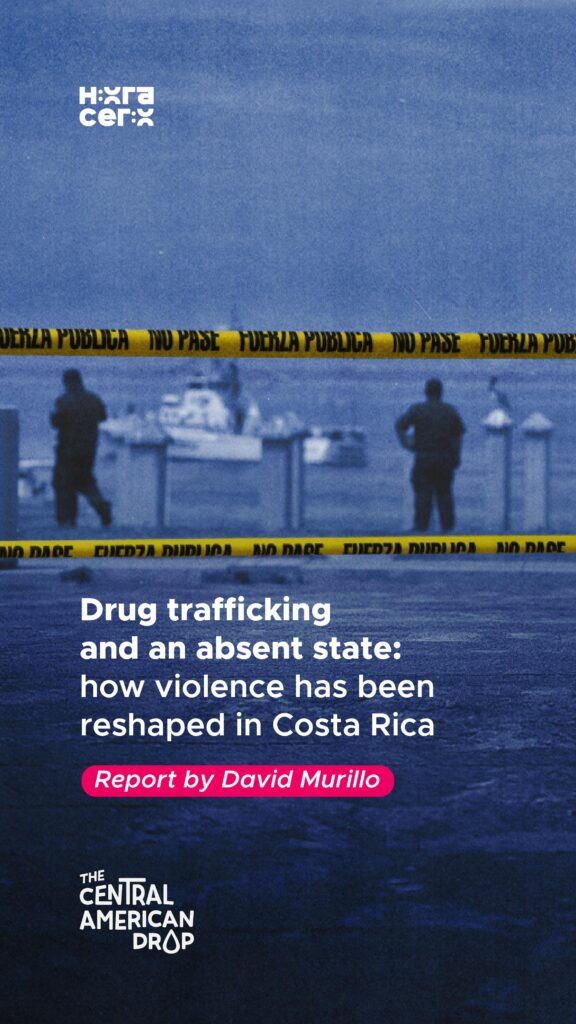
For much of its recent history, Costa Rica built its social and political life on the idea that extreme violence was a foreign phenomenon, something that occurred outside its borders or in exceptional circumstances. This perception persisted for years because the data supported this narrative: relatively stable homicide rates, a limited presence of hired killers, and a state that, despite its weaknesses, maintained sufficient territorial control to prevent lethal violence from becoming commonplace. Until recently, the thought of a shootout in a public place, a person murdered in front of a business, or a body lying in a residential street would have been an extraordinary event, capable of paralyzing entire communities and occupying public attention for days.
This equilibrium began to erode gradually from the second half of the 2010s, when homicides began an upward trend that, while not yet generating widespread alarm, already indicated changes in the nature of the violence, particularly in coastal and urban areas where disputes associated with domestic drug trafficking were beginning to solidify. By 2018, the increase was no longer circumstantial but had become a sustained trend, and although the pandemic partially shifted the media focus during 2019 and 2020, organized crime maintained its activity, paving the way for the breakdown that would follow.
The turning point became evident in 2021 and was clearly recorded in 2022, when the Judicial Investigation Agency (OIJ) documented 661 homicides, a figure considered historic at the time and marking the entry of the issue of insecurity into the center of the national debate. However, this record ended up serving as a prelude to an even greater deterioration, because in 2023 Costa Rica reached its all-time high for homicides, with 907 murders recorded by the Judicial Investigation Agency, followed by 880 in 2024 and 873 in 2025, resulting in the three most violent years in the country’s history.
The surge in homicides not only altered the indicators but also the way violence manifested itself in public spaces. Murders began to occur more frequently in streets, neighborhoods, businesses, and open areas, shifting violence from more closed environments to visible and shared settings, which directly increased the risk for people uninvolved in any criminal activity. As a result, people are afraid to go out on the street, who may think of acquiring a weapon, or in protecting their home as much as possible, to avoid risks.
According to OIJ records, nearly 70% of documented homicides are linked to “settling of scores”, a category that refers to disputes between criminal structures, territorial control, and revenge, but which does not imply an absence of collateral damage. The motive for the crime stems from criminal disputes, even if its consequences affect third parties.
This trend is reflected in the words of Gerardo Castaing, a retired criminal investigator from the OIJ and former director of that institution, who maintains that the country is experiencing a profound transformation in the nature of violence when he statesthat “Costa Rica has traditionally been a democratic country, a country of peace, where security generally reigned until a few years ago” and that this scheme changed because “a pacifist police force was chosen, a type of civilian police force that had no presence in the streets, in the districts, in the cantons, so that the presence on the street, the patrolling of the streets, on foot, in vehicles, ceased to exist.»
This lack of preventive presence has a direct correlation with the evolution of the criminal phenomenon, and Castaing affirms this in operational terms when he states that «there is no preventive form against crime» because the responsibility for primary prevention falls on the Public Force and the models used «have not yielded any results whatsoever,» an assessment that must be read in light of a country where homicides reached consecutive record levels for three years.
For Castaing, the loss of territorial control by the State is not rhetoric, but a functional fact: “Crime began to grow and took over the streets, it took over the environment to the point that now they walk around with high-caliber weapons and decide who they kill, when they kill them, how they kill them, and then they kill them.”
The areas with the highest concentration of homicides in Costa Rica are not random. Limón and Puntarenas, the two provinces with the highest rates of lethal violence, have ports and key logistical routes for drug trafficking, which has directly exposed them to disputes between drug cartels. In this context, contract killings have become a tool for imposing territorial control, resolving conflicts, and sending messages, transforming homicide from an isolated incident into part of an organized criminal dynamic.

The social dimension of this process is reflected in Castaing’s words when he observes that “statistics normalize things. An event, repeated so often, becomes normal, and that is happening in Costa Rica. We must take into account that what is happening are murders, not just homicides. So people are already seeing it as normal,” a warning that implies that society can become accustomed to the volume of violent events and shift attention to other issues while the lethal phenomenon continues.
During the first years of the surge, the dominant narrative held that the violence stemmed primarily from clashes between criminals, a notion reinforced even by the Executive branch, when President Rodrigo Chaves asserted that those dying were mostly criminals killing each other. This framework began to crumble when the killings shifted to public spaces and collateral victims began to appear—people with no connection to organized crime who died in shootouts or from stray bullets—demonstrating that the violence was no longer confined to the criminal underworld.
The focus of the discussion cannot be limited to homicides because insecurity is also expressed in other crimes that reinforce the perception of social deterioration, but lethal violence remains the hardest and most objectively measurable indicator of the failure of prevention and control policies when these maintain high figures for several consecutive years.
However, the explanation for these figures lies in the evolution of organized crime in the country. Castaing distinguishes between two dynamics that coexist in Costa Rica today: on the one hand, international drug trafficking, which uses the country as an entry and storage point for drugs, and on the other, internal drug trafficking, which has grown in structure and operational capacity to the point of becoming the main driver of violence. According to Castaing, this internal drug trafficking “is generating all the insecurity in the country,” not only because of the number of homicides it produces, but also because of its ability to establish territorial control.
This control materializes when criminal organizations impose rules on specific neighborhoods and communities, deciding who sells drugs, who can operate in the area, which groups can enter, and how conflicts are resolved. Cases like that of Pecho de Rata or alias The Devil These cases, linked to territorial disputes and the systematic use of hired killers, show how these organizations maintain their control through violence, but also through the recruitment of young people who fulfill key roles as salespeople, lookouts, transporters, or hitmen, especially in contexts marked by school dropout rates and a lack of job opportunities. In this way, homicide ceases to be an isolated incident and comes to serve a specific function within an organized criminal logic that is constantly reproduced in territories where the State has lost its presence, and, moreover, becomes a source of employment.
This growth of domestic criminal markets is directly linked to the inability to financially cripple the structures that sustain them, including money laundering, which is an implicit driver of violence. Castaing states that “money laundering in the country is extremely high” and that “the National Institute Against Drugs, which is responsible for combating money laundering, is also overwhelmed,” a point that highlights institutional weakness and the inadequacy of financial control mechanisms in the face of expanding illicit economies.
The training of security forces, the availability of human resources, and political will repeatedly appear as inseparable factors in the diagnosis of insecurity in Costa Rica, not as abstract concepts, but as concrete conditions that determine the State’s capacity to prevent, contain, and dismantle criminal structures.
Gerardo Castaing has explicitly stated that «political consensus is lacking» and that the absence of legal tools such as an effective asset forfeiture law directly limits the possibility of striking organized crime at its economic base, a point that takes on special relevance when observing the period between 2023 and 2025, during which the country registered the highest levels of homicides in its history without a sustained reversal of the phenomenon.
The institutional fragility that characterizes this scenario becomes more apparent when analyzing cases that demonstrate links between state power and criminal structures. The case of Celso Gamboa, in this context, is dangerous, not only because of the seriousness of the accusations, but also because of the institutional history that precedes them.
A former Supreme Court Justice and former Minister of Public Security, Gamboa held strategic positions within the state apparatus for years before being linked to international drug trafficking investigations and subsequently being requested for extradition by the United States Drug Enforcement Administration. Beyond the legal outcome of his case, the fact that a figure with that level of political and judicial power managed to remain in key positions for so long without institutional controlsthey had detectedor stop possible links with drug trafficking became a point of reference to understand how organized crime not only expanded into territories, but also found margins of tolerance, omission or weakness within the State itself.
At the same time, the institutional response to the rise in violence has focused on measures that appear more reactive than preventative. The creation of the High-Security Center against Organized Crime, known as CACCO, was officially presented as a tool to combat organized crime, although in practice it addresses a different urgency: the collapse of the Costa Rican prison system, a structural problem that has persisted for years and manifests itself in overcrowding, loss of internal control, and limited management capacity in the Institutional Care Centers and La Reforma Prison.
The CACCO did not emerge as a center designed to dismantle complex criminal networks, but as a belated response to the saturation of a prison system that ceased to fulfill its basic function of containment, and whose inauguration, carried out by the Salvadoran president Nayib Bukele, reinforced the punitive symbolism of the measure without resolving the structural causes that fuel organized crime outside the prison walls.
This combination of high levels of homicidal violence, a lack of political consensus, legal limitations, institutional infiltration, and responses focused on incarceration contributed to a scenario in which, according to Castaing, the confrontation between branches of government and the lack of effective control “transmit behavioral patterns to society” that place criminal structures in a “comfortable position,” facilitating the expansion of their operations. The period from 2023 to 2025, encompassing the most violent years in the country’s history, ultimately transformed insecurity into a measurable problem attributable to concrete decisions regarding public policy, institutional design, and implementation capacity, rather than an abstract or circumstantial concern.
In the lead-up to the 2026 elections, insecurity solidified as a central theme of the political debate, with clearly differentiated proposals reflecting distinct interpretations of the problem’s causes and how to address it. From the ruling party and allied sectors, candidates such as Laura Fernández (leading in all opinion polls), as well as José Aguilar and Fabricio Alvarado, have proposed approaches centered on a punitive justice system. These include the suspension of individual rights in certain contexts, the construction of mega-prisons, and harsher penalties as mechanisms to curb violence and organized crime. This is reinforced by the public friendship between Presidents Chávez and Bukele, demonstrating a trend toward «Bukeleism» in security matters.
In contrast, other proposals have emphasized technological strengthening and inter-institutional coordination. The C5 plan, championed by Álvaro Ramos of the National Liberation Party, proposes a model for integrating information, surveillance, and response that seeks to coordinate the various security institutions under a single command and control system. Meanwhile, figures like Ariel Robles and Claudia Dobles have insisted on approaches that combine social prevention, strengthening the education system, and reinforcing police control in coastal areas and strategic territories, with particular attention to regaining territorial control as a prerequisite for reducing violence.

| Cookie | Duración | Descripción |
|---|---|---|
| cookielawinfo-checkbox-analytics | 11 months | This cookie is set by GDPR Cookie Consent plugin. The cookie is used to store the user consent for the cookies in the category "Analytics". |
| cookielawinfo-checkbox-functional | 11 months | The cookie is set by GDPR cookie consent to record the user consent for the cookies in the category "Functional". |
| cookielawinfo-checkbox-necessary | 11 months | This cookie is set by GDPR Cookie Consent plugin. The cookies is used to store the user consent for the cookies in the category "Necessary". |
| cookielawinfo-checkbox-others | 11 months | This cookie is set by GDPR Cookie Consent plugin. The cookie is used to store the user consent for the cookies in the category "Other. |
| cookielawinfo-checkbox-performance | 11 months | This cookie is set by GDPR Cookie Consent plugin. The cookie is used to store the user consent for the cookies in the category "Performance". |
| viewed_cookie_policy | 11 months | The cookie is set by the GDPR Cookie Consent plugin and is used to store whether or not user has consented to the use of cookies. It does not store any personal data. |