

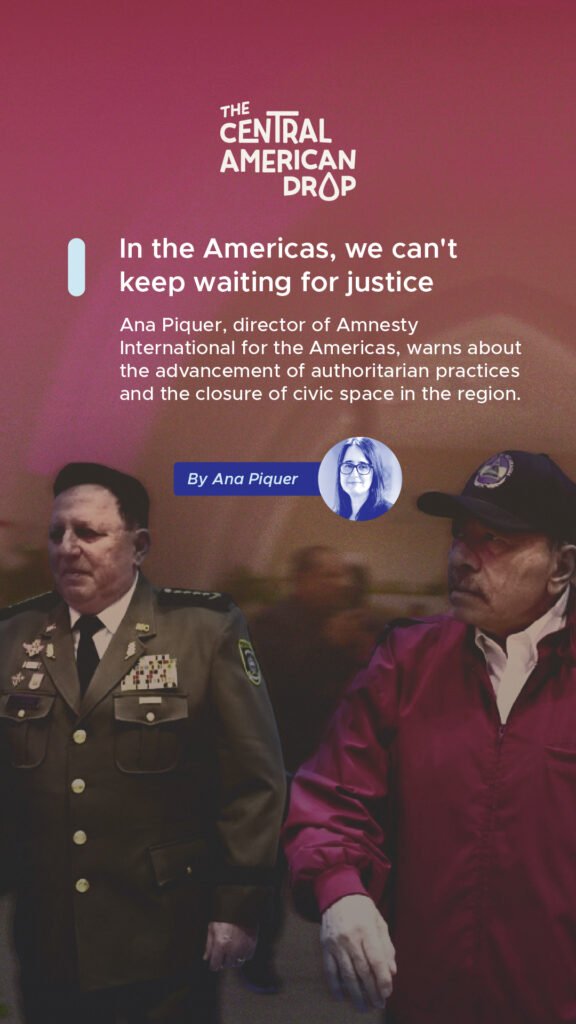
In much of the Americas, justice has too often become a deferred promise. For thousands of people persecuted, censored, imprisoned, displaced, or punished for defending human rights, waiting is not a neutral position: it can mean losing their freedom, security, livelihood, and even their lives.
We are at a dangerous stage where a new world order is taking shape: powerful states, multinationals and anti-rights movements are openly attacking multilateralism, international law and cooperation systems.

Repression doesn’t always come with tanks. Sometimes it comes with laws, searches, audits, threats, smear campaigns, and bureaucracies designed to stifle dissent. This system despises international solidarity, uses force as a political language, and treats civil society organizations that prioritize human rights as the enemy.
In Latin America, this message is already having visible effects. Countries such as Ecuador, El Salvador, Nicaragua, Paraguay, Peru, and Venezuela have adopted or reformed legal frameworks that impose disproportionate controls on civil society organizations, limiting their ability to function, access resources, support communities, and defend human rights. The report ““Breaking the Social Fabric”, by Amnesty InternationalIt shows how these provisions threaten freedom of association, weaken the autonomy of organizations, and deteriorate the networks of trust and solidarity that sustain communities.
The United States has proudly sponsored this crisis, establishing a dehumanizing and discriminatory narrative, weakening international accountability mechanisms, hardening cruel immigration policies, and fueling militarized responses.
This trend is worrying, as it has fostered the rise of authoritarian practices and direct human rights violations in the region. US policies have had repercussions in various countries, influencing electoral processes in countries such as Peru, Colombia, Honduras, and Chile; strengthening militarization through security cooperation with countries like El Salvador and Ecuador; maintaining a policy of pressure and intervention in Venezuela, largely motivated by the control of natural resources such as oil; and exerting threats or pressure on many other countries to align themselves with US interests.
The region is also closing ranks against those who report the news. Harassment, censorship, and attacks against journalists have been reported in various countries, some with lethal consequences, such as in Colombia, Ecuador, Honduras, Mexico, and Peru. When journalists are attacked and silenced, our right to be informed about what is happening in our country is also attacked.
What is at stake, therefore, is not only freedom of expression. It is also the possibility of knowing whether a persecuted person will have protection; whether a community can report abuse without suffering reprisals; whether a family can learn the truth about a missing loved one; or whether human rights can protect us from the arbitrary exercise of power.
In this context, the Organization of American States (OAS) held its 56th General Assembly in Panama City, focused on defending multilateralism and democracy in the Americas, with the United States’ particular agenda centered on strengthening security and the economy while neglecting the human rights situation.
The timing could not have been more significant. As the region faces a rise in authoritarian practices, one of the main political bodies of the inter-American system had to answer a fundamental question: can multilateralism continue to be an effective tool for protecting people?
Despite the tensions, the Assembly approved four declarations and 14 resolutions, among which the Panama declaration in defense of multilateralism stands out, as well as the resolutions on the situation in Nicaragua and Haiti.
The resolution on Haiti calls for increased international support for the country to restore security, combat armed groups, move toward democratic elections, and address the humanitarian crisis, all under Haitian leadership and with respect for human rights and the country’s sovereignty. In this context, Amnesty International organized a side event to discuss the implementation of the OAS Roadmap for Stability and Peace with a human rights focus, emphasizing that child protection must be central to any national, regional, and international response to the Haitian crisis.
On the other hand, the resolution on Nicaragua condemns human rights violations in the country, including cases that could be considered crimes against humanity. During the assembly, civil society organizations used this opportunity to continue denouncing the case of Brooklyn Rivera and his recent death, which the State needs to clarify, as well as the disappearance of his family members and the situation of all other people arbitrarily detained for political reasons in Nicaragua.
In countries with such a closed civic space, where repression, disappearances, and torture are part of everyday life, there must be a record of truth, a historical memory, a preservation of evidence and documentation that ensure justice, even when the possibility of achieving it comes in the future, when changes in the structures and spaces of power become a reality.
During the Assembly, Venezuela was also discussed. At various events, emphasis was placed on the importance of the fact-finding mission in Venezuela, as well as the need for an on-site visit to verify compliance with Inter-American human rights standards and to listen to and support the victims. Now is not the time to halt the process; now more than ever, it is time to push for structural reparations. The Assembly took place in the days leading up to the June 24 earthquakes, which have exacerbated the social and humanitarian crisis.
To achieve justice in the different contexts of the aforementioned countries, it is extremely important to document events while they are still recent, to have the participation of the victims, and to consider comprehensive reparations that allow the reconstruction of the lives of each of the people who have been wronged, as well as the social fabric of a region damaged by impunity and indifference.
Listening to victims is not a mere formality. The OAS is a valuable forum not only for decision-making, but also for receiving information and listening, especially to organized civil society and human rights defenders. Therefore, the widespread discontent expressed by civil society organizations regarding this last General Assembly is striking (and concerning). Both in the lead-up to and during the event, there were moments of tension, disagreement, and obstacles to the effective participation of civil society and dialogue with states.
Laura Gil, Assistant Secretary of the OAS, declared“At this moment, when multilateralism is so questioned, citizens are experiencing a crisis of confidence in their own institutions and in multilateral ones. I believe that we must not only declare the importance of multilateralism but also demonstrate it.”
It is essential that the OAS has suitable profiles and the necessary experience, sensitivity and openness to be able to address the complexity of the region in a proactive manner, always keeping the promotion and defense of human rights at the center.
This struggle for space and participation isn’t just happening at a macro level. It’s happening everywhere, in every country, where human rights are at risk. That’s why the OAS itself also needs to defend itself and position itself as what it should be: a fundamental ally in the defense of human rights and against the authoritarian practices that are increasingly spreading throughout the continent.
But there is another dangerous front, uncomfortable but real: even within civil society there are groups that defend anti-rights agendas, that oppose diversity, freedom and justice, and that, unfortunately, have the support of numerous States throughout the region.
Excluding human rights defenders is not just a domestic practice. It is spreading to the inter-American sphere. Faced with this risk, it is the task of the OAS and its Division for Civil Society Participation to guarantee the participation of all civil society in political spaces and protection mechanisms.
The governments of the Americas must understand something urgently: human rights are not a concession. They are an obligation.States must protect journalists, human rights defenders, indigenous communities, social leaders, and families of missing persons; end cruel, racist, and dehumanizing migration policies; and guarantee our rights to nationality, to protest, to truth, to freedom of expression, to justice, to reparation, and to live without fear.
In the Americas, promises abound. Truth, justice, and protection are lacking. Repressive states are plentiful, and accountability is lacking. Our dignity cannot wait any longer.
| Cookie | Duración | Descripción |
|---|---|---|
| cookielawinfo-checkbox-analytics | 11 months | This cookie is set by GDPR Cookie Consent plugin. The cookie is used to store the user consent for the cookies in the category "Analytics". |
| cookielawinfo-checkbox-functional | 11 months | The cookie is set by GDPR cookie consent to record the user consent for the cookies in the category "Functional". |
| cookielawinfo-checkbox-necessary | 11 months | This cookie is set by GDPR Cookie Consent plugin. The cookies is used to store the user consent for the cookies in the category "Necessary". |
| cookielawinfo-checkbox-others | 11 months | This cookie is set by GDPR Cookie Consent plugin. The cookie is used to store the user consent for the cookies in the category "Other. |
| cookielawinfo-checkbox-performance | 11 months | This cookie is set by GDPR Cookie Consent plugin. The cookie is used to store the user consent for the cookies in the category "Performance". |
| viewed_cookie_policy | 11 months | The cookie is set by the GDPR Cookie Consent plugin and is used to store whether or not user has consented to the use of cookies. It does not store any personal data. |