

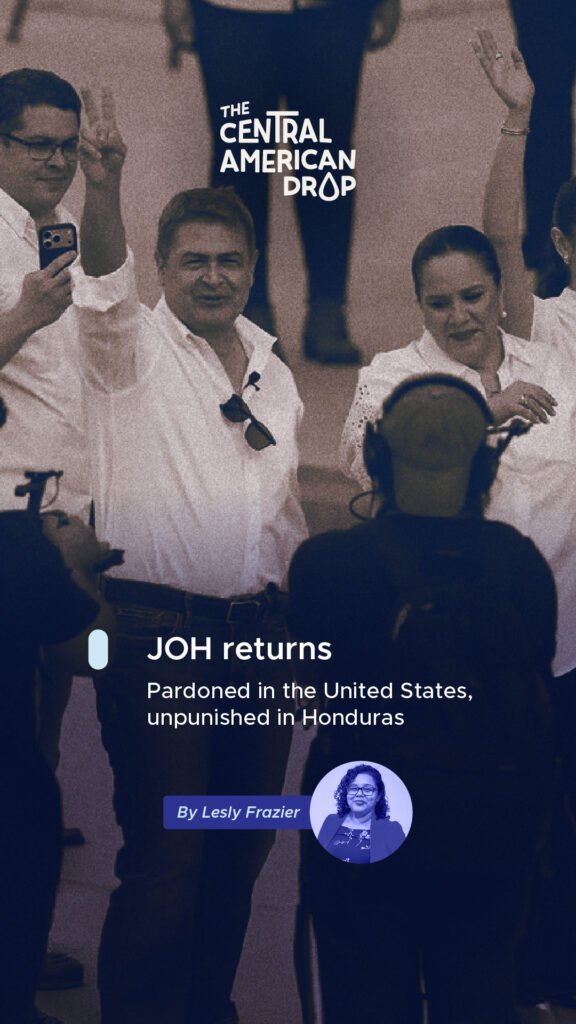
The return of former president Juan Orlando Hernández, convicted in the United States for drug trafficking-related crimes and granted a presidential pardon by Donald Trump, reignites the political debate and questions about the state of Honduran justice and the fate of the corruption cases that marked his administration as president of the Central American country.
Juan Orlando Hernández Alvarado regained his freedom after being held in the United States, where he was found guilty in a trial that began on February 20 and concluded on March 8, 2024 with a verdict issued by a jury of the Southern District Court of New York.
Subsequently, on June 26, 2024, Judge Kevin Castel sentenced him to 45 years in prison for three crimes related to drug trafficking and firearms. However, on December 1, 2025, he was released after receiving a presidential pardon granted by then-President Donald Trump.
During the trial in New York, the prosecution presented a dozen witnesses, including confessed drug traffickers, former officials, and security agents, who testified that Hernández received millions of dollars in bribes from criminal organizations, provided protection to cocaine trafficking, and used state institutions to favor the cartels. The defense rejected the accusations and maintained that the former president was the victim of political persecution.
In handing down the sentence, Judge Kevin Castel stated that Hernández contributed to turning Honduras into a “narco-state” and that he used his power to obstruct anti-drug trafficking efforts. The case of Juan Orlando Hernández is unprecedented in Honduran history. His brother, Juan Antonio “Tony” Hernández, was sentenced on similar charges in 2021.
Despite being considered one of the most influential drug traffickers in the Central American region, he is free and returned to Honduras this Sunday, July 26, where hundreds of supporters of the National Party mobilized from different parts of the country towards Comayagua to receive him with slogans and applause in a political event alongside nationalist leaders.
During the welcome ceremony, Hernández insisted on his innocence and attributed his release to the will of God. Accompanied by leaders of the National Party, including former congresswoman Gladys Aurora López and Minister of Human Rights Leda Lizeth García Pagán, he stated that his return represents «a miracle» and called for strengthening the political institution.

At the close of his speech, he asserted that «the National Party is a jewel that must be protected,» affirming that it is a «strong and robust» party and maintaining that he is returning to strengthen it.
The presidential pardon granted by Donald Trump allowed the early release of the former president, but it did not overturn the guilty verdict or the sentence issued by the US justice system, so legally Hernández continues to be a person convicted of those crimes.
The former president’s return also revives questions about the corruption investigations launched during the years the Mission to Support the Fight against Corruption and Impunity in Honduras (MACCIH) was in operation, many of which stalled after legal reforms, court rulings and the closure of the international mission in 2020.
Currently in Honduras, Hernández faces only the so-called Pandora II case, in which the Public Prosecutor’s Office accuses him of the alleged embezzlement of 282 million lempiras intended for support programs for rural women and rural development.
The Pandora case was one of the MACCIH’s landmark investigations. According to the investigation, public funds from the Ministry of Agriculture and Livestock (SAG) were diverted through a network of public officials and non-governmental organizations to finance political activities, primarily those of the National Party.
Over time, several of the processes stemming from these investigations ended with dismissals, changes in precautionary measures, or remain without a final resolution.
“The evidence existed,” explains former MACCIH prosecutor Alex Navas, who rejects claims that the cases lacked evidentiary support. He explained that the investigations had sufficient documentary, expert, and testimonial evidence. In his view, the main obstacle to advancing the cases was political interference and institutional decisions that limited the administration of justice.
During its operation, the MACCIH presented twelve emblematic cases of corruption, including the Network of Deputies, Pandora’s Box, Open Ark, the Lady’s Petty Cash, Patuca III, Hospitals and Public Procurement, Fraud over the Gualcarque and the so-called Pact of Impunity, several of them with accusations against officials and structures linked to the political environment of Hernández.
For various sectors, the departure of the MACCIH represented a setback in the fight against corruption. Although the Specialized Prosecutor’s Unit Against Corruption Networks (UFERCO) was subsequently strengthened, numerous investigations continue to face lengthy processes within the judicial system.
Lawyer Alex Navas argues that Honduras faces a structural crisis in the administration of justice and believes that political influence over the institutions responsible for investigating and punishing crimes remains one of the main obstacles to combating corruption.
Similarly, human rights expert Joaquín Mejía asserts that Hernández’s return reflects profound institutional weaknesses and demonstrates an unequal application of justice. According to the academic, while Indigenous and Garifuna communities face criminalization, a person convicted of drug trafficking receives political support and institutional protection.
Beyond the return of the former president, various sectors believe that the case once again highlights the difficulties the Honduran state faces in investigating and punishing acts of corruption linked to high-ranking officials.
While the sentence handed down by the US justice system set an international precedent, in Honduras questions persist about the future of corruption cases that remain without a definitive resolution and about the capacity of the judicial system to act independently in the face of political and economic power structures.

| Cookie | Duración | Descripción |
|---|---|---|
| cookielawinfo-checkbox-analytics | 11 months | This cookie is set by GDPR Cookie Consent plugin. The cookie is used to store the user consent for the cookies in the category "Analytics". |
| cookielawinfo-checkbox-functional | 11 months | The cookie is set by GDPR cookie consent to record the user consent for the cookies in the category "Functional". |
| cookielawinfo-checkbox-necessary | 11 months | This cookie is set by GDPR Cookie Consent plugin. The cookies is used to store the user consent for the cookies in the category "Necessary". |
| cookielawinfo-checkbox-others | 11 months | This cookie is set by GDPR Cookie Consent plugin. The cookie is used to store the user consent for the cookies in the category "Other. |
| cookielawinfo-checkbox-performance | 11 months | This cookie is set by GDPR Cookie Consent plugin. The cookie is used to store the user consent for the cookies in the category "Performance". |
| viewed_cookie_policy | 11 months | The cookie is set by the GDPR Cookie Consent plugin and is used to store whether or not user has consented to the use of cookies. It does not store any personal data. |