

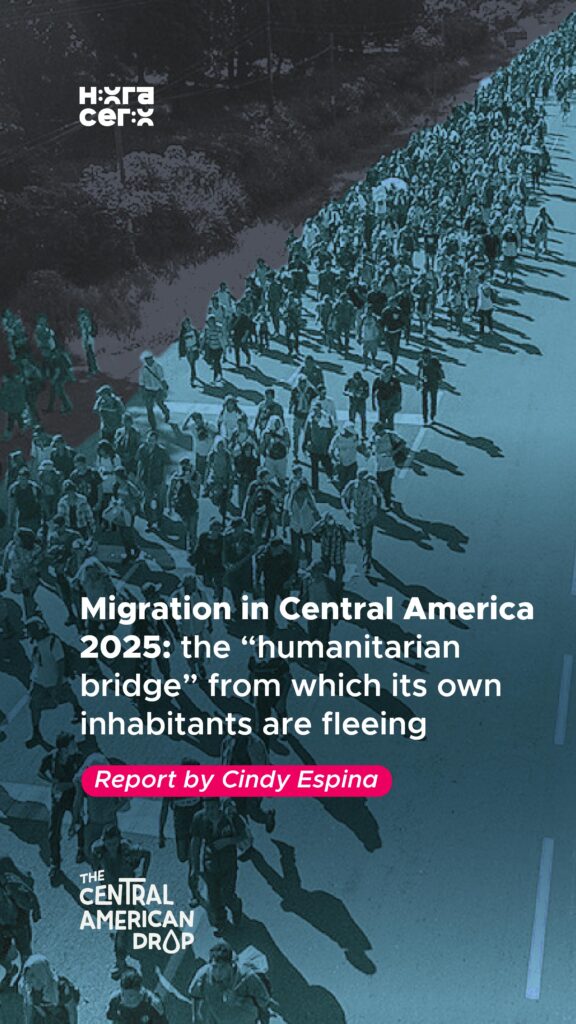
The increase in migration from southern Latin America, the Caribbean, and other continents such as Asia and Africa has turned Central America into a migration corridor and, consequently, it has gradually become another external border of the United States: a vertical border that it controls and contains with cooperation policies that criminalize migration, and 2025 was the consolidation of this regime of externalizing borders which they called a “humanitarian bridge.” A bridge that its own inhabitants want to flee.
On January 20, 2025, with the arrival of Donald Trump to the presidency of the United States, migration policies in Central America changed, and we witnessed a new bilateral cooperation regime with EE.UU.: immigrants became the currency used for negotiation. This led to the development of strategies called “Humanitarian Bridge” and “Operation Ring of Fire”.
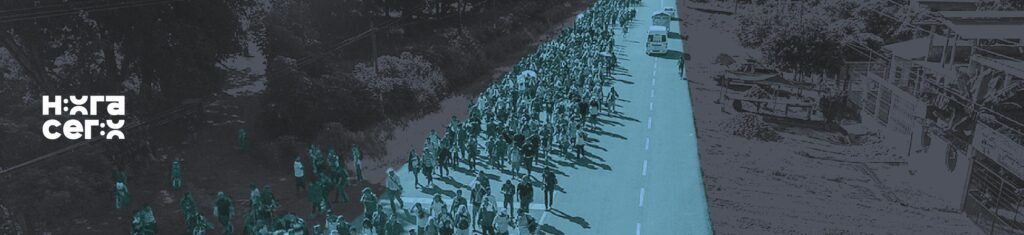
Throughout 2025, Hora Cero documented and explained the impact of these dynamics of cooperation and policies of deportation and securitization of migration implemented in the territory of Central America. We also reported the resistance of immigrant people and their sons and daughters to defend the rights of their community in the United States, from the protests in California against ICE raids, until the unstoppable and constant struggle of the Honduran people to maintain their TPS status.
Amid threats of intervention and increased tariffs, Panama, Costa Rica, Nicaragua, and Honduras were the United States’ enforcement arm for deporting people from Venezuela, Colombia, Haiti, the Dominican Republic, China, India, Iran, Nepal, Pakistan, Sri Lanka, Türkiye, Uzbekistan, and Vietnam. These events were documented through photographs of deported people held in hotels in Panama or in shelters donated to receive refugees, used by Costa Rica to implement the United States’ Safe Third Country policy.
For its part, El Salvador used the arm of the law that criminalizes deportation to imprison and criminalize Venezuelan and Salvadoran migrants, mostly men, without any criminal record or trial. This was a joint action between the authoritarian government of Nayib Bukele and Trump. This resulted in the enforced disappearance of 252 people over four months in the prison called the Terrorism Confinement Center (Cecot).
For its part, Guatemala deployed military forces along all the border areas it shares with El Salvador, Honduras (to the east), and Mexico (to the west). It was also the country that cooperated most with the United States in the attempt to deportation of hundreds of Guatemalan children and adolescents, a plan that was stopped by the US judicial system.
Undoubtedly, Central America’s cooperation with the deportation policy and the hardening of Trump’s anti-immigrant policies reshaped migration patterns: there was a decreaseThere was a change in the number of people in transit, and the destinations were also modified. Currently, people of Central American origin continue to be the majority of people with irregularities during their immigration in Mexico.
According to data from the Migration Policy Unit, by October 2025, it registered 11,847 Hondurans who entered Mexico irregularly. People of this nationality are the second largest group, after Venezuelans. The list continues with Guatemalans in fourth place (9,894) and Salvadorans in fifth.
Meanwhile, while Costa Rica adopted the United States’ safe third country policy has led to dozens of refugees seeking refuge in Nicaragua, with resettled in Spain, since the the Central American country cannot guarantee their safety in the face of the transnational violence of the dictatorial regime of Daniel Ortega and Rosario Murillo.
The policies and strategies adopted, as well as data on the constant exodus of Central Americans, have made the region a territory that navigates in contradiction, where governments and dictatorships support the main oppressor that sustains the economy of the countries they govern and repress.
2025 was one of the more complex years in terms of migration, because it was a major setback in the gains made in favor of migrants crossing the migration corridors of this region. In this section, we collect stories, data, and critical analysis about this period, crucial for those of us who closely follow what is happening at our borders, in our territories, and in transnational communities. Hora Cero will remain here: recounting, writing, and accompanying the struggles that mark this moving territory that traverses the bodies of Central American people.

| Cookie | Duración | Descripción |
|---|---|---|
| cookielawinfo-checkbox-analytics | 11 months | This cookie is set by GDPR Cookie Consent plugin. The cookie is used to store the user consent for the cookies in the category "Analytics". |
| cookielawinfo-checkbox-functional | 11 months | The cookie is set by GDPR cookie consent to record the user consent for the cookies in the category "Functional". |
| cookielawinfo-checkbox-necessary | 11 months | This cookie is set by GDPR Cookie Consent plugin. The cookies is used to store the user consent for the cookies in the category "Necessary". |
| cookielawinfo-checkbox-others | 11 months | This cookie is set by GDPR Cookie Consent plugin. The cookie is used to store the user consent for the cookies in the category "Other. |
| cookielawinfo-checkbox-performance | 11 months | This cookie is set by GDPR Cookie Consent plugin. The cookie is used to store the user consent for the cookies in the category "Performance". |
| viewed_cookie_policy | 11 months | The cookie is set by the GDPR Cookie Consent plugin and is used to store whether or not user has consented to the use of cookies. It does not store any personal data. |