

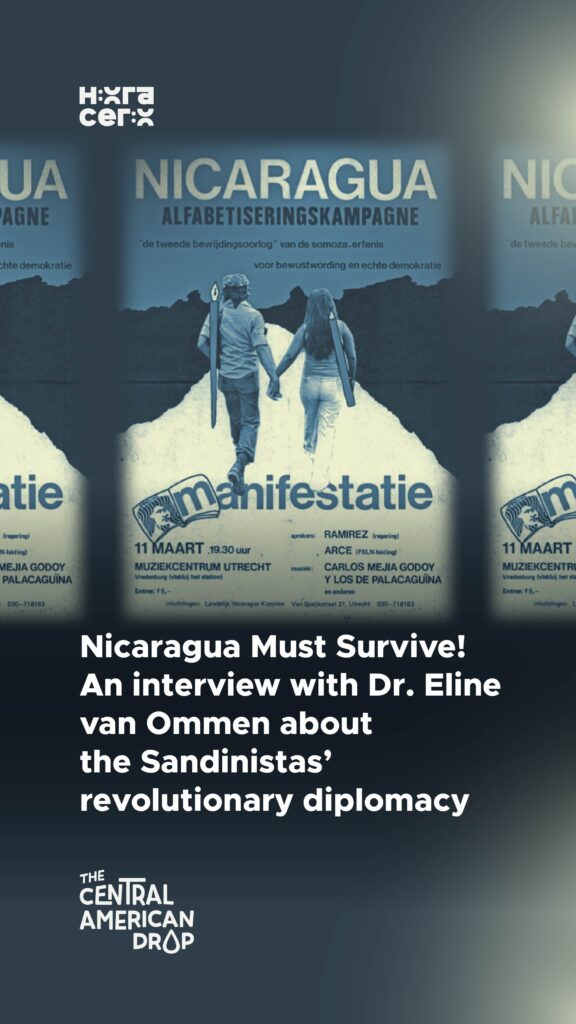
Eline is a historian of twentieth-century Latin America whose work focuses on revolutions, transnational and grassroots activism, and Cold War foreign policy. Her research examines the international dimensions of Nicaragua’s revolutionary decade, European solidarity movements, and the broader web of relations between Central America and Europe. Currently, she is an Associate Professor in International History at the University of Leeds.
HC: What drew you to study Nicaragua’s diplomatic relations during the Cold War? What was your main interest or personal motivation with this topic?
Eline: I have always been drawn to stories of people fighting and mobilizing for social change, particularly those who advise others to take up arms against their own government, or those who do so themselves and leave everything behind. That interest led me to write my MA thesis on Dutch solidarity activism and the Nicaraguan Revolution, and it was during that research that I realized I was only seeing part of a much larger picture. While reading documents in the Dutch archives, I noticed that the Sandinistas were the driving force behind most of the activities of these solidarity groups.
Once I understood that the Nicaraguans, or the Sandinista revolutionaries more specifically, were key to explaining the massive outpouring of transnational solidarity with the revolution, I wanted to find out how exactly they had managed to build such an ambitious and creative international foreign policy. It struck me that, despite Nicaragua’s small size, they were remarkably effective at harnessing the international environment to the revolution’s advantage. What was happening in the Netherlands in the 1970s and 80s was, I came to realize, part of a much bigger story — not so much a history of the Netherlands, but a history of the internationalization of the revolution.
HC: What was so innovative about the Sandinistas’ foreign policy before and after the revolution?
Eline: When we look at the beginnings of it, we have to remember that the Sandinistas weren’t in charge of the state yet. They were just a small, quite unsuccessful group of young guerrillas and revolutionaries in exile, and they had been trying to topple Somozas’ regime for decades without much luck. They had no real contacts with traditional diplomats, like between ambassadors or between foreign ministers. So, what they had to do was kind of try and get to these higher levels of the state through the grassroots, a kind of bottom-up approach.
What was creative, I think, is that they used culture, they used artists, they used literacy, they used people like Ernesto Cardenal, and poetry. They used the kind of cultural appeal that they had; they used that as a way to get to these higher-level diplomats.
What was creative, I think, is that they used culture, such as artists, literacy, poetry, and people like Ernesto Cardenal. They leaned into their cultural appeal as a way of getting to higher-level diplomats and politicians. And then these grassroots organizers could write to their MPs, who could then table questions about what was happening in Nicaragua, which meant foreign ministers had to respond, which meant diplomats suddenly had to think about Nicaragua when they simply hadn’t before. They really managed to put Nicaragua on the political agenda from the bottom up, through culture, through solidarity, through young people connecting with each other… And I think that that is incredibly creative.
And then after the revolution, I think for a couple of years – or months even – they kind of thought, “okay, now we have access to the state, we don’t really need that creative and grassroots diplomacy anymore. We can now just meet directly with state leaders and foreign ministers”. But then, when Ronald Reagan came to power in the United States and launched a political, economic and military campaign against the revolution, they realized, well, that that was just not going to be enough. They still needed that cultural appeal.
HC: How did the context of the Cold War impact the Sandinistas’ diplomatic strategies?
Eline: It was a paradox, really, as the Cold War both hindered them and benefited them at the same time. Without it, they wouldn’t have had the international attention they needed, but it also forced them into a political battle they didn’t want to be part of. From the moment they launched their revolutionary diplomatic campaign, so they tried to go beyond the Cold War framework entirely, saying that what was happening in Nicaragua had essentially nothing to do with the Cold War, that they were simply fighting for the improvement of their own country, for social justice. Anti-imperialist, yes, but not necessarily anti-American. They just wanted to be independent.
Their popularity was largely tied to this whole idea of staying out of the Cold War narrative, but the very thing they were publicly trying to distance themselves from was also what made people pay attention in the first place.
HC: What would motivate Europeans to support the Sandinista struggle?
Eline: I think for a lot of people, the Nicaraguan Revolution offered hope that a kind of radical revolutionary change was still possible. If we think about the specific context in Western Europe at the time, with Thatcher in the UK and conservatives and Christian Democrats in power across the continent, political space for the left was closing. Chile was over. Nicaragua felt like a way out.
In a way, it became an escape. Some people saw themselves as refugees from Thatcher’s Britain, and Nicaragua offered hope for something different. It appealed to people for different reasons, too. For some, it was the promise of a social democratic alternative, for others something more radical, and for others still it was the Christian dimension of the revolution, this idea of liberation theology, that drew them in.
What the Sandinistas were very good at was making people believe that a different future was still possible, even if it wasn’t happening in Europe, and making people feel that they could be part of it, making them feel they could be part of the revolution, too.
HC: What were some material outcomes of these diplomatic efforts?
Eline: I would say that solidarity activism put Nicaragua on the political agenda, and that in turn pushed politicians to successfully advocate for more aid. Western European governments came to feel they could contribute influence the revolution’s trajectory by giving aid, and they did. They contributed to the literacy campaign, and Nicaragua received significantly more money from Western Europe than other Central American countries.
Though to what extent that was the result of the Europeans trying to keep Nicaragua out of the Soviet camp, and to what extent it was the result of solidarity activism, is hard to say. Pragmatic decision-making at the state level obviously played a big role.
But there were also direct campaigns, like Nicaragua Must Survive, that were specifically designed to fundraise for Nicaragua, and they did bring in quite a lot of money. Nicaragua’s economy virtually collapsed in the late 80s, so it wasn’t enough in the end, but it probably did make a difference to the longevity of the revolution.
HC: In your opinion, do you think that the legacy of what Nicaragua meant in the 80s still shapes how Nicaragua is perceived today?
Eline: Yes, in Europe at least, a lot of former activists still hold on to the revolution as this beautiful thing they were once part of, but people are not particularly attuned to what’s going on in the country now. When people think about Nicaragua, they often think about the 80s. As I say in the book, Nicaragua has become a kind of nostalgia, a memory, rather than a real place.
That’s obviously very difficult for Nicaraguans today, who are essentially saying: this might be a fond childhood memory for you, but we are still living here, this is still a real country with real problems that we would like to address.
I think the people in Europe who are still interested in Nicaragua do know that what is happening there now is terrible, but some find it still a bit hard to speak out openly against the Ortega regime. Because to do that, they also have to say goodbye to their own memories, to the time when they were young and full of hope. And that can be a hard thing to ask of someone.
HC: What lessons, what lessons, from the Sandinista solidarity strategy should contemporary solidarity take?
Eline: I think what made the solidarity campaigns so successful was the importance of personal, human connections. The brigadistas going to Nicaragua and meeting people, Nicaraguans travelling abroad and having one-to-one conversations — building things up from the grassroots level like that made it last longer.
Today with social media you can have a huge impact very quickly, but it also dies out quickly, and I think that’s because those personal connections aren’t there in the same way. It shows the value of that slow, hard grassroots work that can eventually really pay off. Contemporary solidarity movements tend to move faster, but perhaps at the cost of the depth that makes solidarity stick.
HC: What surprised you the most during your research?
Eline: The whole thing has been such a journey.. I think personally, I have become a lot more interested now in stories related to a kind of peace-building rather than radical revolutionary change. So, I think learning about Nicaragua made me realize that there’s so much more beyond the moment of revolutionary triumph.
That moment when everyone is celebrating, yes, that’s already incredible, that people made that happen. But the hard work comes after. And I think the Nicaragua story made me realize that that is probably the most important work, and also the work that historians tend to overlook, because we are drawn to the big stories of revolution and triumph rather than the slow, grassroots work of building peace and a better future.
| Cookie | Duración | Descripción |
|---|---|---|
| cookielawinfo-checkbox-analytics | 11 months | This cookie is set by GDPR Cookie Consent plugin. The cookie is used to store the user consent for the cookies in the category "Analytics". |
| cookielawinfo-checkbox-functional | 11 months | The cookie is set by GDPR cookie consent to record the user consent for the cookies in the category "Functional". |
| cookielawinfo-checkbox-necessary | 11 months | This cookie is set by GDPR Cookie Consent plugin. The cookies is used to store the user consent for the cookies in the category "Necessary". |
| cookielawinfo-checkbox-others | 11 months | This cookie is set by GDPR Cookie Consent plugin. The cookie is used to store the user consent for the cookies in the category "Other. |
| cookielawinfo-checkbox-performance | 11 months | This cookie is set by GDPR Cookie Consent plugin. The cookie is used to store the user consent for the cookies in the category "Performance". |
| viewed_cookie_policy | 11 months | The cookie is set by the GDPR Cookie Consent plugin and is used to store whether or not user has consented to the use of cookies. It does not store any personal data. |