

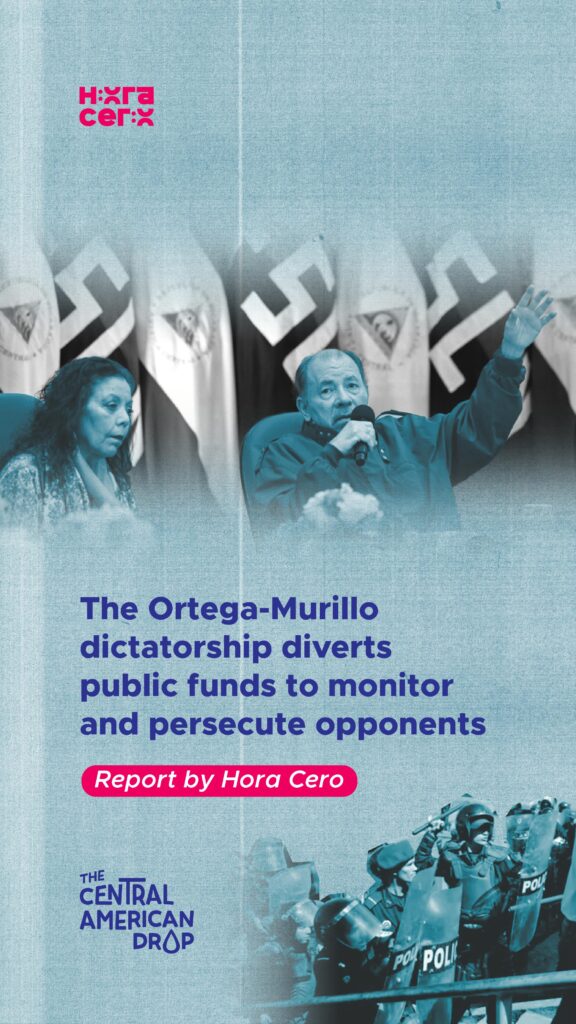
The Group of Human Rights Experts on Nicaragua (GHREN) warned, in a report submitted to the UN Human Rights Council, that the Nicaraguan government “is financing the repression of its opponents by diverting public funds.”
According to GHREN, in June 2018, Nicaraguan authorities launched “Operation Clean-Up,” which required funding from “pro-government armed groups” and whose logistical cost amounted to $5 million. Its objective was to dismantle and suppress citizen protests.
In May 2018, Fidel Moreno, one of the most trusted men of the Ortega-Murillo regime, asked several public institutions and municipalities to divert part of their budgets to finance repressive actions, including budget money and funds allocated to social programs.
Once diverted, the funds were used to finance food, transportation, and other expenses for pro-government armed groups. GHREN identified that, concerning food, the main supplier, financed with diverted funds, was a company owned by co-president Rosario Murillo.
On the other hand, in addition to these covert financial transactions, the Sandinista National Liberation Front (FSLN) has financed itself through mandatory contributions from public officials, including judicial personnel. Public employees who did not comply with this requirement suffered reprisals.
Since 2018, the Government of Nicaragua has developed a systematic apparatus of repression against opposition members through arbitrary arrests, enforced disappearances, torture, political persecution, and arbitrary deprivation of nationality.
The repression is of such magnitude that it has extended beyond protesters and political opponents: it includes journalists, human rights defenders, students, academics, religious leaders, businesspeople, farmers, indigenous people, Afro-descendants, and relatives of people critical of the government.
The Ortega-Murillo dictatorship has developed practices to persecute exiled Nicaraguans through threats, surveillance, defamation campaigns, immigration restrictions, confiscation of property, deprivation of liberty, and the abuse of mechanisms such as INTERPOL.
Finally, the report highlights that the judicial system and other state institutions have been instrumentalized to facilitate this repression and guarantee impunity in parallel through legal reforms, mass dismissals of judges and judicial personnel, and the blocking of resources for victims to access justice.
In the words of Jan-Michael Simon, president of GHREN, “political persecution is financed by the State, carried out through its institutions and extends beyond borders to ensure that no one – absolutely no one – stands in the way of the regime.”
The Group of Experts on Human Rights in Nicaragua is an independent body mandated by the UN Human Rights Council. It was created in 2022 to investigate, comprehensively and independently, human rights violations committed in Nicaragua since 2018.

| Cookie | Duración | Descripción |
|---|---|---|
| cookielawinfo-checkbox-analytics | 11 months | This cookie is set by GDPR Cookie Consent plugin. The cookie is used to store the user consent for the cookies in the category "Analytics". |
| cookielawinfo-checkbox-functional | 11 months | The cookie is set by GDPR cookie consent to record the user consent for the cookies in the category "Functional". |
| cookielawinfo-checkbox-necessary | 11 months | This cookie is set by GDPR Cookie Consent plugin. The cookies is used to store the user consent for the cookies in the category "Necessary". |
| cookielawinfo-checkbox-others | 11 months | This cookie is set by GDPR Cookie Consent plugin. The cookie is used to store the user consent for the cookies in the category "Other. |
| cookielawinfo-checkbox-performance | 11 months | This cookie is set by GDPR Cookie Consent plugin. The cookie is used to store the user consent for the cookies in the category "Performance". |
| viewed_cookie_policy | 11 months | The cookie is set by the GDPR Cookie Consent plugin and is used to store whether or not user has consented to the use of cookies. It does not store any personal data. |