

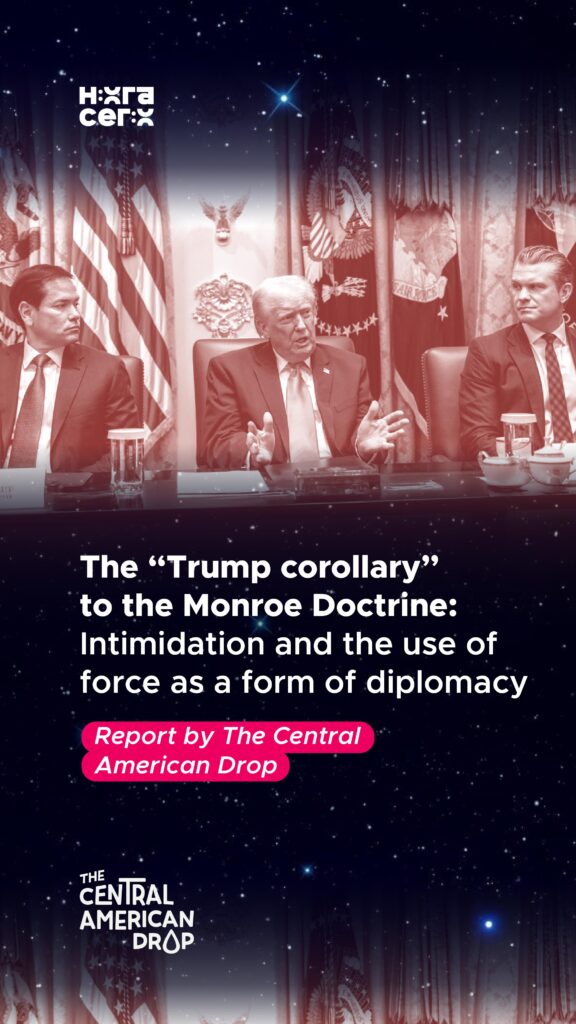
In November 2025, the White House published the new United States National Security Strategy. This document details the direction that American policy will take; this redesign represents a re-evaluation of the country’s foreign policy approach after the Cold War.
The document details the plans for each hemisphere. For the Americas, the report points to “the Trump corollary to the Monroe Doctrine,” which entails the restoration of American power and domination over its areas of interest.
The Monroe Doctrine was a declaration made by President James Monroe in 1823. The speech became one of the cornerstones of American foreign policy. The doctrine states that the United States should avoid interference by other nations in the Americas in the context of recent independence.
Trump’s policy update aims to curb China’s influence in the region, which he considers a direct threat to US security and interests. This adjustment seeks to strengthen ties with global partners and establish a hostile and coercive diplomacy with those he deems adversaries.
The new United States National Security Strategy poses a serious threat to the countries of the region. Throughout 2025, President Trump has promoted intimidating measures against presidents and governments.
Mass deportations have placed pressure on receiving countries and have even generated humanitarian crises, as happened with Costa Rica and Panama, where hundreds of migrants from Asia and the Middle East were expelled despite being asylum seekers.
Trump also declared his desire to regain control of the Panama Canal due to the country’s proximity to China. Faced with these threats, the Mulino government had to accept the reopening of disused US military bases.
The capture of Nicolás Maduro and his wife Cilia Flores is the prime example of Trump’s doctrine. The country’s instability, the migration of more than 8 million Venezuelans to the United States, Chavismo’s ties to organized crime, and the country’s oil reserves have been key factors in understanding this decision.
After the invasion of Ukraine and the genocide in Gaza, international law appears to be a rule that even the most powerful nations can circumvent. The implementation of the “Trump Corollary” highlights the vulnerability of countries in the region and the lack of mechanisms to sanction those who violate international law.
| Cookie | Duración | Descripción |
|---|---|---|
| cookielawinfo-checkbox-analytics | 11 months | This cookie is set by GDPR Cookie Consent plugin. The cookie is used to store the user consent for the cookies in the category "Analytics". |
| cookielawinfo-checkbox-functional | 11 months | The cookie is set by GDPR cookie consent to record the user consent for the cookies in the category "Functional". |
| cookielawinfo-checkbox-necessary | 11 months | This cookie is set by GDPR Cookie Consent plugin. The cookies is used to store the user consent for the cookies in the category "Necessary". |
| cookielawinfo-checkbox-others | 11 months | This cookie is set by GDPR Cookie Consent plugin. The cookie is used to store the user consent for the cookies in the category "Other. |
| cookielawinfo-checkbox-performance | 11 months | This cookie is set by GDPR Cookie Consent plugin. The cookie is used to store the user consent for the cookies in the category "Performance". |
| viewed_cookie_policy | 11 months | The cookie is set by the GDPR Cookie Consent plugin and is used to store whether or not user has consented to the use of cookies. It does not store any personal data. |