

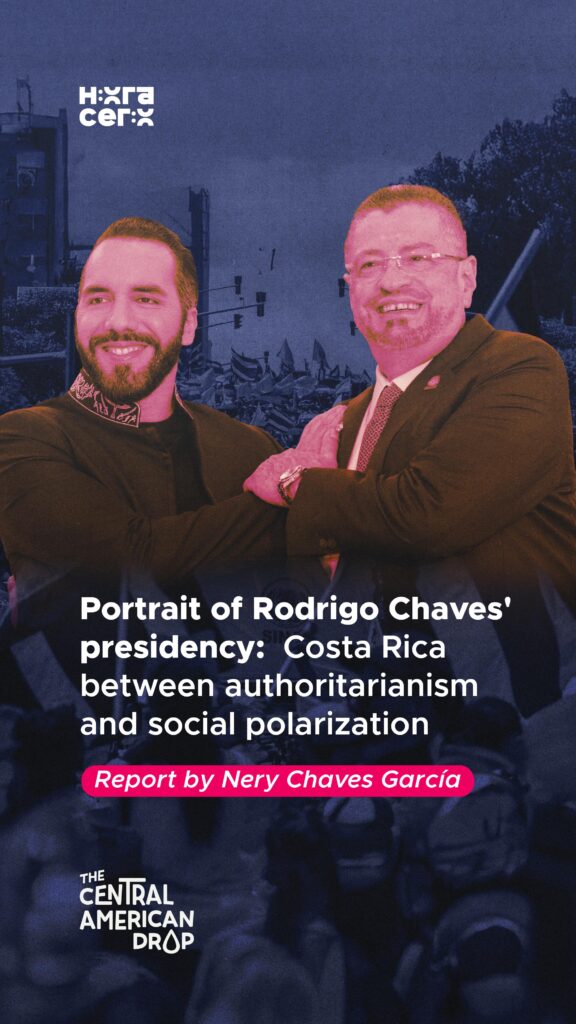
The administration of Rodrigo Chaves Robles has deepened the long-standing crises in the failed so-called “Switzerland of Central America”: dismantling of public services, defunding education at all levels, the deterioration of security, the increase in the cost of living, and, among the most sensitive issues, the strengthening of social polarization as a political culture. This latter sentiment is fueled by the population’s expectation of change—though not necessarily something positive—that doesn’t originate from traditional political parties and is exacerbated by Rodrigo Chaves’ populist rhetoric. In his discourse, Chaves is the key to confronting—and, of course, winning—the existing conflict with the rapacious political and economic elites and the democratic institutions that prevent him from «eating his words»—as his campaign slogan stated.
Thus, Chaves has built a polarized country, in conflict and in strong tension with the institutions, all heading into a deeply tense election just four weeks away. The outlook remains undecided and uncertain. The only point of agreement among various polls (University of Costa Rica and National University) is that the ruling party candidate, Laura Fernández of Pueblo Soberano (PS), leads in voter intention and is surpassed only by undecided voters and those who abstain. Far behind is Álvaro Ramos of Liberación Nacional, a traditional party that has not won an election since 2010. Thus, uncertainty surrounds the election scheduled for February 2nd. The challenge, then, seems to be whether the ruling party will manage to win in the first round-exceeding 40% approval, or if it will go to a second instance in April.
Rodrigo Chaves Robles’ cynical and disrespectful tone was evident from the 2022 election campaign onward. Even then, he displayed deeply patriarchal attitudes, hatred of any dissent, and contempt for the vulnerable majority. As president, he imposed a weekly press conference in which he unfolded his agenda and political actions, characterized by improvisation, ignorance, and a disregard for the most basic norms of public administration. His central theme in these conferences was conflict, which he waged against broad sectors of the population, particular actors from other branches of government, such as the president of the Legislative Assembly, Rodrigo Arias, prostitutes, and journalists. The tensions have sparked countless reactions, alerting them to the attacks on the most basic principles of democracy, as dialogue of any kind is impossible with the current government.
In January 2025, billboards on national highways were placed where a photograph appeared of: Rodrigo Arias (President of the Legislative Assembly), Carlo Díaz (Attorney General), Marta Acosta (Comptroller General), and Orlando Aguirre (President of the Supreme Court of Justice), with a central message in red: “Resign.” The government demarcated the said in the municipality and pointed out that it was a “manifestation of the freedom of expression of the Costa Rican people”. Days later, Boris Marchegiani, Secretary General of the Sovereign People’s Party of the Chavista current office, accepted that he was the one who paid because of the billboards denouncing a series of «outrages» by the Supreme Electoral Tribunal (TSE) that prevented him from reaching the Mayor’s office in Quepos.
With the official declaration of the start of the electoral period, tensions escalated due to Chaves’s «political belligerence,» prompting warnings from the Supreme Electoral Tribunal (TSE). The government labeled the Tribunal’s statements as censorship, even launching a communications campaign. A profile picture was published on all government social media accounts: a blurred image of the president, superimposed with a colored bar and with the central slogan «the gag has fallen». The president himself had declared this at a press conference that the Supreme Electoral Tribunal had gagged him in the middle of the election campaign. This campaign opened an appeal against the government, in addition to a request to lift immunity to the president due to political belligerence.
One of the high points in the tension between the powers was the public message from the president. In the video, the magistrate apresident, President Eugenia María Zamora, accompanied by the rest of the judges, stressed that in 76 years no president of the TSE had had to be referred to the presidency of the Republic for disrespecting the personal integrity of the magistrates and the Supreme Electoral Tribunal. Zamora drew attention to the fact that the Constitution does not empower Chavesto dismiss her and pointed to numerous grievances againstDemocracy and the Supreme Electoral Tribunal. This is a delicate matter, since the Supreme Electoral Tribunal (TSE) is responsible for safeguarding what is most sacred to Costa Rica’s weak and limited democracy: the votes.
Despite facing various conflicts, Chávez has consolidated an alliance with the Social Christian Unity Party (PUSC) and New Republic (NR). This alliance has allowed him to emerge unscathed from both impeachment processes, lifting of immunity against him. The first of these was in July 2025, when the full Court decided by majority vote to endorse the FGR’s accusation against Chaves for the crime of extortion; relatedala contract with the Central American Bank for Economic Integration (CABEI) for a communication strategy. On that first occasion, 34 votes were cast in favor of lifting the immunity of thepresident, but the minimum required is 38. Both the PUSC and NR parties were key in preventing Chaves from being brought to justice—at least for now. Two weeks later, the Supreme Electoral Tribunal (TSE) requested the lifting of his immunity, which received 35 votes in favor last December. Among the most recurring questions was the alleged unconstitutionality of the request because the TSE is not authorized to make such a request. On the other hand, the New Republic maintained that it did not. I wanted to make a martyr of Chávez, and that this could boost popular support for Laura Fernández, the official candidate.
Manifestations of authoritarianism are spreading among the population; the president is one of the main voices in propagating them. withhate speech. We would have to add theattacks on the pressand in general, all actions that impede accountability or transparency in its policies. Finally, the police repression by the Chávez government is no small matter, being one of the most recent examples againstpeasants who were demonstrating at CasaPresidentiallast November. In that crackdown, one person was arrested. On the 9th September 2023, ironically, during a demonstration against police violence, four people were arrested who are currently facing legal proceedings for crimes fabricated by the Public Force. On the morning of January 13th, they published a call for financial support to face the trial against him.

Tension with the student sector has been a constant throughout Chaves’ administration. The role of themMinister of Education, Anna Katharina Müller, on the defunding of public education in general. The project of “L», the path of education, was the basis inpolicypublic of the ministerMüller but it never came to light. It is not possible to identify any achievement of this administration regarding education. al On the contrary, the setbacks are historic. A clear example is showninThe elimination of the mandatory sex and relationship education programs offered by the Ministry of Public Education (MEP). The government indicated that the programs would not be eliminated, but modified to “remove erotic and perverse material”.
However, according to a technical criterion of the MEP itself, the programs would have been eliminated. Instead, “education programs for peace and coexistence” were imposed, with topics such as “sexual health, consent, diversity and gender identity”. Less than a year after this change, pregnancies and the transmission of sexually transmitted infections (STIs)increased in the adolescent population of the Central Pacific, according to an alert from the Costa Rican Social Security Fund. Another significant setback involves the elimination of the protocol for addressing bullying in schools for the LGBTQ+ community. Political conservatism was evident in thenew religious education programwhich was supported by the Episcopal Conference, the Evangelical Alliance Federation, and other religious bodies.
A few months later, the «State of Education» report, the State of the Nation program, and the investigative body of the National Council of Rectors (CONARE) published a report that concluded that the crisis in the education system is profound. One of its manifestations is “the biggest drop in investment in forty years. Furthermore, the report notes that the youngest students have experienced a decline in their mathematical reasoning and reading comprehension skills. The same report concludes that this decline is due to «a series of poor public policy decisions» lacking technical expertise.
Another worrying and central issue in the elections is the issue of homicides. In 2025, a slight improvement was observed; 873 homicides were recorded with a rate of 16.7 per 100,000 inhabitants. The upward trend in homicides has been recorded since 2023, which was also the most important peak, reaching 907 homicides. In 2024, the homicides reached 880. The improvement in 2025 is slight compared to a situation that is far from being diminished. Parallel to this situation, the legal accusation against Celso Gamboa demonstrated the presence of drug trafficking at high levels of the State. Celso worked at the Attorney General’s Office, was Minister of Public Security (MSP) – during the government of Laura Chinchilla of the National Liberation Party, characterized by its high repression and social conflict -, directed the Directorate of Intelligence and National Security (DIS), and was a full magistrate of the Criminal Cassation Chamber, and served as a defense attorney in various drug trafficking cases. According to the Drug Enforcement Administration (DEA), Celso Gamboa was fundamental in cocaine shipments from Colombia to the United States (EE.UU.)This accusation will make Gamboa the first Costa Rican to be extradited to the U.S. to face legal charges for drug trafficking. The transfer will have to wait until Gamboa completes a series of legal proceedings, also as a defendant, for forgery, use of a false document, and influence peddling.
Costa Rica’s reconfiguration in the drug trafficking route and geopolitics has been denounced for several years, even by the New York Times, which published a report demonstrating the presence of drug cartels on the coasts and in the Talamanca mountain range—a region the Spanish crown never managed to conquer. The report also highlighted a series of missteps by the Chaves Robles administration, which had achieved a reduction in the confiscation of drugs, while on other borders, drugs were identified in Costa Rican exports, like in pineapple boxes.
This context has been fertile ground for the strengthening of Rodrigo Chaves’ hardline rhetoric and, consequently, his closeness to Nayib Bukele, the unconstitutional president from El Salvador. This approach became evident in 2023, when both leaders toured Costa Rica amidst a national emergency. On that occasion, Chávez authorized the entry of Salvadoran Armed Forces to safeguard the Costa Rican population during the climate emergency caused by heavy rainfall. This situation generated multiple criticisms against the president, as well as the assertion that this power is unique and exclusive to the Legislative Assembly. At the end of 2025, Chaves reported that he was heading to El Salvador to “I’m going to visit the famous prison”. In Salvadoran territory, he signed the «Shield of the Americas Alliance» with Bukele to «receive his experience in the war against gangs» and «imitate» the judicial reforms because, currently, said power is «harmful»-in Chaves’ words.
The Chaves-Bukele alliance is one of the many signs that Costa Rica is aligning itself with the international far right. Even during their first meeting in Costa Rica, the two leaders declared they would build a league of nations to get closer to Trump. Currently, in the midst of the election contest, Bukele posted on his social media the need for continuity in the Costa Rican government and arrived in the country to lay the first stone of the High-Security Center for Organized Crime (CACCO) – the Bukele-era mega-prison in Costa Rica. Thus, the Costa Rican electoral path remains polarized and leans toward the extreme right, as Laura Fernández is the only candidate who leads in voting intention and is surpassed only by abstention and indecision.

| Cookie | Duración | Descripción |
|---|---|---|
| cookielawinfo-checkbox-analytics | 11 months | This cookie is set by GDPR Cookie Consent plugin. The cookie is used to store the user consent for the cookies in the category "Analytics". |
| cookielawinfo-checkbox-functional | 11 months | The cookie is set by GDPR cookie consent to record the user consent for the cookies in the category "Functional". |
| cookielawinfo-checkbox-necessary | 11 months | This cookie is set by GDPR Cookie Consent plugin. The cookies is used to store the user consent for the cookies in the category "Necessary". |
| cookielawinfo-checkbox-others | 11 months | This cookie is set by GDPR Cookie Consent plugin. The cookie is used to store the user consent for the cookies in the category "Other. |
| cookielawinfo-checkbox-performance | 11 months | This cookie is set by GDPR Cookie Consent plugin. The cookie is used to store the user consent for the cookies in the category "Performance". |
| viewed_cookie_policy | 11 months | The cookie is set by the GDPR Cookie Consent plugin and is used to store whether or not user has consented to the use of cookies. It does not store any personal data. |