

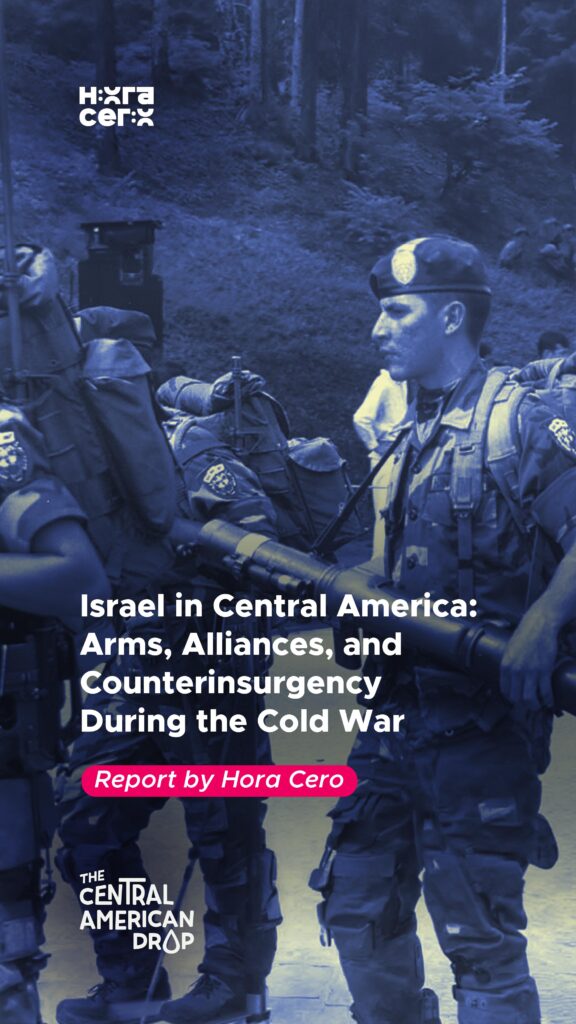
During the Cold War, Central America became one of the main arenas where internal wars, global ideological disputes, and experiments in counterinsurgency converged. In this context, Israel played a decisive (though often obscured) role as a supplier of weapons, military training, and strategic advising to several governments in the region. Its presence emerged from a combination of U.S. arms restrictions, escalating internal conflicts, and the international isolation of regimes accused of systematic human rights violations.
In the first place, as the U.S. Congress began to limit or suspend direct military aid to Central American governments, particularly in the late 1970s, Israel emerged as a reliable partner to fill the gap. For dictatorships and governments facing internal war, Israel offered relatively inexpensive, so-called “combat-tested” weaponry accompanied by technical assistance and doctrinal guidance. At the same time, maintaining ties with Israel functioned as an indirect means of preserving favor in Washington, even when official U.S. aid was politically constrained. The internal benefit was two-fold: combat against «communism» as a way to preserve power and solidify diplomatic relationships with the United States.
Nicaragua
The case of Nicaragua under the dictatorship of Anastasio Somoza illustrates this relationship. Beginning in the 1950s, Israel supplied the Somoza regime with tanks, aircraft, rifles, and ammunition. By the 1970s, the vast majority of Nicaragua’s military hardware originated in Israel, even after the United States formally withdrew its support for the National Guard. In return, Somoza’s government provided diplomatic backing to Israel in international forums such as the United Nations, consolidating an alliance rooted in both military and political interests.
Following the triumph of the Sandinista Revolution in 1979, the relationship took a different but equally strategic turn. During the Reagan administration, the Sandinista government was accused of antisemitism—claims investigated by the U.S. embassy, non-governmental organizations, and Jewish groups, none of which found substantive evidence. Nevertheless, these accusations served a crucial political function, reinforcing the narrative used to justify funding and support for the counterrevolutionary war against Nicaragua.
Within this framework, Israel became secretly involved in supplying arms to the Contras. Some of these weapons came from stockpiles captured from the Palestine Liberation Organization and were transferred, using CIA funds, through third countries. Reports also indicate that Israeli advisers were involved in training Contra forces. This collaboration underscored not only the coordination between Israel and the United States but also the export of warfare and territorial control strategies developed in the Middle East to Central America.
Honduras an El Salvador
Honduras and El Salvador were additional key sites of this militarization. In Honduras, Israel sold supersonic fighter jets, missiles, rifles, and training programs throughout the 1970s and 1980s, helping transform the country into a regional platform for counterinsurgency operations. In El Salvador, a substantial portion of arms imports between 1975 and 1979 originated in Israel. Israeli advisers contributed to shaping doctrines of surveillance, intelligence, and repression during the civil war, and the use of Israeli-supplied napalm by Salvadoran forces has been documented.
Costa Rica
Costa Rica, though officially without an army, was not exempt. During the 1980s, its police and security forces received Israeli weaponry, intelligence training, and counterterrorism instruction. In addition, U.S.–Israeli “development” projects along the border facilitated logistical operations linked to the Contras, calling into question Costa Rica’s image of neutrality during the regional conflict.
Guatemala
The most extreme case was Guatemala, where the withdrawal of U.S. military assistance opened the door to a deep partnership with Israel. Israeli weapons, surveillance technology, and military advisers were integrated into the Guatemalan state’s counterinsurgency strategy during the most violent years of the internal armed conflict. These policies contributed to campaigns of extermination against Indigenous Maya communities, now recognized as acts of genocide.
Taken together, the Central American experience reveals how Israel served as a strategic proxy for the United States when direct intervention was politically untenable. Arms sales and military training operated as instruments of foreign policy, embedding the region within a transnational counterinsurgency network. Central America was not only a site of local conflict, but also a global laboratory in which forms of warfare, population control, and repression were tested—leaving profound and lasting consequences across the region.
*To learn more, you can consult the book “It’s No Secret: Israel Military Involvement in Central America (1986) by Milton H Jamail, Margo Gutiérrez

| Cookie | Duración | Descripción |
|---|---|---|
| cookielawinfo-checkbox-analytics | 11 months | This cookie is set by GDPR Cookie Consent plugin. The cookie is used to store the user consent for the cookies in the category "Analytics". |
| cookielawinfo-checkbox-functional | 11 months | The cookie is set by GDPR cookie consent to record the user consent for the cookies in the category "Functional". |
| cookielawinfo-checkbox-necessary | 11 months | This cookie is set by GDPR Cookie Consent plugin. The cookies is used to store the user consent for the cookies in the category "Necessary". |
| cookielawinfo-checkbox-others | 11 months | This cookie is set by GDPR Cookie Consent plugin. The cookie is used to store the user consent for the cookies in the category "Other. |
| cookielawinfo-checkbox-performance | 11 months | This cookie is set by GDPR Cookie Consent plugin. The cookie is used to store the user consent for the cookies in the category "Performance". |
| viewed_cookie_policy | 11 months | The cookie is set by the GDPR Cookie Consent plugin and is used to store whether or not user has consented to the use of cookies. It does not store any personal data. |