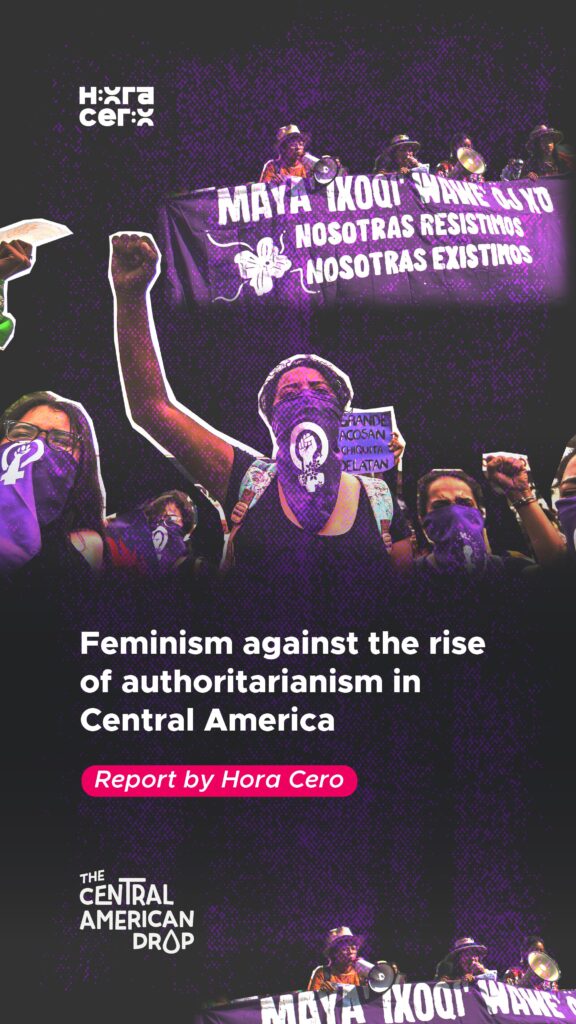
The far right is growing globally, fueled by anti-immigrant rhetoric and attacks on the rights of women and minorities. Donald Trump’s rise has given a new sense of impunity to those who espouse these ideas.
In a historically conservative region, the new wave of the far right reinforces old discourses of contempt for those who demand an end to corruption, the expansion of rights for women, the inclusion of indigenous and Afro-descendant communities in political life, and an end to environmental extractivism.
Nayib Bukele in El Salvador has dedicated himself to stifling and persecuting social organizations that denounce human rights violations committed during his administration. The imprisonment of lawyer Ruth López in May 2025 exemplifies this intimidation strategy.
Since 2018, women in Nicaragua have been banned from marching on March 8th and on any other date. In the country, dissent is punishable by imprisonment, exile, or denationalization under the dictatorship. For Ortega and Murillo, the women’s movement has always been seen as an enemy.
Rodrigo Chaves, the Costa Rican president accused of sexual harassment while working at the World Bank, has promoted a confrontational discourse with little respect for institutions. In an announcement made alongside evangelicals, the president pledged to modify the Technical Standard for therapeutic abortion.
Honduran feminists fear that Nasry Asfura’s government will eliminate or weaken state entities dedicated to defending women’s rights. Honduras has one of the highest rates of femicide in Latin America, and successive governments have shown little commitment to reducing these numbers.
In Guatemala, the Pact of the Corrupt (an alliance between judicial actors and the country’s elites) seeks to weaken institutions. For years, these groups have tried to dismantle progress on women’s rights in one of the most unequal countries in Latin America.
In every country, the women’s movement has been standing strong in denouncing human rights violations and the attempts by various governments to weaken institutions.
From the streets, universities, and communities, and even in exile, feminism and women’s organizations continue to fight for rights and the construction of a more just Central America for all.
| Cookie | Duración | Descripción |
|---|---|---|
| cookielawinfo-checkbox-analytics | 11 months | This cookie is set by GDPR Cookie Consent plugin. The cookie is used to store the user consent for the cookies in the category "Analytics". |
| cookielawinfo-checkbox-functional | 11 months | The cookie is set by GDPR cookie consent to record the user consent for the cookies in the category "Functional". |
| cookielawinfo-checkbox-necessary | 11 months | This cookie is set by GDPR Cookie Consent plugin. The cookies is used to store the user consent for the cookies in the category "Necessary". |
| cookielawinfo-checkbox-others | 11 months | This cookie is set by GDPR Cookie Consent plugin. The cookie is used to store the user consent for the cookies in the category "Other. |
| cookielawinfo-checkbox-performance | 11 months | This cookie is set by GDPR Cookie Consent plugin. The cookie is used to store the user consent for the cookies in the category "Performance". |
| viewed_cookie_policy | 11 months | The cookie is set by the GDPR Cookie Consent plugin and is used to store whether or not user has consented to the use of cookies. It does not store any personal data. |