

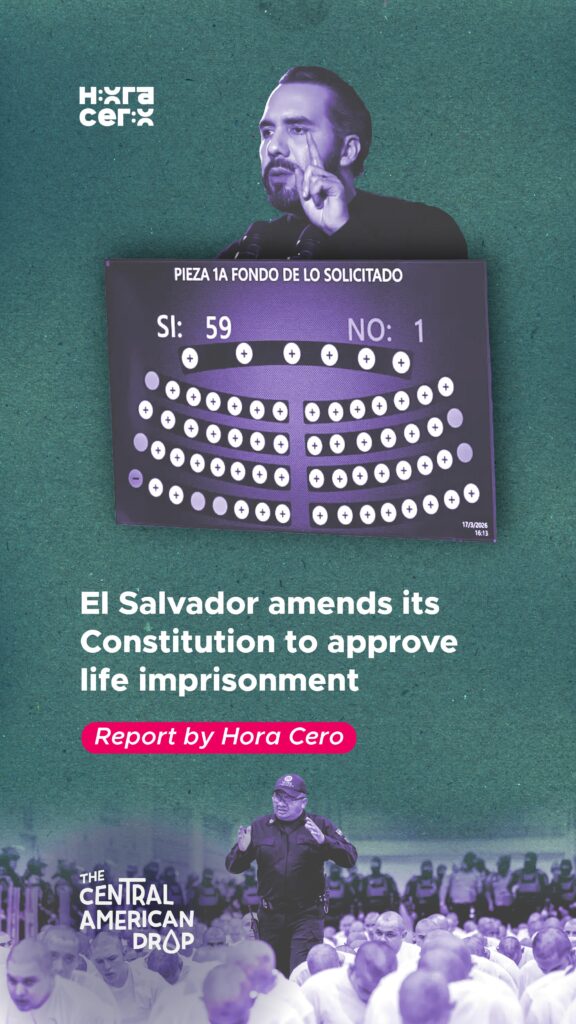
The National Assembly of El Salvador approved a constitutional reform that eliminates the prohibition on life sentences for terrorists, murderers, and rapists. Bukele announced his intention to change the law after the release of an international report on crimes against humanity.
Article 27 of the Constitution of El Salvador, before its reform, prohibited “life imprisonment, infamous punishments (…) and all forms of torture.” Now, the article states that “life imprisonment alone will be imposed on murderers, rapists, and terrorists.»
During the plenary session on March 18, 59 of the 60 members of El Salvador’s Legislative Assembly voted in favor of the reform: 54 from Nuevas Ideas, 2 from ARENA, 2 from the PCN, and 1 from the PDC. The proposal received only one dissenting vote, cast by Claudia Ortiz of the Vamos party.
According to the World Prison Brief (WPB), El Salvador currently has 1,659 prisoners per 100,000 inhabitants. This makes it the country with the highest per capita incarceration rate in the world.
Security Minister Gustavo Villatoro, who presented the proposal on behalf of the Presidency to the Legislative Assembly, declared that for the State, «the relentless war against terrorists does not stop,» referring to gang members, but also to those convicted of other crimes.
This constitutional reform was carried out in the context of the fourth anniversary of the state of emergency’s approval. It is estimated that, between 2022 and 2026, approximately 91,500 people were detained without a warrant, accused of being gang members or accomplices.
The reform reopens the debate on one of the main functions of modern prisons: rehabilitation. Although social reintegration is considered a human right, its success depends on multiple factors: social, individual, and, of course, the type of crime committed.
The Salvadoran government has repeatedly promoted, through its official social media channels, the «Zero Idleness Plan,» a public policy aimed at eliminating inactivity among inmates in prisons. Recently, he advertised on his official TikTok account to a prisoner convicted of sexual offenses against minors.
The video, as well as the participation of an inmate convicted of this type of crime in the «Zero Idleness Plan,» was harshly criticized on social media by the mother of one of the victims. Furthermore, with the reform, individuals sentenced to life imprisonment can request a review of their sentence every five years.
Previously, Bukele has stated that he does not believe in the social reintegration of gang members, saying that being a gang member «is a continuing crime» and that «no one ceases to be a member until the day they die.» However, investigations into the release of gang leaders during his administration provide a contrary message.
Given the context of violence in El Salvador, the inconsistencies in the application of public rehabilitation policies, the presidential statements, and the accusations about crimes against humanity in the country, the debate on the administration of justice faces a moment of tension and polarization.

| Cookie | Duración | Descripción |
|---|---|---|
| cookielawinfo-checkbox-analytics | 11 months | This cookie is set by GDPR Cookie Consent plugin. The cookie is used to store the user consent for the cookies in the category "Analytics". |
| cookielawinfo-checkbox-functional | 11 months | The cookie is set by GDPR cookie consent to record the user consent for the cookies in the category "Functional". |
| cookielawinfo-checkbox-necessary | 11 months | This cookie is set by GDPR Cookie Consent plugin. The cookies is used to store the user consent for the cookies in the category "Necessary". |
| cookielawinfo-checkbox-others | 11 months | This cookie is set by GDPR Cookie Consent plugin. The cookie is used to store the user consent for the cookies in the category "Other. |
| cookielawinfo-checkbox-performance | 11 months | This cookie is set by GDPR Cookie Consent plugin. The cookie is used to store the user consent for the cookies in the category "Performance". |
| viewed_cookie_policy | 11 months | The cookie is set by the GDPR Cookie Consent plugin and is used to store whether or not user has consented to the use of cookies. It does not store any personal data. |