

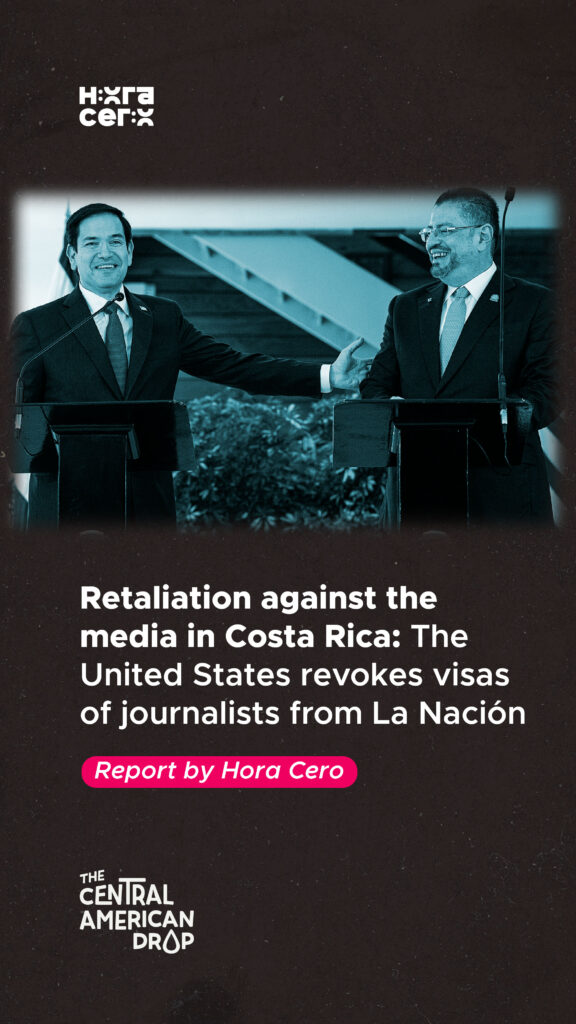
As World Press Freedom Day approached, the Department of Homeland Security for the United States (DHS) barred five executives from the newspaper La Nación from entering the country. According to the newspaper, the U.S. government canceled their visas without explanation.
The members of La Nación’s board of directors are the most recent, in a list of Costa Rican citizens whose US visas have been canceled. Apparently, the cancellations began after the visit of the Secretary of State of EE.UUMarco Rubio, to the country.
During his time in Costa Rica, Rubio described the country as the “model of what we want other countries in the region and, frankly, the world to be,” accompanying those words with an assessment of Chinese companies, such as Huawei, noting that, in his opinion, they represent a global danger.
In this regard, Rubio congratulated Rodrigo Chaves, the president of Costa Rica, for signing a decree that prohibits Chinese 5G technology providers, such as Huawei, from entering the country.
Chaves won the Costa Rican elections in 2022, despite La Nación publishing a report about an internal investigation in which the World Bank determined that Chaves committed sexual harassment while employed by the institution.
Between 2022 and 2026, two things have characterized Rodrigo Chaves’ presidential administration: his closeness to the government of Donald Trump and the constant criticism of the newspaper La Nación and its journalists. Previously, Chaves openly identified La Nación as an enemy of his administration.
In an editorial published on May 4, the newspaper stated that “in the absence of explanations for the decision or objective reasons to support it, alone, it is possible to reach one conclusion: their purpose has been to punish the editorial line of La Nación.”
In connection with La Nación, the U.S. government revoked the visas of most of the newspaper’s board members (five out of seven). The newspaper’s president, Pedro Abreu, stated that those whose visas were revoked have family, personal, and professional ties in the U.S.
In total, the DHS has canceled the visas of 15 Costa Rican officials and citizens, including former legislators and judges, as well as former president and Nobel Peace Prize laureate Óscar Arias and his brother, Rodrigo Arias. The latter favored trade with China during his time as a member of the Costa Rican Congress.
To make matters worse, the Reporters Without Borders (RSF) report published on April 30 indicated that Costa Rica has fallen in its press freedom ranking, from 36th to 38th place. In 2022, the country ranked 8th in the RSF index, meaning that in four years it has dropped 28 places.
According to RSF’s analysis, the deterioration is directly related to the confrontational attitude that has characterized the Chávez government and critical media outlets. In that sense, the cancellation of their visas by the EEUU confirms the tension and attacks faced by the Costa Rican media.
| Cookie | Duración | Descripción |
|---|---|---|
| cookielawinfo-checkbox-analytics | 11 months | This cookie is set by GDPR Cookie Consent plugin. The cookie is used to store the user consent for the cookies in the category "Analytics". |
| cookielawinfo-checkbox-functional | 11 months | The cookie is set by GDPR cookie consent to record the user consent for the cookies in the category "Functional". |
| cookielawinfo-checkbox-necessary | 11 months | This cookie is set by GDPR Cookie Consent plugin. The cookies is used to store the user consent for the cookies in the category "Necessary". |
| cookielawinfo-checkbox-others | 11 months | This cookie is set by GDPR Cookie Consent plugin. The cookie is used to store the user consent for the cookies in the category "Other. |
| cookielawinfo-checkbox-performance | 11 months | This cookie is set by GDPR Cookie Consent plugin. The cookie is used to store the user consent for the cookies in the category "Performance". |
| viewed_cookie_policy | 11 months | The cookie is set by the GDPR Cookie Consent plugin and is used to store whether or not user has consented to the use of cookies. It does not store any personal data. |