

Honduras enters its 3rd year under a state of emergency
In 2025, the Ministry of Security reported a reduction from 1,911 to 1,641 homicides between January and mid-September, that is, a 14% decrease.
At the same time, the State of the Country (ASJ) project’s «Security and Justice» report indicates that, despite this decrease, Honduras remains among the most violent countries in Central America due to its high homicide rate and other serious crimes.
Poverty, inequality, and remittances
Six out of ten Hondurans remain in poverty, according to a report by ASJ. Additionally, an analysis by Envío/ERIC-SJ indicates that the economy remains heavily dependent on remittances, which account for nearly 25% of GDP, with high levels of informality and wealth concentration hindering real improvements in people’s lives.
United States immigration policy
The United States’ immigration policy impacted the country in 2025, with at least 27,000 Hondurans deported in that year alone.
A key event was the revocation of Temporary Protected Status (TPS) for around 51,000 Hondurans, a decision with profound economic and social implications for thousands of families dependent on remittances.
External intervention and Trump’s support
The open involvement of US President Donald Trump had a major impact on the election campaign, as he expressed support for candidate Nasry Asfura and publicly discredited his rivals.
That external support became a central topic of debate on sovereignty, foreign influence, and the geopolitical alignments of the future Honduran government.
Crisis over the vote count
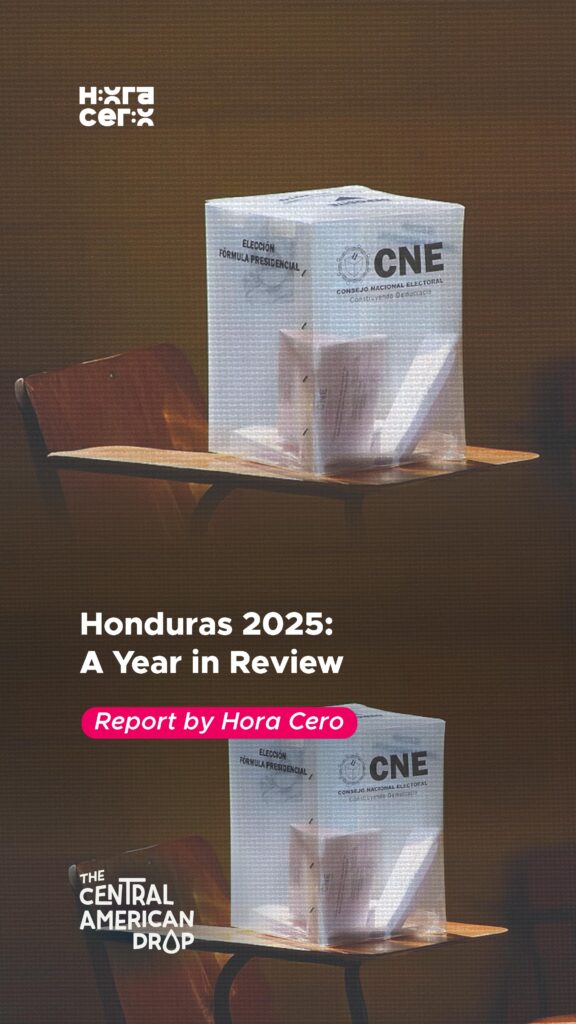
Following the elections held on November 30, a major crisis erupted due to delays and inconsistencies in the special recount, which kept the presidential result paralyzed for weeks.
Allegations of fraud, street protests, and doubts about the legitimacy of the future government marked the final stretch of the year.
Berta Cáceres, incomplete justice
In 2025, there was partial progress in the Berta Cáceres case. The Supreme Court of Justice upheld the 30-year prison sentence against Sergio Rodríguez Orellana, an employee of DESA.
Furthermore, in early 2025, an Interdisciplinary Group of Independent Experts (GIEI) was established to assess whether the State has truly investigated the possible masterminds and business and state networks linked to the Agua Zarca project, a measure that COPINH considers an advance, although still insufficient to break the structural impunity of the case.
The case of Juan López
In 2025, the case of Juan López continued to be marked by limited progress and high international concern. One year after his murder, the Office of the United Nations High Commissioner for Human Rights (OHCHR) and organizations such as Amnesty International noted that, although three alleged perpetrators have been prosecuted and are in pretrial detention, the possible masterminds behind the crime have still not been identified or charged.
An investigation is needed that includes the responsibility of companies and state actors linked to the socio-environmental conflict in the Aguán Valley.
Human rights and violence
CONADEH reports that, from 2022 to 2025, more than 60 women human rights defenders have been murdered in the country, confirming Honduras as one of the most dangerous environments for those who defend land, territory, and the environment.

| Cookie | Duración | Descripción |
|---|---|---|
| cookielawinfo-checkbox-analytics | 11 months | This cookie is set by GDPR Cookie Consent plugin. The cookie is used to store the user consent for the cookies in the category "Analytics". |
| cookielawinfo-checkbox-functional | 11 months | The cookie is set by GDPR cookie consent to record the user consent for the cookies in the category "Functional". |
| cookielawinfo-checkbox-necessary | 11 months | This cookie is set by GDPR Cookie Consent plugin. The cookies is used to store the user consent for the cookies in the category "Necessary". |
| cookielawinfo-checkbox-others | 11 months | This cookie is set by GDPR Cookie Consent plugin. The cookie is used to store the user consent for the cookies in the category "Other. |
| cookielawinfo-checkbox-performance | 11 months | This cookie is set by GDPR Cookie Consent plugin. The cookie is used to store the user consent for the cookies in the category "Performance". |
| viewed_cookie_policy | 11 months | The cookie is set by the GDPR Cookie Consent plugin and is used to store whether or not user has consented to the use of cookies. It does not store any personal data. |