

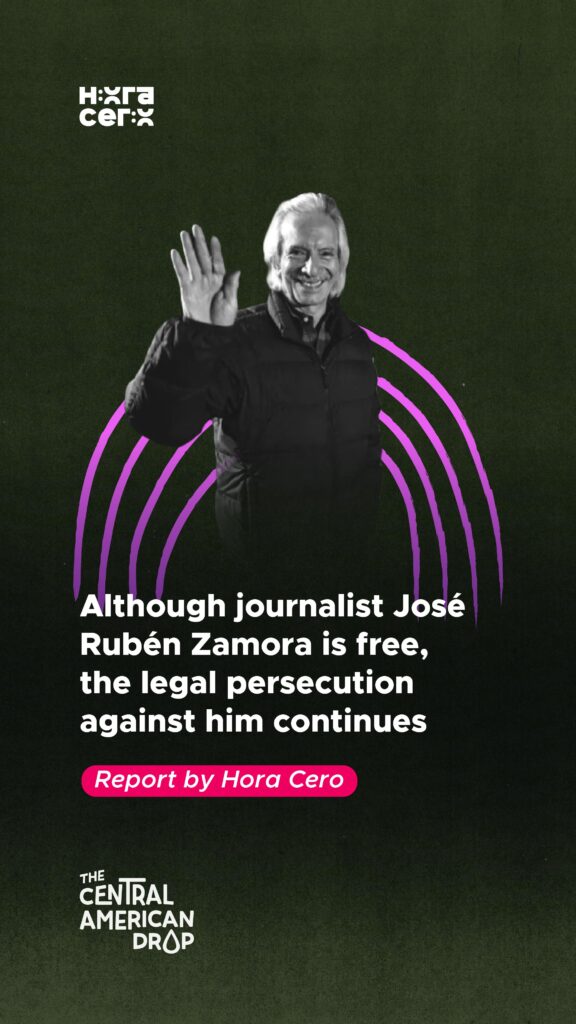
On February 12, Guatemalan journalist José Rubén Zamora, 69, was released from pretrial detention and granted house arrest for the second time. Zamora must appear before the Public Prosecutor’s Office twice a month and is prohibited from leaving the country.
The journalist has faced a labyrinthine legal process that began in 2022 when he was arrested in July on charges of influence peddling and money laundering. In June 2023, he was sentenced to six years in prison.
In October 2024, a judge granted him house arrest, but he was sent back to prison in March 2025 after the prosecution appealed. In March 2025, a court accepted his appeal in the money laundering case, opening the possibility of another trial.
José Rubén Zamora spent 1,295 days in prison, and an appeal by the prosecution could send him back to jail. Guatemalan President Bernardo Arévalo has denounced irregularities in the case, stating that it is retaliation for the journalist’s decades-long exposé of corruption.
In an interview with El País, Zamora pointed to Attorney General Consuelo Porras and the Foundation Against Terrorism as those responsible for orchestrating a campaign against him, with the help of the Army and the far right in Guatemala.
On February 18, the journalist requested that the Ministry of the Interior cancel the legal status of the Foundation Against Terrorism, arguing that this organization has used the judicial system to silence critical voices and human rights defenders.
According to the document presented by Zamora, the NGO employed legal action, stigmatization campaigns, and various forms of pressure to restrict fundamental rights. The Foundation has been sanctioned by the European Union for undermining the rule of law in Guatemala.
According to the Institute for Comparative Studies in Criminal and Social Sciences (Inecip), more than 166 people have been criminalized by the Public Prosecutor’s Office, including journalists, prosecutors, and human rights defenders. Many of them are in exile.
| Cookie | Duración | Descripción |
|---|---|---|
| cookielawinfo-checkbox-analytics | 11 months | This cookie is set by GDPR Cookie Consent plugin. The cookie is used to store the user consent for the cookies in the category "Analytics". |
| cookielawinfo-checkbox-functional | 11 months | The cookie is set by GDPR cookie consent to record the user consent for the cookies in the category "Functional". |
| cookielawinfo-checkbox-necessary | 11 months | This cookie is set by GDPR Cookie Consent plugin. The cookies is used to store the user consent for the cookies in the category "Necessary". |
| cookielawinfo-checkbox-others | 11 months | This cookie is set by GDPR Cookie Consent plugin. The cookie is used to store the user consent for the cookies in the category "Other. |
| cookielawinfo-checkbox-performance | 11 months | This cookie is set by GDPR Cookie Consent plugin. The cookie is used to store the user consent for the cookies in the category "Performance". |
| viewed_cookie_policy | 11 months | The cookie is set by the GDPR Cookie Consent plugin and is used to store whether or not user has consented to the use of cookies. It does not store any personal data. |