

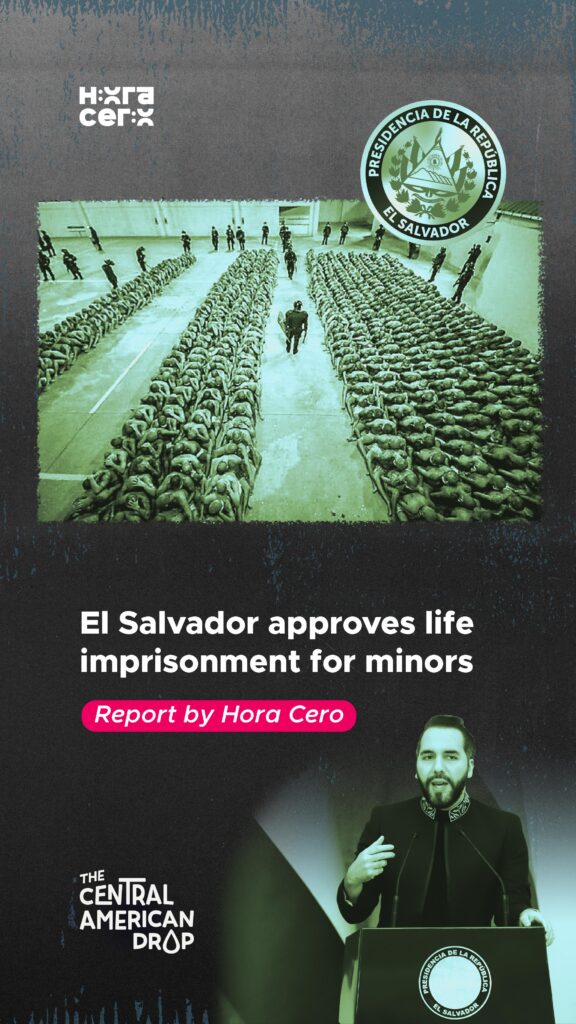
The Presidency of El Salvador approved a constitutional reform, which will come into effect on April 26, that includes the possibility of sentencing minors between the ages of 12 and 18 to life imprisonment.
The formal discussion and approval of life imprisonment in El Salvador began in March 2026, driven by Nayib Bukele, shortly after the publication of an international report on possible crimes against humanity in the country, related to the ongoing state of emergency.
In March, the Legislative Assembly of El Salvador, with a majority from the Nuevas Ideas party, approved the constitutional reform to modify Article 27, allowing life sentences for murderers, rapists, and terrorists.
However, the reform to the Salvadoran Constitution was not the only change made by the Assembly. There were also modifications to other laws, such as the Chate Penal and Procesal Penal, the Comprehensive Special Law for a Life Free of Violence for Women, the Special Law Against Acts of Terrorism, and the Juvenile Criminal Law.
Similarly, the Organic Law of the Judiciary was amended to transform juvenile courts into criminal courts. These courts will now be responsible for reviewing cases involving life imprisonment for minors between the ages of 12 and 18.
The Committee on the Rights of the Child (CRC) and the United Nations Children’s Fund (UNICEF) have expressed their “deep concern” regarding the approval of these reforms. The Government of El Salvador has not responded to any requests from international human rights bodies.
For UNICEF, minors in conflict with the law should receive treatment that “prioritizes their rehabilitation and reintegration.” In other words, for adolescents, prison should be the “last resort and for the shortest possible time,” so that they can reintegrate into society.
After four years of a state of emergency, the Salvadoran presidency defends these measures as part of its “war on gangs,” which began in March 2022 after a wave of murders.
However, during the last dialogue with the Inter-American Commission on Human Rights (IACHR), several Salvadoran human rights organizations indicated that the majority of those imprisoned in the regime, in exceptional cases, have been arbitrarily detained.
Although the sentence of life imprisonment, for minors between 12 and 18 years old, could be imposed. The question for El Salvador is whether the incarceration of adolescents will be a definitive solution to gangs or, on the contrary, a sign of repression, and whether it should be reviewed to assess its continuity in each case.
In any case, the documentary “La Vida Loca” (2008) by photographer and filmmaker Christian Poveda shows that this is not the first time that adolescents in conflict with the law have sparked debate in El Salvador. “La Vida Loca” demonstrates that the law is insufficient in the face of a phenomenon that is not purely criminal, but rather social.
| Cookie | Duración | Descripción |
|---|---|---|
| cookielawinfo-checkbox-analytics | 11 months | This cookie is set by GDPR Cookie Consent plugin. The cookie is used to store the user consent for the cookies in the category "Analytics". |
| cookielawinfo-checkbox-functional | 11 months | The cookie is set by GDPR cookie consent to record the user consent for the cookies in the category "Functional". |
| cookielawinfo-checkbox-necessary | 11 months | This cookie is set by GDPR Cookie Consent plugin. The cookies is used to store the user consent for the cookies in the category "Necessary". |
| cookielawinfo-checkbox-others | 11 months | This cookie is set by GDPR Cookie Consent plugin. The cookie is used to store the user consent for the cookies in the category "Other. |
| cookielawinfo-checkbox-performance | 11 months | This cookie is set by GDPR Cookie Consent plugin. The cookie is used to store the user consent for the cookies in the category "Performance". |
| viewed_cookie_policy | 11 months | The cookie is set by the GDPR Cookie Consent plugin and is used to store whether or not user has consented to the use of cookies. It does not store any personal data. |