

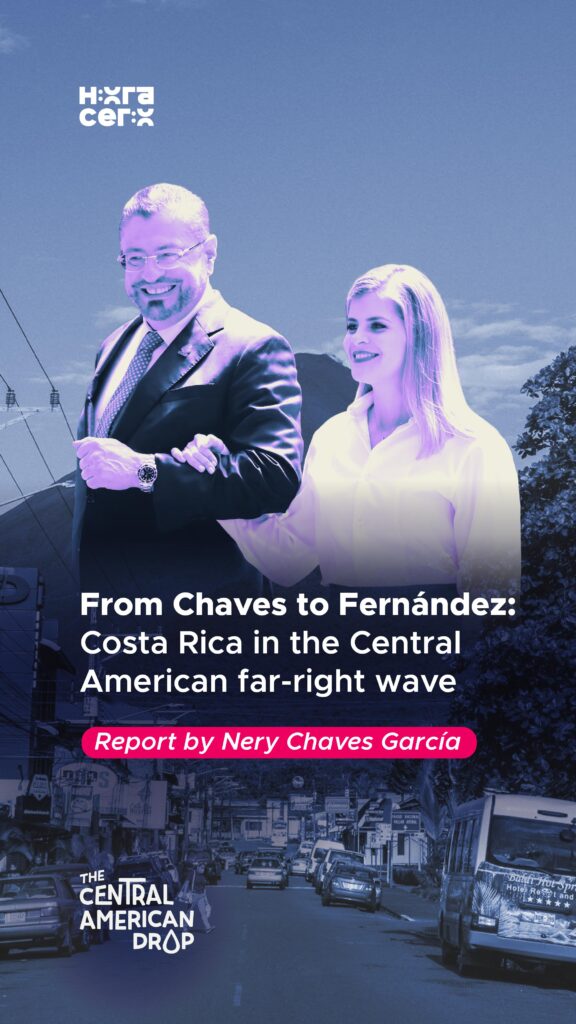
The electoral victory of Laura Fernández, designated and “heir to power” of Rodrigo Chaves Robles, is consolidating the advance of the far right in Costa Rica and, consequently, in Central America. The failed «Central American Switzerland» is adding to the birth of new far-right movements around the world. A wave characterized by neoliberalism recharged and that, according to Camila Perachena and Alberto Vergara, is a conservative, anti-LGBTQ+ and anti-women’s rights movement, revisionist of history, that openly supports violence, that even claims to the military dictatorships and has emerged with the imprint of the “cultural battle” where polarization becomes key to building support. A wave full of rather strident and internationally articulate men, which includes Nayib Bukele in El Salvador, Javier Milei in Argentina, José Antonio Kast in Chile, and others. All presidents who were summoned to the Shield of the Americas Donald Trump’s meeting in Miami. A hemispheric security and military alliance based on the motto: “Peace through force”.
In Costa Rica, the neoliberal model has been in place for over three decades, leading to serious consequences such as high levels of inequality and impoverishment. During Rodrigo’s presidency, according to Vianey Mora, “a neoliberal state without limits” was consolidated. Violence also intensified, manifested in the historic rise of homicides and the high presence of drug trafficking and organized crime in the communities. A matter that is not insignificant, according to Vianey Mora, points out that it is the deep “distrust between people, fueled by the polarization which the Chaves government insists on.”
Camila Perachena and Alberto Vergara argue that social polarization is a fundamental strategy for the new extreme right, because it allows them to build support while exacerbating the differences with “the other” and highlighting one’s own identity. Polarization brings with it the affective. The emotional aspect acts as a catalyst for electoral support. In that sense, it’s not just about polarization, but about building a stable «us,» so identifiable that it adopts the banners of the far right.
In this regard, Sindy Mora indicates that Chaves and Chavismo in general “have been very skillful in building an idea of an “us.” A «us» that clearly comes to avenge a country that has not been universal in its public policies, has not been inclusive of all groups, of all territories. A «us» that is a fiction where there is no corruption, no elites, no Costa Ricans with crowns, (…) a very fictitious «us,» built from religiosity. Vianey Mora, a future congresswoman, points out that “Chaves gave hope, a sense of belonging, a sense of community, he speaks to them differently (…) he talks about transforming things.”
The emotional appeal is fundamental in electoral situations and in Chaves’ populist discourse. Besides, it is very effective because, according to Camila Perachena, it «enables the new right wing to govern.» On the other hand, «there is an appropriation of the discourse,» adds Sindy Mora; the banners of Chavismo have become part of «us,» even if that «us» is diffuse, fictitious, and real at the same time. “The enemies of the people,” says Vianey Mora, were identified at the beginning of Chaves’s administration. First these “enemies” were condensed in the Legislative Assembly, the Comptroller General’s Office, the historical two-party system—particularly the National Liberation Party (PLN)—and gradually it extended to the «scoundrel press» or any person or sector critical of his government. Thus, conflict is central to Rodrigo Chaves’s discourse and his masculine style of governing. This kind of speech inflames tensions, differences, and particularly the battle with the other. It fuels polarization, as Vianey mentioned earlier.
That confrontation found fertile ground in a caudillo-dominated society. In Costa Rica, the “political revenge” of sectors that see the rights of women and the LGBTQ+ community as a threat has blossomed. Sindy Mora points to the existence of “a kind of settling of scores regarding sexual and reproductive rights,” which, in turn, positions “a political figure who is a man who comes to restore order,” thus supporting a “very masculine way of exercising power.” Therefore, it is not surprising that men over 50 are the ones who support Chávez. This sector—not the only one, but yes, one important one – adopts conservative positions and deniers of rights. Even Chavismo could co-opt evangelical and conservative sectors, until swallowing Fabricio Alvarado.
Therefore, for Sindy Mora, Chavismo is much more than a political party: “It is a right-wing political movement that rejects parties, has a distinctive aesthetic, a very characteristic color, a very characteristic way of speaking, a very characteristic language that connects with people, simple, sometimes offensive (…) that constructs otherness, or that helps to construct a ‘we’.” In this movement, aesthetics are so important that central symbols emerged in the electoral campaign, such as the figure of the jaguar, which also constructed its own and collective identity. The jaguar, for example, is associated with “strength, audacity, and territorial presence.” It identifies the historian Andrea Jiménez that this aesthetic is central to the ongoing communication campaign that is being disseminated widely through official state channels, government-created media outlets, and repeaters on social networks such as Facebook, Instagram, X, or TikTok via influencers and the use of massive bots. Thus, the generation of identity is so fundamental because it transforms adherents into standard-bearers of a political project that “is not just a political discourse, it is a stance before the world,” says Sindy Mora. In this way, Chavismo is as visceral as the figure of the president and sees something positive in that fervor.
The Chaves Robles administration is rooted in an exercise of male and authoritarian power, where polarization and conflict are the central axis. Faced with numerous conflicts, Chavez places himself in a strong but complicated position. He faces a conflict against the “Costa Ricans with crowns” – the “other” personified in the elites and detractors. In that conflict, the demand for “continuity of change” embodied in the heir Laura Fernández and in the forty provincial counci, – out of a total of , – to consolidate the transformation from Costa Rica. In this way, Chávez attempted to transfer his popular support to Laura Fernández (a transfer that was not entirely successful). Therefore, it is not surprising that Chávez Robles was the most important figure of the electoral contest despite not participating in it, according to the latest opinion study by the Center for Research and Political Studies (CIEP).
This is due to the character of the government. This is very characteristic of populism and authoritarianism. Regarding this, Sindy Mora emphasizes that authoritarianism implies a social relationship with the leader and their cause: “It is a relationship where sectors and social groups are willing to give up something of themselves to obtain other things (…) it is a dependent relationship. I depend on the leader to tell me what to do, and if the leader tells me to limit myself what “I have guarantees and my individual rights so that this solves the issue of insecurity. I will do it, and the leader depends on these groups to venerate him, support him, not criticize him, and not become his opposition.” For her part, Vianey Mora emphasizes that “the people» are championed by personalities, championed by the candidate who most inspires love at that moment, and not by a party or political project.
In this way, Chavismo represents a much more complex actor than a simple political figure or party; it is a social movement that shows itself related to authoritarianism, social polarization, and therefore, conflict. The reflection becomes even more complex when considering that «the most vulnerable sectors are the most predisposed to authoritarianism,» as Sindy Mora highlighted in a study on authoritarianism conducted years ago. This situation is reflected in the high electoral support for Fernández in historically impoverished, excluded, and vulnerable coastal and border cantons.
Fernández’s electoral victory was already official after the announcement by the Supreme Electoral Tribunal (TSE), as had also been recognized by other candidates. Suddenly, the national television screen split in two: on one side was Chávez and on the other, Fernández. It is not apparent at any point that, and it happens, Chaves begins to speak and acknowledges Fernández’s victory even before she herself shares his acceptance speech. Several minutes later, Fernández accepted power in a speech in which Chávez and Pilar Cisneros were central; he also pledged to remain steadfast in “the continuity of change.” A few days later, the president-elect, appointed her Minister of the Presidency. A detail that should not go unnoticed: the president-elect is a subordinate of Chávez.
It is truly complex to construct scenarios for Costa Rica, even more so. It’s difficult to decipher what «the third republic» is. Several scenarios emerge, one in which Laura is a loyal follower. operator of Chavismo and others. It’s either that she’ll rebel, or that Chavismo will implode (quite possible). What can be inferred so far is that Fernández is indeed a loyal Chavista enforcer, even now, she directly confronted the judiciary. In Vianey’s words, «we are heading towards a more authoritarian and above all conservative neoliberalism, with the right wing consolidating its power hand in hand with drug trafficking» – the latter related to Chávez’s questionable measures that expanded the territorial control of crime.In this regard, Sindy points out that little is
about the Third Republic and that characterizing it could be an exercise in speculation. What is undeniable, however, is that Fernández’s administration will be particularly…repressive towards opposition and dissent. This is what Fernández said in his acceptance speech, in which he «politically threatened the opposition,» according to Sindy Mora. This is in tune with the rhetoric of “they won’t let me govern” and the demand for 40 seats in Congress, rhetoric that “imagines a world without opposition, without diversity, without disagreements, without conflict,” Sindy pointed out. Thus, uncertainty and the extreme conservative right are the few certainties for the failed Switzerland of Central America.
| Cookie | Duración | Descripción |
|---|---|---|
| cookielawinfo-checkbox-analytics | 11 months | This cookie is set by GDPR Cookie Consent plugin. The cookie is used to store the user consent for the cookies in the category "Analytics". |
| cookielawinfo-checkbox-functional | 11 months | The cookie is set by GDPR cookie consent to record the user consent for the cookies in the category "Functional". |
| cookielawinfo-checkbox-necessary | 11 months | This cookie is set by GDPR Cookie Consent plugin. The cookies is used to store the user consent for the cookies in the category "Necessary". |
| cookielawinfo-checkbox-others | 11 months | This cookie is set by GDPR Cookie Consent plugin. The cookie is used to store the user consent for the cookies in the category "Other. |
| cookielawinfo-checkbox-performance | 11 months | This cookie is set by GDPR Cookie Consent plugin. The cookie is used to store the user consent for the cookies in the category "Performance". |
| viewed_cookie_policy | 11 months | The cookie is set by the GDPR Cookie Consent plugin and is used to store whether or not user has consented to the use of cookies. It does not store any personal data. |