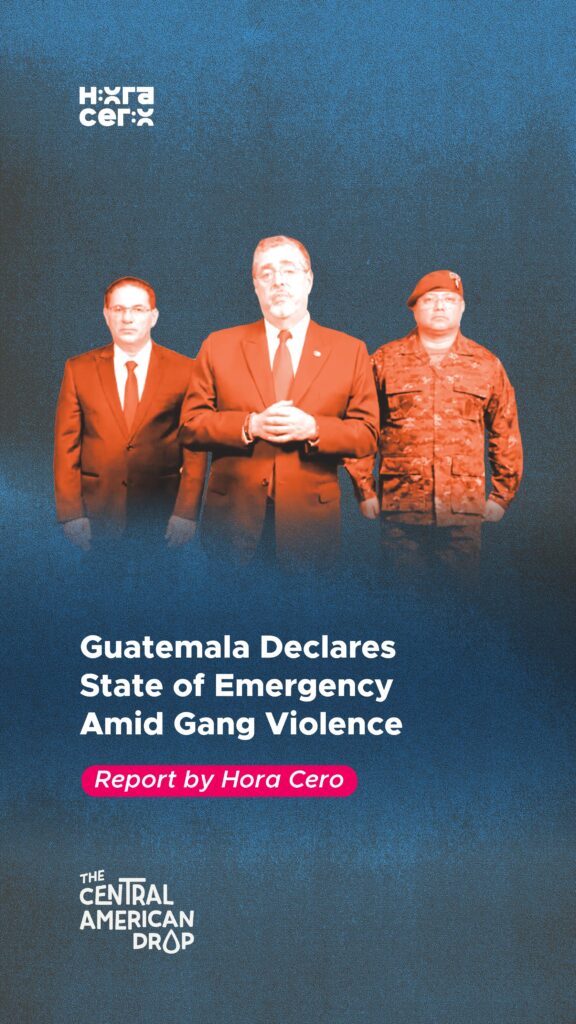
The government responds to escalating criminal control with emergency powers and military deployment.
On Sunday, January 18, Guatemalan President Bernardo Arévalo declared a 30-day state of emergency after a violent weekend in which a group of prisoners took control of three prisons in the country.
On Saturday, inmates took control of the Renovación 1, Fraijanes 2, and Preventivo prisons in Zone 18. They took several guards hostage and demanded the return of lost privileges.
In response to the authorities’ operations to restore control in the prisons, gang groups attacked police officers in different parts of the capital, leaving 10 dead and several wounded.
The riots were led by the Barrio 18 gang, headed by Aldo Dupié Ochoa, known as «El Lobo,» who was waiting to be transferred to another prison.
The Congress of the Republic ratified Arévalo’s decision on January 19, with 145 votes in favor and 5 against. In October of last year, Congress declared the gangs to be terrorist organizations after 20 leaders of Barrio 18 escaped from prison.
Extortion is one of the main sources of income for gangs and one of the main security concerns for Guatemalans.
A state of emergency is an exceptional constitutional measure that authorizes arrests and interrogations without a court order and suspends the rights of assembly and demonstration.
According to the president of Guatemala, behind the violence crisis are “groups that benefit from corruption.”
For the president, it is no coincidence that these events are occurring in the midst of the process of electing the new Attorney General of the Public Ministry, a position held by Consuelo Porras, who is accused of corruption and who has launched a judicial persecution against Arévalo.
Unfortunately, in Central America, states of emergency have been a constant tool in combating waves of crime. Although the state of siege decreed by Arévalo is supposed to last only a month, in countries like Honduras and El Salvador, it has been extended for years.
| Cookie | Duración | Descripción |
|---|---|---|
| cookielawinfo-checkbox-analytics | 11 months | This cookie is set by GDPR Cookie Consent plugin. The cookie is used to store the user consent for the cookies in the category "Analytics". |
| cookielawinfo-checkbox-functional | 11 months | The cookie is set by GDPR cookie consent to record the user consent for the cookies in the category "Functional". |
| cookielawinfo-checkbox-necessary | 11 months | This cookie is set by GDPR Cookie Consent plugin. The cookies is used to store the user consent for the cookies in the category "Necessary". |
| cookielawinfo-checkbox-others | 11 months | This cookie is set by GDPR Cookie Consent plugin. The cookie is used to store the user consent for the cookies in the category "Other. |
| cookielawinfo-checkbox-performance | 11 months | This cookie is set by GDPR Cookie Consent plugin. The cookie is used to store the user consent for the cookies in the category "Performance". |
| viewed_cookie_policy | 11 months | The cookie is set by the GDPR Cookie Consent plugin and is used to store whether or not user has consented to the use of cookies. It does not store any personal data. |