

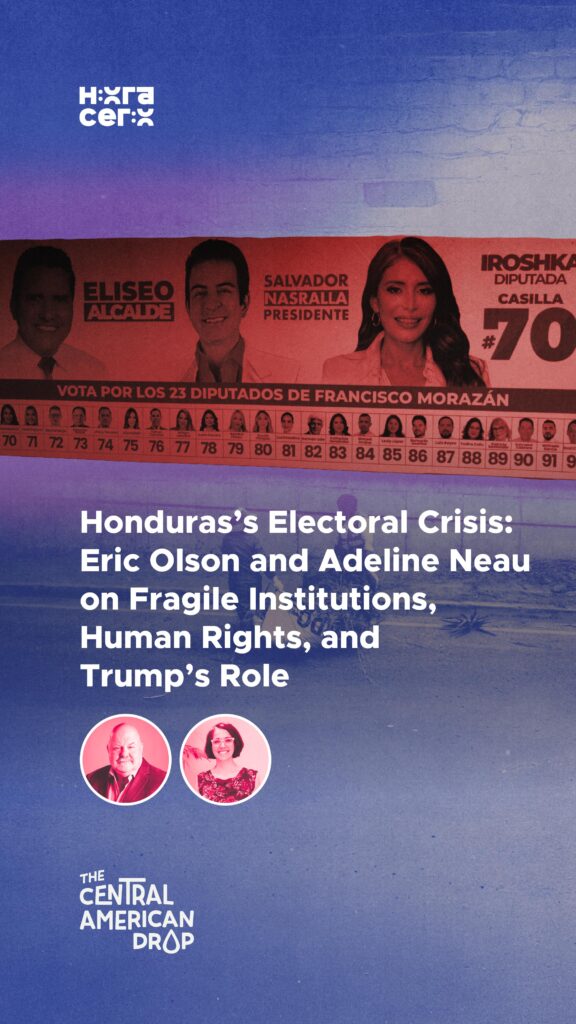
Welcome to this special conversation organized by The Central American Drop to discuss one of the most consequential political moments in the region: the Honduran elections and what their results mean for democracy, human rights, and everyday life in Honduras. Our mission is to make complex regional realities accessible, connect English‑speaking readers with sharp analysis, and amplify voices defending democracy and human rights across Central America.
We are joined today by two guests who bring deep expertise and on‑the‑ground perspective: Eric Olson, Senior Advisor at the Seattle International Foundation, who has spent years studying governance, security, and democratic institutions across Central America and Mexico; and Adeline Neau, a lawyer and researcher at Amnesty International and a leading advocate documenting major human rights challenges in the region. Our goal is to unpack what happened at the polls, what the results reveal about Honduras’s political trajectory, the influence of U.S. politics in Central America, and the day‑to‑day struggles Hondurans face.
Fragility of Honduran democracy
HoraCero: Many days have passed since Hondurans went out to vote, and we still do not know who the next president will be. Candidates like Rixi Moncada are denouncing an electoral coup and Donald Trump’s intervention in the process. How do these events reflect the fragility of Honduras’s democratic institutions?
Eric Olson: People in the United States and outside Honduras often treat elections there like a horse race—who is ahead, who is behind, who is left, right, or center. But Honduras is exceptional in a negative sense. It has built an electoral system rooted in partisanship, not technical independence.
The National Electoral Council has three councillors, each representing a political party. Other electoral institutions are also controlled by the three main parties—whether the tribunal for electoral crimes or other bodies tied to elections and the rule of law. Party negotiations decide who heads these institutions, making them partisan rather than technical.
This is Honduras’s sovereign choice, but it has produced an extremely fragile electoral process that is easy to discredit and easy to accuse of fraud. Each party helped design a weak system—especially the CNE—so all share responsibility for its partisan nature.
You can argue some institutions are a bit stronger or more institutional than others, but in every case, party negotiations determine leadership, which immediately raises doubts about fairness and legitimacy.
Despite this, authorities have done a relatively good job of bringing in and counting votes, but doubts remain, and that is not surprising in a system built so each party can question the results if it loses. Notice that the party not losing is not questioning the process; the others are. That is by design.
So when you speak of fragility, that is accurate. The political parties created this fragile system, and these are the consequences.
Human rights context in Honduras
HoraCero: Honduras is often described as one of the most dangerous countries in the region for human rights defenders. How would you describe the current human rights situation, particularly in the context of the recent elections?
Adeline Neau: The current electoral context is very tense. Over the last month, Amnesty International has prepared for different scenarios involving alleged fraud, protests, and potential repression, drawing on what happened after previous elections. In 2017, protests were repressed and several people were killed, including victims of extrajudicial executions. There was also a coup not so long ago.
So far, violence has not escalated to the same level, but results have still not been published. There is a great deal of uncertainty, so we remain vigilant and in contact with Honduran authorities in case the situation deteriorates.
The country has also been under a state of emergency for three years, heavily criticized by civil society, the UN, and Amnesty. We have all called for an end to it, given the lack of transparency and allegations of human rights violations.
Elections should occur in an environment where people can exchange ideas, take to the streets, and express their demands. Freedom of expression and peaceful protest are human rights, even if this is not always visible in Honduras, given the long record of violations Amnesty has documented. We are worried because the situation is not over and the usual quick response is to deploy the military in the streets.
We hope it remains calm, but we will not be fully certain until around January 20, so there is still more than a month of risk.
Key moments in recent Honduran history
HoraCero: To understand the current political crisis, which key moments in Honduras’s recent history do you see as most important?
Eric Olson: Several factors have contributed to today’s instability. One is the lack of technically independent electoral institutions. Looking at recent history, two big events stand out.
First, like much of Latin America, Honduras historically had two dominant parties: a classic liberal party and a conservative National Party. For years they alternated in power, producing a degree of bipartisan stability.
This changed dramatically in 2009 with a coup d’état. The army forced then‑President Mel Zelaya of the Liberal Party from office, literally taking him from his home in his pajamas and putting him on a plane to Costa Rica. The democratic process was interrupted.
The coup split the party system. Zelaya, formerly of the Liberal Party, created a new movement, Libre, more stridently leftist and aligned with other revolutionary movements in the region. He brought Liberal Party members and people from what was called the National Resistance into this new party.
This broke the previous consensus and turned Honduras into a three‑party system, which is inherently less stable. It weakened the Liberal Party into a smaller third force and deepened polarization. The trauma of a coup was profound, especially since Honduras had not experienced one since 1982, meaning most Hondurans had no personal memory of military rule.
That trauma fueled intense polarization that still shapes political debate. The resulting “desconfianza”—lack of trust—makes it very difficult for Congress and institutions to function. On top of this came corruption, which leads to the second key factor.
The rise and fall of Juan Orlando Hernández, a two‑term president from the National Party, is crucial. With the Liberal Party splintered and Libre emerging, the National Party rose to prominence. Hernández led it to victory in 2013 and then did something unexpected: he ran for a second term.
The constitution explicitly forbids re‑election, but through manipulation of the Supreme Court and other mechanisms he managed to run again and won. This sparked a large movement against him, but the opposition was divided: a weakened Liberal Party and Libre still recovering from the 2009 trauma.
He imposed his re‑election amid fraud and post‑electoral violence. Later, information emerged about his corruption and links to drug trafficking. His brother was captured and prosecuted in the United States, and prosecutors revealed connections between the Hernández family and traffickers.
The United States chose not to prosecute Juan Orlando while he was president, likely to avoid further destabilization, and waited until after he left office. The combination of corruption, polarization, and Libre’s rise made it possible for Libre to win in 2021.
Today’s elections take place in this context: a society marked by the 2009 coup and the corruption and illegality of Hernández’s government, which voters rejected in 2021.
Juan Orlando Hernández and human rights
HoraCero: The former president, Juan Orlando Hernández, who faced drug trafficking charges, was released from prison after a pardon from U.S. President Donald Trump. From a human rights perspective, how would you characterize his time in office?
Adeline Neau: I will highlight just a few points. First, there were severe restrictions on freedom of expression and the right to peaceful protest, with frequent deployment of military forces to repress demonstrations. After the 2017 elections, security forces, including the military police, were deployed and the UN human rights office in Honduras documented extrajudicial executions, torture, ill‑treatment, and disappearances.
The Ombudsman and the national mechanism against torture also documented serious abuses in prisons. Yet almost no police or military officers were tried, and impunity remained pervasive.
Another defining element was the situation of human rights defenders, especially those defending land, territory, and the environment—an issue that is crucial in the climate crisis. The most emblematic case was the killing of Berta Cáceres, a land defender and coordinator of COPINH, who was murdered in March; we are approaching the tenth anniversary of her killing.
Her case was not unique, but it drew global attention. During Hernández’s administration, Honduras was labeled one of the most lethal countries in the world for human rights defenders, a trend that persisted for years and only began to shift when Guatemala surpassed it in killings.
Those defending land, water, and forests should be protected because they are protecting the planet for future generations, yet they pay a very high price. Amnesty documented not only lethal violence but also arbitrary detentions and declared several defenders prisoners of conscience.
In northern Honduras, in Tocoa, members of a committee defending territory faced years of unfair proceedings and imprisonment for nearly three years. Around September 2024, their leader, Juan López, the committee’s coordinator, was killed, showing that the same patterns continue.
Impunity prevails in cases of violence against defenders. Some changes were introduced in the last mandate, but they were timid. Overall, Hernández’s administration was marked by violence against protesters and human rights defenders, widespread impunity and corruption, as well as serious issues affecting women and migrants.
We should also recall that, when he was president of Congress before 2013, a law was passed allowing the creation of Employment and Economic Development Zones (ZEDEs). These zones were widely criticized because they created quasi‑parallel administrations with little transparency and serious human rights concerns.
Although the Castro government tried to roll them back, ZEDEs have not been fully eradicated. Indigenous and Afro‑descendant communities are especially concerned because ZEDEs can be imposed in their territories without proper information, prior consultation, and consent.
Trump’s foreign policy in Central America
HoraCero: Since the beginning of Donald Trump’s administration, Central America appears to have become a key focus of U.S. foreign policy. We have seen close ties with Nayib Bukele in El Salvador, and the governments of Guatemala and Costa Rica have aligned with Trump’s deportation policies. How would you describe his administration’s overall approach to the region?
Eric Olson: There are two levels to this. First, what the administration says publicly. The relationship is defined as transactional and not rooted in values. Under Biden, the U.S. had significantly increased support for democracy, rule of law, and justice sector reform in the region. Under Trump, that support collapsed almost immediately.
The message was that the U.S. was not interested in intervening abroad and that assistance was not useful, especially in Central America. U.S. interests were redefined more narrowly.
Under Biden, promoting democracy and prosperity in Central America was seen as part of U.S. interests. Under Trump, that broader logic was abandoned in favor of a narrower, transactional approach centered on two issues: immigration and drug trafficking.
On immigration, the focus was not just on stopping migration but on forcing countries to accept returnees, including, in some cases, non‑nationals such as Nicaraguans or even people from Africa. There was an aggressive push for agreements to accept deportations.
On drug trafficking, the administration framed traffickers and “narcoterrorists” as a direct national security threat and used war‑like language. Combating drug trafficking and related crime appeared to be the top priority and underpinned threats of military action, especially regarding Venezuela, but also aimed at organized crime groups like MS‑13.
This is the formal framework. The confusing part is that President Trump often acted outside this logic, without consulting his own team. For example, despite a statement from Secretary of State Marco Rubio that the U.S. would no longer intervene in foreign elections or comment on them, Trump endorsed a presidential candidate in Honduras, contradicting that position.
Despite his declared focus on fighting drug trafficking, he pardoned a convicted drug trafficker, former president Juan Orlando Hernández. So declared policies are frequently undermined by the president’s own actions, creating confusion in the U.S. and across Central America.
Some governments believe that cooperating on counter‑narcotics and migration is their safest strategy, and that may be rational, but Trump could abruptly change course. There is no stable, coherent framework, leaving governments, civil society, and independent journalists unsure of what to expect.
Bukele in El Salvador has taken a different approach, seeking to ingratiate himself by doing whatever the administration wants. He accepted Venezuelan deportees and others. Strong evidence from Human Rights Watch, Cristosal, and The New York Times shows those Venezuelans suffered torture, beatings, and abuse in Salvadoran custody, and more than 80,000 Salvadorans have been detained without due process.
Nicaragua is different again, with almost no relationship, though it is conceivable Trump might seek a deal there in exchange for drug‑trafficking cooperation. Overall, it is impossible to point to a consistent, guiding framework. In this context, the best option is to hold firmly to core values: independent media, human rights, and the rule of law.
Central America’s current political moment
HoraCero: Although it is still unclear who will become the next president of Honduras, neither Nasry Asfura—a far‑right candidate backed by Trump—nor Salvador Nasralla—a controversial figure from the Liberal Party—seems promising for maintaining balance in Central America’s political compass. How would you describe the current political moment in the region?
Adeline Neau: From a human rights perspective, the situation is very complicated. Human rights are often still just words on paper. The closure of civic space has reached alarming levels, especially in El Salvador and Nicaragua, where criticism is not tolerated.
For the first time in years, Amnesty has simultaneously designated five prisoners of conscience in Central America—people jailed solely for defending human rights. Many more could be named, but doing so carries security risks by exposing them and their families to further repression.
Civil society is extremely weak under the constant threat of repression. Nicaragua and El Salvador have adopted very restrictive laws that severely hinder human rights organizations. Cristosal is a prominent example: lawyer Ruth López has been jailed, and a judge recently extended her detention without allowing her to see a lawyer or her family, in clear violation of her rights.
At the same time, the regional and global human rights system is showing its limits. States systematically ignore their obligations, and almost nothing happens in response. This makes human rights campaigning very difficult.
The so‑called “Bukele model” illustrates a key challenge: states have failed for so long to provide security that many people now welcome policies that restrict rights and liberties as long as they feel safer.
Honduras is moving in a similar direction, with a state of emergency in place for three years and public appetite for tougher measures. Amnesty will be watching this closely, as well as developments in Costa Rica, where a more security‑focused narrative and calls for “mano dura” policies are becoming more common.
Guatemala has a more progressive government, but it has been unable to implement major reforms because the justice system is deeply corrupt. Human rights defenders, judges, journalists, and opposition figures, including from President Arévalo’s party, face unfounded, lengthy criminal proceedings.
This forces many people to choose between staying and risking prison or death, or leaving. Hundreds of people from Nicaragua, El Salvador, and Guatemala now live in the U.S., Mexico, or Spain because states not only fail to protect them but often are the persecutors.
This is the regional context in which the Honduran elections—and soon Costa Rica’s elections—are taking place. We will monitor the human rights dimensions of the public policies and legislation these governments pursue.
Misconceptions about the Central American crisis
HoraCero: In your experience, what are the biggest misconceptions the international community has about the Central American and Honduran crisis at this moment?
Eric Olson: One major misconception is the continued tendency to view Central America through a left–right lens—liberal, progressive, leftist, populist versus conservative. These categories are increasingly meaningless.
Daniel Ortega may once have been considered a progressive leftist, but he no longer fits that description. People also ask whether Bukele is left or right, given his origins in the FMLN, but such labels are no longer useful.
The real divide is about democracy, rule of law, transparency, and accountability—what we could loosely call the Amnesty International agenda regarding justice and independent courts. People on the left or right either uphold these principles or not; that is what matters.
A second misconception is the tendency to see Central America only as corrupt and inept. While corruption is real, this view ignores the many courageous, innovative people and organizations in civil society throughout the region, including in Honduras, Guatemala, El Salvador, and Nicaragua, who fight for a more democratic system of justice and rule of law.
If we only speak in broad negative terms and forget these actors, we risk concluding there is no point in engaging with Central America at all. Those people exist and must be supported. That is what our foundation focuses on, and there is a responsibility to continue supporting them rather than simply accepting that leadership is corrupt and nothing more can be done.
Adeline Neau: I want to return to security policies and states of emergency. They may bring temporary calm and a favorable business climate—that is the official narrative—but if they are not grounded in respect for human rights, they fuel further violations and injustice. This is not sustainable and will eventually explode. It does not produce lasting peace and security.
Space for freedom of expression and human rights defense is crucial, especially now. Many people continue to work in extremely difficult conditions, either in their countries or in exile, struggling to access funding and keep their organizations alive.
We also need to consider the impact of recent U.S. funding cuts on human rights defenders, journalists, and others offering critical perspectives on government policies and plans.
If countries become fully closed, with no civil society left to report and document abuses, the situation will become extremely dangerous, with no accountability or justice. We need people who can defend rights, publish reports, and tell the stories of victims.
Preserving space for civil society and freedom of expression is essential. These are fundamental human rights.
| Cookie | Duración | Descripción |
|---|---|---|
| cookielawinfo-checkbox-analytics | 11 months | This cookie is set by GDPR Cookie Consent plugin. The cookie is used to store the user consent for the cookies in the category "Analytics". |
| cookielawinfo-checkbox-functional | 11 months | The cookie is set by GDPR cookie consent to record the user consent for the cookies in the category "Functional". |
| cookielawinfo-checkbox-necessary | 11 months | This cookie is set by GDPR Cookie Consent plugin. The cookies is used to store the user consent for the cookies in the category "Necessary". |
| cookielawinfo-checkbox-others | 11 months | This cookie is set by GDPR Cookie Consent plugin. The cookie is used to store the user consent for the cookies in the category "Other. |
| cookielawinfo-checkbox-performance | 11 months | This cookie is set by GDPR Cookie Consent plugin. The cookie is used to store the user consent for the cookies in the category "Performance". |
| viewed_cookie_policy | 11 months | The cookie is set by the GDPR Cookie Consent plugin and is used to store whether or not user has consented to the use of cookies. It does not store any personal data. |