

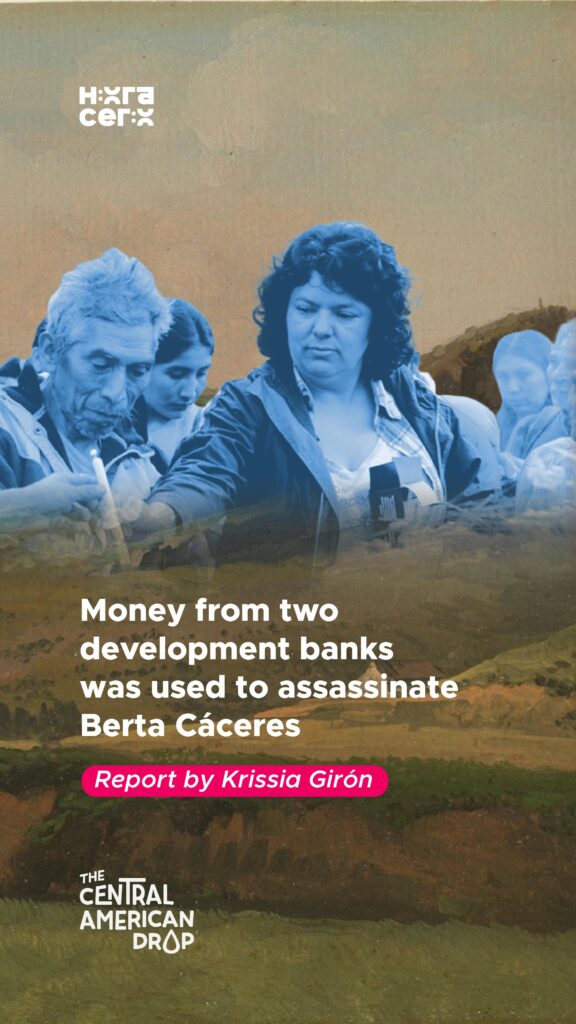
The Interdisciplinary Group of Independent Experts (GIEI) of the Inter-American Commission on Human Rights (IACHR) presented a report on January 12, revealing those responsible for financing the murder of Berta Cáceres.
According to the GIEI, the criminal operation used funds from development banks in both Central America and Europe to hire hitmen.
The report details all the routes the money followed, through Honduran banks and companies, and how it was collected through checks to be finally distributed among Cáceres’ hitmen.
The financial investigation concluded that the $25,000 collected by the hitmen came from “funds transferred by the banks FMO (Development Bank of the Netherlands) and the BCIE (Central American Bank for Economic Integration)” with payment orders issued to the Honduran company Desa S.A.
The GIEI points out that Desa S.A. triangulated the money through several of its accounts until it was collected by people trusted by David Castillo, the company’s executive president and convicted for the murder of Berta Cáceres in 2021.
Furthermore, the report also pointed to the Atala Zablah family, one of the wealthiest business clans in Central America, with multiple banking investments in the region, as directly responsible for the criminal operation.
However, although it has been legally proven that Desa S.A. participated in the financial plot to assassinate Cáceres, Daniel Atala, the financial manager of this company, has not been linked to the case in any way.
Among the events immediately following the assassination, the report details the communication and actions of Daniel Atala and other members of the Atala Zablah family with the Honduran Ministry of Security.
According to the GIEI, there are “documents and messages [that] reveal a sustained relationship between Desa executives and shareholders with the then Minister of Security, as well as with police officers, before, during and after the murder.”
The Atala Zablah family promoted the construction of a hydroelectric dam in western Honduras, through the project known as Agua Zarca, an initiative denounced by the Lenca community to which Cáceres belonged.
Berta Cáceres spearheaded the movement that denounced the future contamination of the river if the Agua Zarca dam was built. Her activism led the World Bank and the Sinohydro company, both financiers of Agua Zarca, to withdraw from the project.

| Cookie | Duración | Descripción |
|---|---|---|
| cookielawinfo-checkbox-analytics | 11 months | This cookie is set by GDPR Cookie Consent plugin. The cookie is used to store the user consent for the cookies in the category "Analytics". |
| cookielawinfo-checkbox-functional | 11 months | The cookie is set by GDPR cookie consent to record the user consent for the cookies in the category "Functional". |
| cookielawinfo-checkbox-necessary | 11 months | This cookie is set by GDPR Cookie Consent plugin. The cookies is used to store the user consent for the cookies in the category "Necessary". |
| cookielawinfo-checkbox-others | 11 months | This cookie is set by GDPR Cookie Consent plugin. The cookie is used to store the user consent for the cookies in the category "Other. |
| cookielawinfo-checkbox-performance | 11 months | This cookie is set by GDPR Cookie Consent plugin. The cookie is used to store the user consent for the cookies in the category "Performance". |
| viewed_cookie_policy | 11 months | The cookie is set by the GDPR Cookie Consent plugin and is used to store whether or not user has consented to the use of cookies. It does not store any personal data. |