

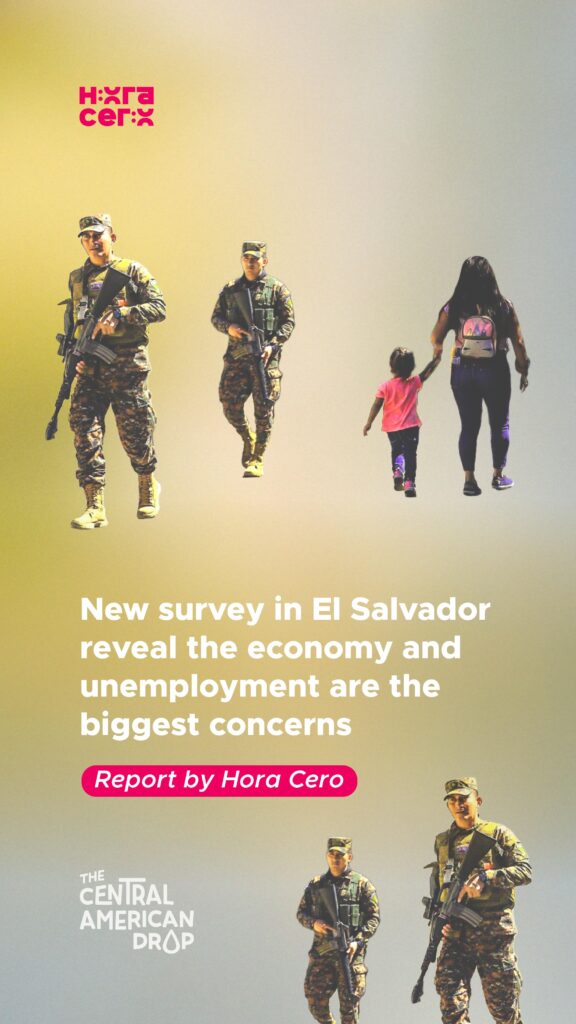
The Institute of Public Opinion (IUDOP) of the Central American University José Simeón Cañas of El Salvador (UCA El Salvador) presented the 2025 Evaluation Survey, entitled “Stability in security versus fragility in the economy”.
The IUDOP surveyed Salvadorans on five key issues: the general situation in El Salvador, how they perceive their family economy, what they think about justice, whether they trust (or not) public institutions, what their assessments are on current issues, and, finally, their expectations for 2026.
Regarding the situation in El Salvador, 62.7% of the population believes that security is the most positive aspect of 2025, compared to the economy. In that area, 44.9% consider the high cost of living and unemployment to be the main failures of the past year.
Regarding household finances, 9 out of 10 people think that the prices of basic goods have increased or remained the same. 44% of the population said
that their main expense is food, and of the percentage that perceived a price increase, 58.2% of people have chosen to stop consuming protein.
Regarding justice and trust in public institutions, 81.7% believe that crime has decreased, while 95.3% stated that they have not been victims of criminal acts.
The president, the Armed Forces (FAES), and the National Civil Police (PNC) were evaluated as the most trusted institutions, in contrast to the Legislative Assembly, the municipalities, and all political parties, which were rated as the least trusted institutions for Salvadorans.
According to IUDOP, the perception of decreased crime combined with trust in the president and security institutions (FAES and PNC) explains the positive evaluation of Bukele’s administration in 2025. The population rated him 8.39 out of 10, higher than the 2024 score of 8.13.
Regarding the current situation in El Salvador, 51.8% of people perceive the mass deportations from the EE.UU…as a threat to the flow of remittances. On the other hand, after a year since the approval of the General Law on Metallic Mining, 67.3% of citizens believe it has benefited the population little or not at all.
Finally, regarding expectations for 2026, 34.5% of the population believes the national economic situation will improve. Furthermore, when Salvadorans think about their country, 70.3% view the future with hope, while 26.4% feel fear.
Amparo Marroquín Parducci, Vice-Rector of Social Projection at UCA El Salvador, indicated that, although hope remains high, there is a significant decrease compared to previous years, especially among the population concerned about their economic situation.
To conduct its survey, IUDOP carried out sampling in different parts of El Salvador, following a multi-stage process, to ensure that the results accurately reflect the Salvadoran population. Therefore, in statistical terms, the survey has a 95% confidence level.
| Cookie | Duración | Descripción |
|---|---|---|
| cookielawinfo-checkbox-analytics | 11 months | This cookie is set by GDPR Cookie Consent plugin. The cookie is used to store the user consent for the cookies in the category "Analytics". |
| cookielawinfo-checkbox-functional | 11 months | The cookie is set by GDPR cookie consent to record the user consent for the cookies in the category "Functional". |
| cookielawinfo-checkbox-necessary | 11 months | This cookie is set by GDPR Cookie Consent plugin. The cookies is used to store the user consent for the cookies in the category "Necessary". |
| cookielawinfo-checkbox-others | 11 months | This cookie is set by GDPR Cookie Consent plugin. The cookie is used to store the user consent for the cookies in the category "Other. |
| cookielawinfo-checkbox-performance | 11 months | This cookie is set by GDPR Cookie Consent plugin. The cookie is used to store the user consent for the cookies in the category "Performance". |
| viewed_cookie_policy | 11 months | The cookie is set by the GDPR Cookie Consent plugin and is used to store whether or not user has consented to the use of cookies. It does not store any personal data. |