

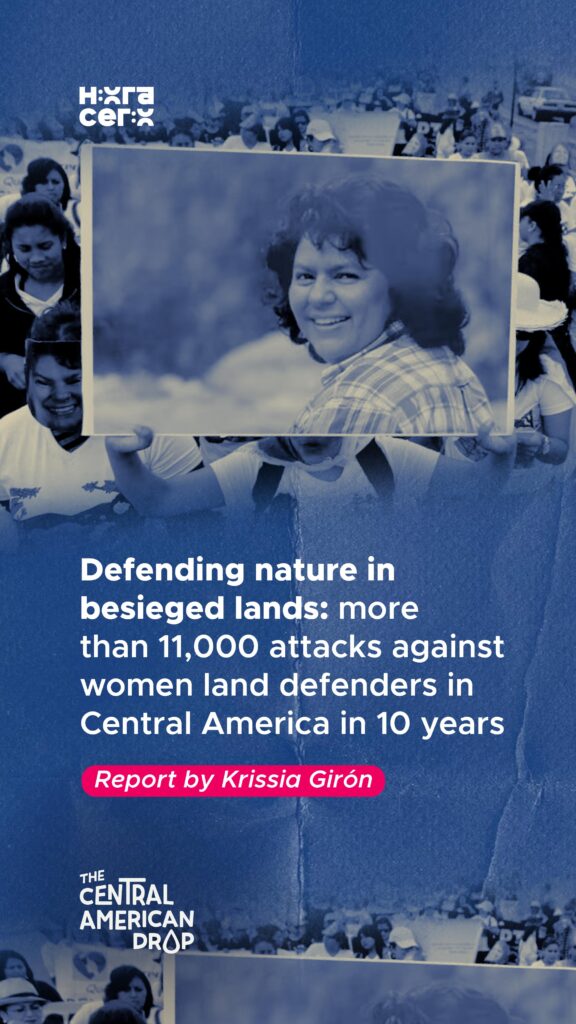
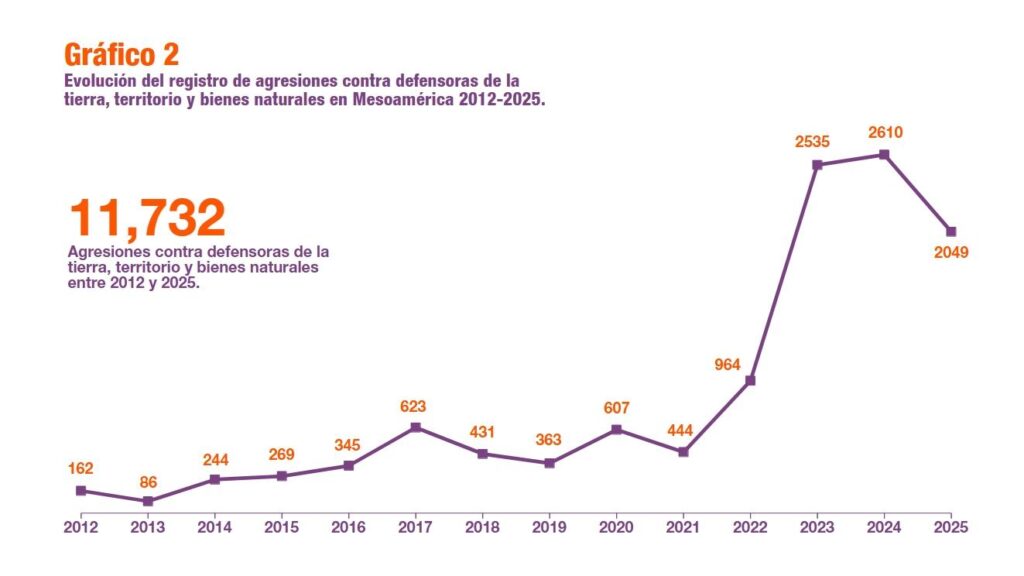
The latest report from the Mesoamerican Initiative of Women Defenders (IM-Defensoras), entitled “Land for those who defend it,” describes the cost of defending life and nature in Central America: a total of 11,732 attacks were directed at women defenders and community and territory organizations, between 2012 and 2025. In that same period, 42 defenders were murdered.
This report condenses a decade of monitoring violence against women, collectives, and dissidents who face mining, hydroelectric, agro-industrial, forestry, tourism, and infrastructure projects in Central America and Mexico, from a feminist and territorial perspective, one that does not separate bodies from territories or environmental defense from the struggle for power and land in the region.
“Most of the women defenders of the land and the environment who have been attacked are indigenous, Garifuna or Afro-descendant women who live in rural areas, work the land, do grassroots work and have been excluded from ownership and decisions about the future of our territories,” the report states.
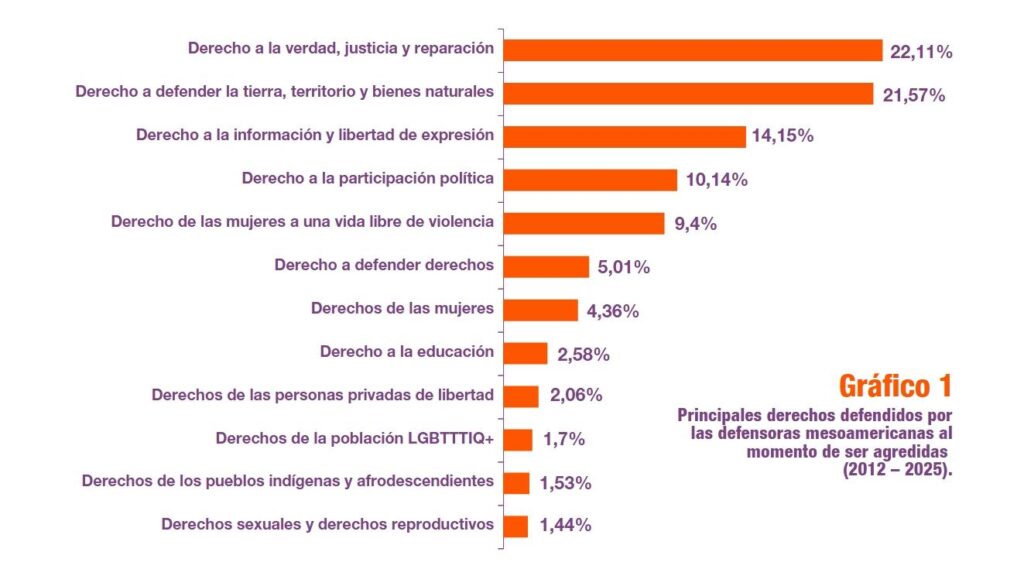
Honduras accounted for 64.1% of all attacks against defenders of land, territory, and natural resources, thus becoming the type of right defended with the most documented attacks in this country (8,373). El Salvador and Guatemala, for their part, registered 12.2% and 7%, respectively. During this same period, 912 attacks were also reported related to actions defending the rights of Indigenous peoples, Afro-descendants, and other ethnic groups in the region.
According to a member of IM-Defensoras who spoke with HoraCero on condition of anonymity, the most revealing and painful fact of the report is that the guardians of biodiversity, the caretakers of their communities and fighters for native peoples and life on the planet, instead of being recognized, are attacked, criminalized and murdered, which she describes as «a failure of humanity».
“Our reports have been conclusive in demonstrating that women defenders of the land are the most frequently attacked group. Second are the women who defend a life free from violence, the right to truth, justice, and reparations, who are fundamentally feminists and women’s organizations that stand alongside victims of attacks. This has not changed, nor is it a coincidence,” she states.
IM-Defensoras reports that, of the 54,395 attacks recorded, 21.6% were against women defenders of land, territory, and the environment. The Initiative’s representative highlights that the types of attacks received include defamation, stigmatization, threats, and criminalization through the justice system.
“In the cases of Nicaragua and El Salvador, we are dealing with dictatorial regimes with high levels of authoritarianism, where there has been a systematic effort to destroy the organizational fabric and social movements. Meanwhile, in Guatemala and Honduras, there are extremely high levels of criminalization and judicial systems completely co-opted by political, business, or organized crime groups. Each country has its own context and its own history; it is also important not to generalize,” she points out.
In Central America, the defense of the land is fought amidst an economic and political model that combines extractive capitalism, patriarchy, and structural racism, which translates into socio-environmental conflicts as a result of the allocation of land for mining, agribusiness, and other megaprojects. A regional analysis of extractive activities done by the Central American Association Centro Humboldt (ACCH) indicates that in 2023, 16% of the region’s territory was under mining concessions, with Nicaragua leading the way at 28%.
In contrast, the defenders uphold a different ethic: they understand that the land is not only a resource, but also a place where their ancestors, their identity, their worldview, and the very essence of life on the planet rest. Protecting rivers, mountains, forests, and seeds, while simultaneously defending their right to exist as Indigenous, Afro-descendant, and peasant communities, is to challenge a model that reduces land to a mere commodity.
“It is a system that destroys life. It is based on the exploitation of the bodies and lives of women and communities; it is designed for destruction, not for building a dignified life. It generates immense daily suffering and displaces people from their communities. That is why women, organized communities, and communities in resistance continually rise against this system of death and destruction,” the representative explains.
Many of these attacks against women human rights defenders occur within the context of collective actions by organizations and communities that continue their struggle against extractivism, agribusiness, mining, and logging. The report states that attacks such as the militarization of territories and evictions “imply direct and widespread violence against communities, including minors and older adults, among other vulnerable populations.”
The report identifies three turning points in the curve of aggressions: the first, in 2017, a year after the murder of Berta Cáceres; the second, in 2020, marked by the COVID-19 pandemic; and the third, in 2022, where they identified a deepening of the militarization policies of the territories and the increase in evictions.
The “syndemic,” as the report describes the COVID-19 health crisis intertwined with economic inequalities, violence, and ecological collapse, arrived in 2020 with an increase in attacks on women land defenders in all countries, while governments in the region tightened repressive measures, restricted rights, and deepened militarization.
The limitations on mobility and the restriction of rights served as an excuse for corporations and states to accelerate mining concessions, boost monocultures and other extractive projects in the name of economic reactivation.
From 2022 onwards, the report records a new escalation: a 163% increase in attacks in 2023, compared to the previous year, with the emphasis on collective attacks, which went from 46% in 2020 to 76% in 2025, characterized by the excessive use of force by authorities and armed bodies, as well as the manipulation of legal frameworks that legalize this type of violence.
One example is the intensification of territorial conflicts in Honduras since the creation of the Commission for Agrarian Security and Access to Land, which has legitimized mass evictions, such as the case of the Agua Blanca Sur community in El Progreso. There, on January 22, 2025, more than 100 police officers stormed a plot of land recovered by the Independent Movement of Landless Men and Women without a warrant and evicted more than 250 families. During the eviction, employees of the AZUNOSA Sugar Company assaulted and threatened farmers from the community and used heavy machinery to destroy more than 300 manzanas (approximately 300 acres) of corn, bean, and cassava crops, the livelihood of these families.
Another paradigmatic case, the report reveals, is the aggression against the Garifuna people: murders, forced disappearances, violent forced evictions, arson attacks on their ancestral health centers, arbitrary arrests, institutionalized racism, and attacks against their spirituality, among others, in a context of attempted dispossession of their ancestral lands.
Such is the case of Miriam Hernández, coordinator of the Honduran Black Fraternal Organization (OFRANEH) and member of the National Network of Women Human Rights Defenders in Honduras. IM-Defensoras has documented 164 attacks against him between 2020 and December 2025. Of these, 86 were perpetrated directly against her personally, and 78 occurred during collective actions in which she participated. Hernández lives in a constant state of risk and threat, despite having been a beneficiary of precautionary measures granted by the Inter-American Commission on Human Rights (IACHR) since 2011.
In the case of El Salvador, the Initiative recorded 578 attacks against women, land, and territory defenders between 2023 and 2025. The increase is due to the popular mobilization spurred by the approval of the Metallic Mining Law, which reversed the historic ban on this environmentally harmful activity in 2024. These attacks against women defenders add to the precedent set by the criminalization of five environmentalists from the Santa Marta Community, and the situation of risk and threat that this entire community faces.
According to IM-Defensoras, the murder of Berta Cáceres marked a turning point by highlighting the leadership of Indigenous women in the face of hydroelectric and extractive projects, as well as the various forms of violence, threats, and impunity they confront daily. A year after this event, in 2017, there was a substantial increase in attacks against women who opposed megaprojects and demanded justice for Berta.
“Through our registration system, in the forms and messages of the attacks against the defenders of the land and territory, we identify trends and patterns that seek, unsuccessfully, to extinguish their struggles. From the assassination of Berta Cáceres in March 2016 until December 2025, 30 defenders of land, territory, and the environment were murdered in Mesoamerica, «7 in Mexico, 8 in Guatemala, 2 in El Salvador, 11 in Honduras, and 2 in Nicaragua,» the report states.
In this regard, the study conducted by the Interdisciplinary Group of Independent Experts (GIEI), stated that the violence Berta faced is the same that all women defenders of the territory in Abya Yala continue to face, and linked the investigated events to «the racist, patriarchal and institutional violence with which the corporate sector, the oligarchy and the State have acted and continue to act to get rid of those who inhabit the territories.»
“It made visible to us the cruelty of power, how far it can go to maintain its interests. It also made visible the impunity surrounding most of the attacks and murders against land defenders,” said the member of IM-Defensoras, who added that this event also transformed the way women defenders organize their protection, strengthening their organizational and collective capacity among women in the communities and helping them better understand the patterns of violence and repressive policies.
“Berta didn’t die, she multiplied. What does this mean? It means that she flourished in the consciences and lives of thousands of people around the world, but especially in her community, her people continue to fight, who remain organized in COPINH, who build training spaces for communities, solidarity economy projects and environmental protection projects, who have a place where people meet, in short, a people who not only haven’t lost hope, but have reaffirmed hope in memory of and as a way of honoring our comrade Berta Cáceres,” she expressed.
The existence of a registry system like IM-Defensoras and the achievements of organizations and communities in the region offer a glimmer of hope and demonstrate that repression has not extinguished the struggles. Today, women human rights defenders in the region are organizing comprehensive feminist protection networks, community support, and transnational solidarity that have saved lives.
The report concludes that the struggles for land and life, led by women defenders, not only resist dispossession, but also sustain the possibility of a habitable future for the rest of the planet.

| Cookie | Duración | Descripción |
|---|---|---|
| cookielawinfo-checkbox-analytics | 11 months | This cookie is set by GDPR Cookie Consent plugin. The cookie is used to store the user consent for the cookies in the category "Analytics". |
| cookielawinfo-checkbox-functional | 11 months | The cookie is set by GDPR cookie consent to record the user consent for the cookies in the category "Functional". |
| cookielawinfo-checkbox-necessary | 11 months | This cookie is set by GDPR Cookie Consent plugin. The cookies is used to store the user consent for the cookies in the category "Necessary". |
| cookielawinfo-checkbox-others | 11 months | This cookie is set by GDPR Cookie Consent plugin. The cookie is used to store the user consent for the cookies in the category "Other. |
| cookielawinfo-checkbox-performance | 11 months | This cookie is set by GDPR Cookie Consent plugin. The cookie is used to store the user consent for the cookies in the category "Performance". |
| viewed_cookie_policy | 11 months | The cookie is set by the GDPR Cookie Consent plugin and is used to store whether or not user has consented to the use of cookies. It does not store any personal data. |