

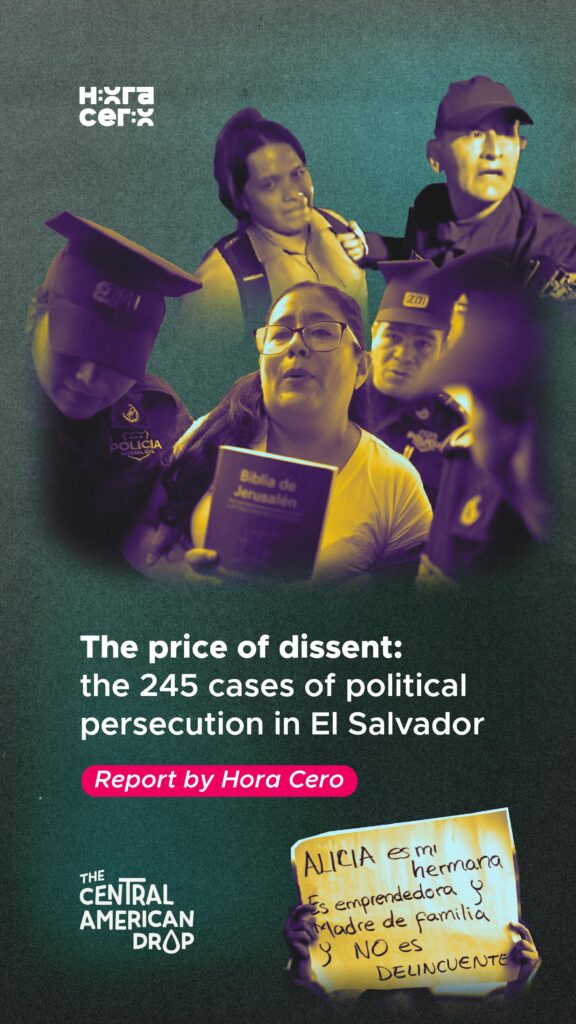
The human rights organization Cristosal presented a report in early March documenting 245 cases of political persecution in El Salvador between 2019 and 2025. According to the document, at least 86 people are currently in prison.
In 73.4% of cases, equivalent to 180 people, those involved face legal proceedings. In the remaining cases, the Salvadoran state used other measures, such as community or administrative sanctions; furthermore, only seven people have been convicted in court.
Of the 245 cases, Cristosal selected 20 emblematic cases to characterize this phenomenon in the country and, from them, concludes that in El Salvador, there is extrajudicial political persecution, political persecution with judicial but not punitive actions, and criminalization with political persecution in various forms.
The emblematic case number 14, that of former San Salvador mayor Ernesto Muyshondt, is the only one characterized as a political prisoner. Human rights defender Ruth López, emblematic case number 18, is being portrayed as a case of persecution against individuals who are beneficiaries of special international protection.
What criteria did Cristosal use for the report and to characterize the 245 cases, including the 20 emblematic cases? The document is a combination of political science literature, legal theory, and international human rights standards.
The report acknowledges a conceptual problem: there is no universally accepted legal definition of “political persecution”, but there are approaches from academic literature and international law.
In this regard, Cristosal proposes a practical and measurable definition to analyze the cases. According to the organization, the cases follow a similar pattern: after a person publicly expresses their disagreement with the current government, they are persecuted to the point of being criminalized.
Publicly expressing criticism of the Bukele government places these people as dissidents or opponents in the government’s judgment. The persecution begins with actions, at different levels of hostility, that cause them harm in their human rights, including, to the point of being criminalized.
Criminalization consists of the misuse of criminal law and of the Salvadoran Supreme Court to neutralize or punish these individuals for their criticism. This criminalization can take various forms: legal reforms, ambiguous laws, accusations, and arrests without evidence.
The report also mentions that 14 people were forced to face their criminal proceedings from exile; that is, they were tried in absentia. In some cases, they had to leave the country to seek refuge and protection.
Finally, Cristosal documented the deaths of at least three people in state custody, including Nayib Bukele’s former security advisor, Alejandro Muyshondt, whose case showed signs of torture and medical negligence.

| Cookie | Duración | Descripción |
|---|---|---|
| cookielawinfo-checkbox-analytics | 11 months | This cookie is set by GDPR Cookie Consent plugin. The cookie is used to store the user consent for the cookies in the category "Analytics". |
| cookielawinfo-checkbox-functional | 11 months | The cookie is set by GDPR cookie consent to record the user consent for the cookies in the category "Functional". |
| cookielawinfo-checkbox-necessary | 11 months | This cookie is set by GDPR Cookie Consent plugin. The cookies is used to store the user consent for the cookies in the category "Necessary". |
| cookielawinfo-checkbox-others | 11 months | This cookie is set by GDPR Cookie Consent plugin. The cookie is used to store the user consent for the cookies in the category "Other. |
| cookielawinfo-checkbox-performance | 11 months | This cookie is set by GDPR Cookie Consent plugin. The cookie is used to store the user consent for the cookies in the category "Performance". |
| viewed_cookie_policy | 11 months | The cookie is set by the GDPR Cookie Consent plugin and is used to store whether or not user has consented to the use of cookies. It does not store any personal data. |