

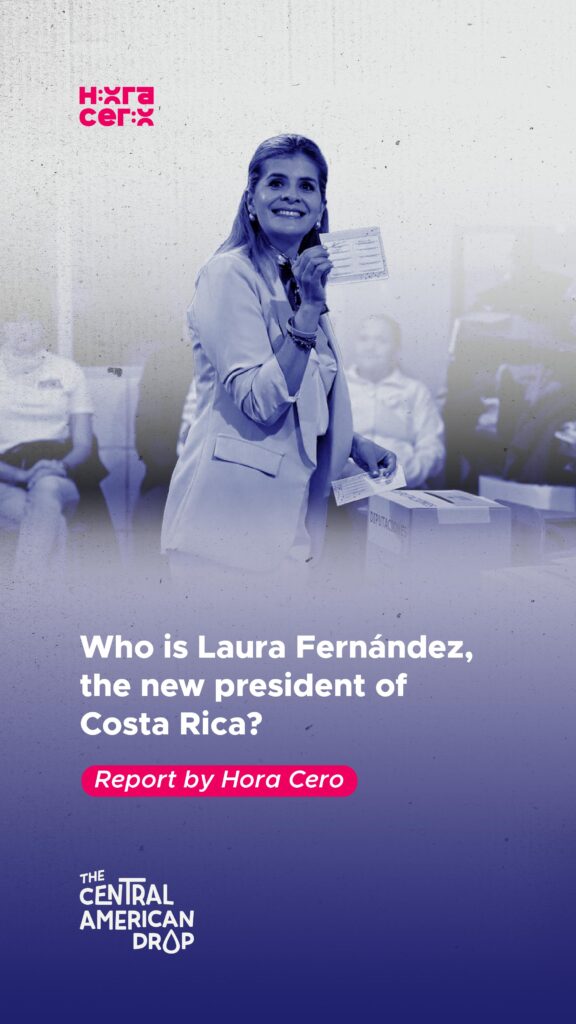
On February 1st, general elections were held in Costa Rica to elect the President and members of the Legislative Assembly. Laura Fernández, the candidate of the Sovereign People’s Party (PPSO), was elected President of Costa Rica in the first round of voting, breaking a 16-year streak of runoff elections.
So far, with over 90% of polling stations reporting to the Costa Rican Supreme Electoral Tribunal (TSE), Laura Fernández has garnered 48.5% of the vote. According to the Costa Rican Constitution, a runoff election is required if no candidate receives at least 40% of the vote.
This result breaks a trend of three consecutive periods in which Costa Rica had to hold a runoff election. Since Laura Chinchilla’s victory in 2010, no candidate had managed to win the election in February.
Fernández, 39, will be the second woman in Costa Rican history to serve as president. Current President Rodrigo Chaves appointed her as Minister of the Presidency from 2024 to 2025 and as Minister of National Planning and Economic Policy (MIDEPLAN) from 2022 to 2025.
For her part, Fernández campaigned with the support of the ruling party, presenting herself as the “technical continuity” of the Chaves administration. In her first speech as president-elect, she reaffirmed that security would be her absolute priority, as well as a reform of the judicial and penal system.
Currently, Rodrigo Chaves has political immunity regarding the charges brought against him by the Costa Rican Attorney General’s Office and the Supreme Electoral Tribunal (TSE), where he is accused of alleged corruption. However, Fernández intends to appoint him Minister of the Presidency after his term ends, which would allow him to retain his immunity.
On the other hand, the second relevant issue in these elections is the new composition of the Legislative Assembly starting May 1st. According to the latest count, the PPSO will have a legislative bloc of 31 deputies, that is, an absolute majority.
The absolute majority will allow Laura Fernández and the PPSO to pass ordinary laws and budgets without needing agreements with the political opposition. This does not apply to the approval of international loans or reforms to the Costa Rican Constitution, where a qualified majority will be required.
According to the results, the National Liberation Party, headed by Álvaro Ramos, remains the second largest force with 33% of the presidential votes and approximately 17 seats in the Legislative Assembly.
Likewise, the Frente Amplio, which has historically been characterized by its social democratic commitment, is currently the third largest political force in the Legislative Assembly with 7 seats, one more than the current legislature (2022 – 2026).
Based on Fernández’s pre-election speeches, his government’s economic agenda is expected to focus on reforming the state apparatus across the board. With a legislative majority in his favor, she may seek to reduce the state’s operating costs and prioritize the security budget.

| Cookie | Duración | Descripción |
|---|---|---|
| cookielawinfo-checkbox-analytics | 11 months | This cookie is set by GDPR Cookie Consent plugin. The cookie is used to store the user consent for the cookies in the category "Analytics". |
| cookielawinfo-checkbox-functional | 11 months | The cookie is set by GDPR cookie consent to record the user consent for the cookies in the category "Functional". |
| cookielawinfo-checkbox-necessary | 11 months | This cookie is set by GDPR Cookie Consent plugin. The cookies is used to store the user consent for the cookies in the category "Necessary". |
| cookielawinfo-checkbox-others | 11 months | This cookie is set by GDPR Cookie Consent plugin. The cookie is used to store the user consent for the cookies in the category "Other. |
| cookielawinfo-checkbox-performance | 11 months | This cookie is set by GDPR Cookie Consent plugin. The cookie is used to store the user consent for the cookies in the category "Performance". |
| viewed_cookie_policy | 11 months | The cookie is set by the GDPR Cookie Consent plugin and is used to store whether or not user has consented to the use of cookies. It does not store any personal data. |